4,068 posters, 219 videos, 101 topics, 69 sessions, 14,365 authors, 6,128 institutions
ePostersLive by SciGen Technologies S.A. All rights reserved.
Alzheimer's Association International Conference 2026
July 12-15, 2026 | London, United Kingdom, and Online

7275
Cognitively Unimpaired Apoe4 Carriers With Cerebral Hyperperfusion Exhibit Better Cognitive Function
Poster Presenter
Authors
Melanie Quiring, Arunima Kapoor, John Paul Alitin, Basant Lashin, Jillian Joyce, Allison Engstrom, Trevor Lohman, Aimee Gaubert, Fatemah Shenasa, Kevin Law, Farrah Ferrer, Danny JJ Wang, Elizabeth Head, Rond Malhas, Kathleen Rodgers, Daniel Nation
Affiliations
University of Southern California, University of California, Irvine, University of Arizona, Tuscon
Part of Topic
Introduction:
• Cerebrovascular dysfunction emerges early in Alzheimer’s disease (AD).
• APOE4 increases risk for AD and contributes to cerebrovascular dysfunction independently of amyloid-β and tau.
•Cognitively unimpaired APOE4 carriers often exhibit elevated cerebral blood flow (CBF) in medial temporal lobe (MTL) regions.
• It is unclear whether hyperperfusion in APOE4 carriers is a marker of cognitive resilience or dysfunction. Prior studies report mixed findings, but do not account for underlying AD pathophysiological changes.
• Aim: Examine whether associations between MTL CBF and cognition differ by APOE genotype and plasma pTau217 status.
Methods:
Participants (aged 55–89) from the Vascular Senescence and Cognition observational study received clinical and neuropsychological evaluation, underwent brain MRI, and provided a blood sample. The present study included 148 cognitively unimpaired older adults, including 62 APOE4 carriers and 86 noncarriers. A subset of 126 participants had valid plasma pTau217 data, including 35 pTau217-positive and 91 pTau217-negative individuals.
• Mean medial temporal lobe cerebral blood flow (MTL CBF) was quantified (mL/100 g tissue/min) from a ~5-minute resting state pseudo-continuous arterial spin labeling (pCASL) MRI scan.
• Plasma pTau217 concentrations were analyzed using the Simoa ALZpath p-Tau217 Advantage Plus assay kit. An established cut-point optimized for Aβ PET positivity (≥ 0.42pg/mL) was applied to classify participants as pTau217 positive or negative.
• Demographically adjusted test scores were used to calculate a memory composite score (delayed story recall, verbal list-learning delayed recall, and recognition memory) and an executive function composite score (processing speed, set shifting, and either inhibitory control or working memory).
• Vascular risk factor burden was categorized as low (0–1 risk factors) or high (≥ 2 risk factors).
• Statistical Analyses: Differences in MTL CBF between APOE4 carriers and noncarriers were tested with analysis of covariance (ANCOVA), adjusted for age, sex, education, and vascular risk factor burden. MTL CBF x APOE4 interactions on memory or executive function were examined using linear regression models adjusted for vascular risk factor burden. Stratified analyses examined whether associations differ by plasma pTau217 status. Significant interactions were decomposed with simple slopes tests. Sensitivity analyses adjusted for hippocampal volume, entorhinal cortical thickness, or white matter hyperintensity volume in separate models.
Results:
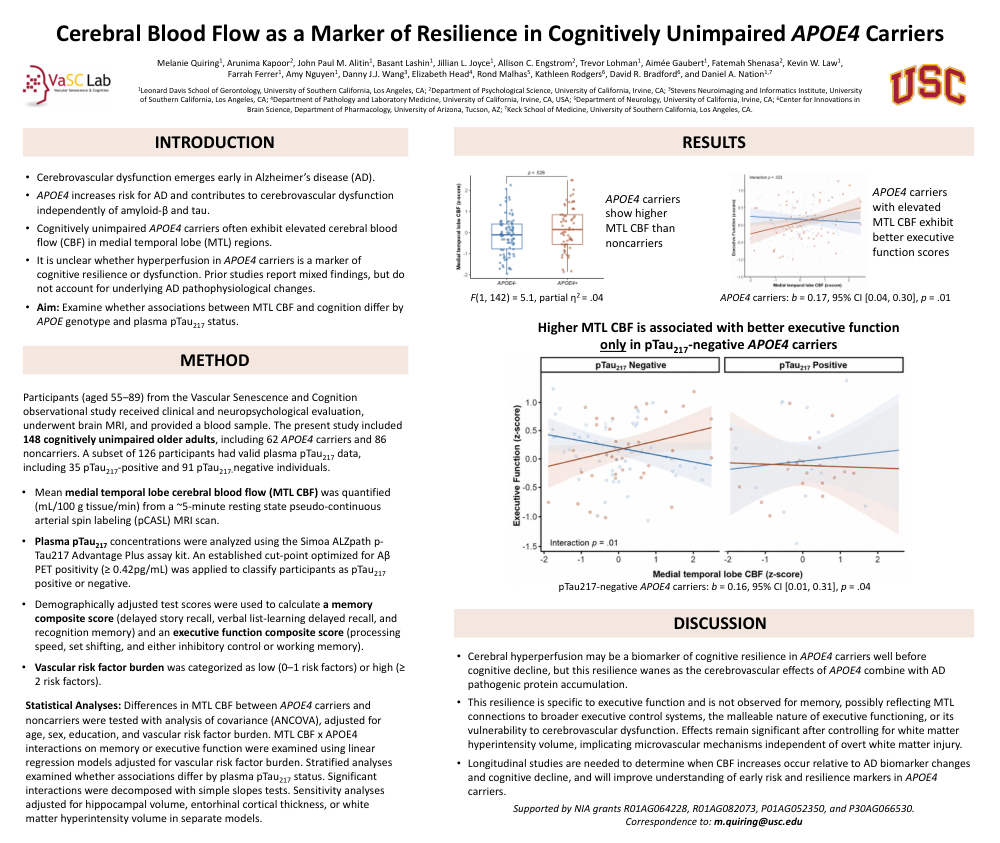
• APOE4 carriers show higher MTL CBF than noncarriers F(1, 142) = 5.1, partial η2 = .04, p = .026
• APOE4 carriers with elevated MTL CBF exhibit better executive function scores (interaction p = .023). APOE4 carriers: b = 0.17, 95% CI [0.04, 0.30], p = .01
• Higher MTL CBF is associated with better executive function only in pTau217-negative APOE4 carriers (interaction p = .01). pTau217-negative APOE4 carriers: b = 0.16, 95% CI [0.01, 0.31], p = .04
Discussion:
• Cerebral hyperperfusion may be a biomarker of cognitive resilience in APOE4 carriers well before cognitive decline, but this resilience wanes as the cerebrovascular effects of APOE4 combine with AD pathogenic protein accumulation.
• This resilience is specific to executive function and is not observed for memory, possibly reflecting MTL connections to broader executive control systems, the malleable nature of executive functioning, or its vulnerability to cerebrovascular dysfunction. Effects remain significant after controlling for white matter hyperintensity volume, implicating microvascular mechanisms independent of overt white matter injury.
• Longitudinal studies are needed to determine when CBF increases occur relative to AD biomarker changes and cognitive decline, and will improve our understanding of early risk and resilience markers in APOE4 carriers.
Comments
Email is required but is not shown publicly.
Loading comments...