4,068 posters, 219 videos, 101 topics, 69 sessions, 14,365 authors, 6,128 institutions
ePostersLive by SciGen Technologies S.A. All rights reserved.
Alzheimer's Association International Conference 2026
July 12-15, 2026 | London, United Kingdom, and Online

3796
The MindCrowd Mobile Laboratory (MC-mlab): Longitudinal Multimodal Phenotyping To Engage Rural Communities In Cognitive Aging Research
Poster Presenter
Authors
Part of Topic
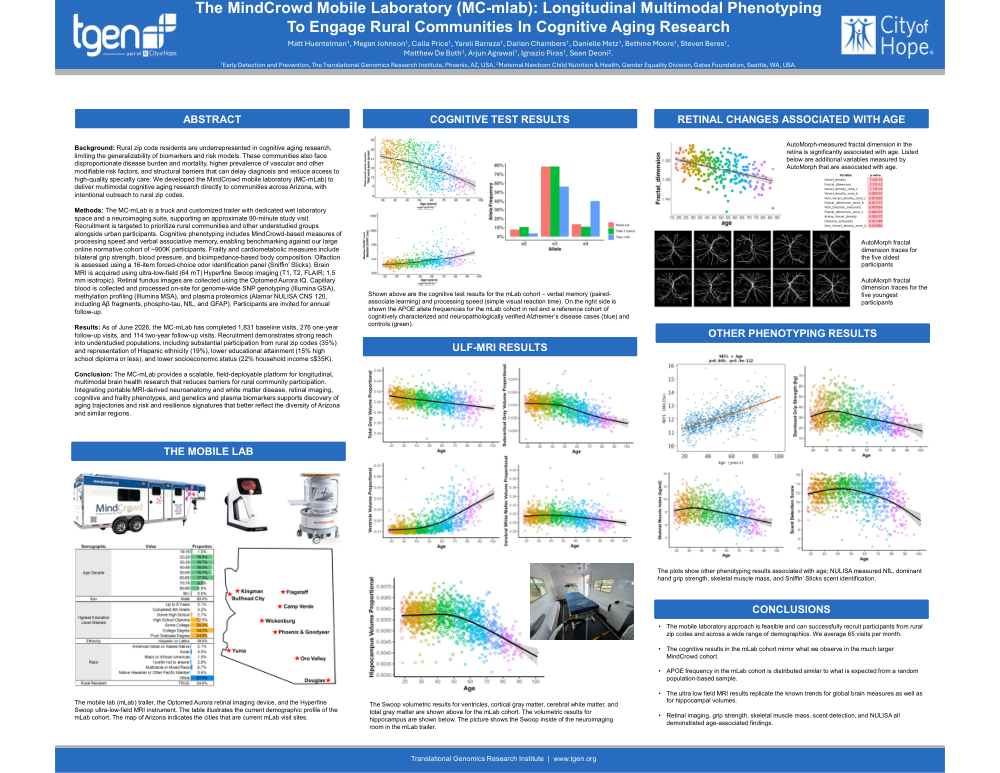
Background: Rural zip code residents are underrepresented in cognitive aging research, limiting the generalizability of biomarkers and risk models. These communities also face disproportionate disease burden and mortality, higher prevalence of vascular and other modifiable risk factors, and structural barriers that can delay diagnosis and reduce access to high-quality specialty care. We developed the MindCrowd mobile laboratory (MC-mLab) to deliver multimodal cognitive aging research directly to communities across Arizona, with intentional outreach to rural zip codes.
Methods: The MC-mLab is a truck and customized trailer with dedicated wet laboratory space and a neuroimaging suite, supporting an approximate 90-minute study visit. Recruitment is targeted to prioritize rural communities and other understudied groups alongside urban participants. Cognitive phenotyping includes MindCrowd-based measures of processing speed and verbal associative memory, enabling benchmarking against our large online normative cohort of ~900K participants. Frailty and cardiometabolic measures include bilateral grip strength, blood pressure, and bioimpedance-based body composition. Olfaction is assessed using a 16-item forced-choice odor identification panel (Sniffin’ Sticks). Brain MRI is acquired using ultra-low-field (64 mT) Hyperfine Swoop imaging (T1, T2, FLAIR; 1.5 mm isotropic). Retinal fundus images are collected using the Optomed Aurora IQ. Capillary blood is collected and processed on-site for genome-wide SNP genotyping (Illumina GSA), methylation profiling (Illumina MSA), and plasma proteomics (Alamar NULISA CNS 120, including Aβ fragments, phospho-tau, NfL, and GFAP). Participants are invited for annual follow-up.
Results: As of June 2026, the MC-mLab has completed 1,831 baseline visits, 276 one-year follow-up visits, and 114 two-year follow-up visits. Recruitment demonstrates strong reach into understudied populations, including substantial participation from rural zip codes (35%) and representation of Hispanic ethnicity (19%), lower educational attainment (15% high school diploma or less), and lower socioeconomic status (22% household income ≤$35K).
Conclusion: The MC-mLab provides a scalable, field-deployable platform for longitudinal, multimodal brain health research that reduces barriers for rural community participation. Integrating portable MRI-derived neuroanatomy and white matter disease, retinal imaging, cognitive and frailty phenotypes, and genetics and plasma biomarkers supports discovery of aging trajectories and risk and resilience signatures that better reflect the diversity of Arizona and similar regions.
Comments
Email is required but is not shown publicly.
Loading comments...