4,068 posters, 219 videos, 101 topics, 69 sessions, 14,365 authors, 6,128 institutions
ePostersLive by SciGen Technologies S.A. All rights reserved.
Alzheimer's Association International Conference 2026
July 12-15, 2026 | London, United Kingdom, and Online

3075
Visuospatial Function And Spatial Navigation In Early Limbic-predominant Age-related Tdp-43 Encephalopathy And Alzheimer’S Disease
Part of Topic
Both Alzheimer’s disease and limbic-predominant age-related TDP-43 encephalopathy are neurodegenerative conditions that present with similar cognitive impairments and structural brain changes, including substantial memory impairment and atrophy of the medial temporal lobe. Therefore, it is essential to identify markers that can distinguish between these conditions. This study aimed to evaluate the usefulness of spatial navigation and visuospatial assessments in distinguishing between older adults with amnestic mild cognitive impairment due to AD from those with aMCI due to LATE.
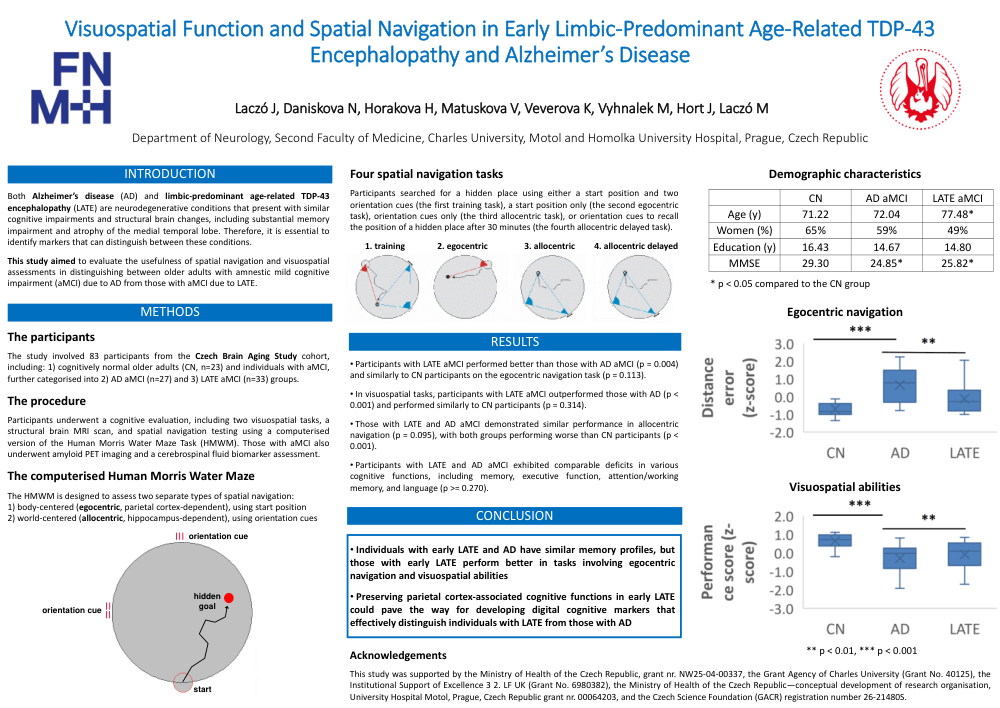
The study involved eighty-three participants from the Czech Brain Aging Study cohort, including cognitively normal older adults and individuals with aMCI, further categorised into AD aMCI and LATE aMCI groups. Participants underwent a cognitive evaluation, including two visuospatial tasks, a structural brain MRI scan, and spatial navigation testing using a computerised version of the Human Morris Water Maze Task. Those with aMCI also underwent amyloid PET imaging and a cerebrospinal fluid biomarker assessment. The Human Morris Water Maze Task is designed to assess two separate types of spatial navigation: body-centred (so-called egocentric, parietal cortex-dependent), using start position, and world-centred (so-called allocentric, hippocampus-dependent), using orientation cues. Participants searched for a hidden place using a start position and two orientation cues (the first training task), a start position only (the second egocentric task), orientation cues only (the third allocentric task) and orientation cues to recall the position of a hidden place after 30 minutes (the fourth allocentric delayed task).
We found that participants with LATE performed better than those with AD and similarly to cognitively normal participants on the egocentric navigation task. In visuospatial tasks, participants with LATE outperformed those with AD and performed similarly to cognitively normal participants. Those with LATE and AD demonstrated similar performance in allocentric navigation, with both groups performing worse than cognitively normal participants. Participants with LATE and AD exhibited comparable deficits in various cognitive domains, including memory, executive function, attention/working memory, and language.
In conclusion, individuals with early LATE and AD have similar memory profiles, but those with early LATE perform better in tasks involving egocentric navigation and visuospatial abilities. Preserving parietal cortex-associated cognitive functions in early LATE could pave the way for developing digital cognitive markers that effectively distinguish individuals with LATE from those with AD.
Comments
Email is required but is not shown publicly.
Loading comments...