4,068 posters, 219 videos, 101 topics, 69 sessions, 14,365 authors, 6,128 institutions
ePostersLive by SciGen Technologies S.A. All rights reserved.
Alzheimer's Association International Conference 2026
July 12-15, 2026 | London, United Kingdom, and Online

5144
Deep Cervical Lymphovenous Anastomosis Expedites Glymphatic Drainage In Alzheimer's Disease Rat Model
Poster Presenter
Authors
Yang Wang, Nannan Zhao, Yajuan Gao, Zhihao Li, Tianzi Gao, Hanbo Tan, Wenhui Guo, Xiaoda Li, Xinyu Liu, Mian Guo, Zhaoheng Xie, Hongbin Han
Affiliations
Institute of Medical Technology, Peking University Health Science Center, Peking University, Beijing, China, 100191, Department of Neurosurgery, The Second Affiliated Hospital of Harbin Medical University, Harbin, China, 150086, Department of Radiology, Peking University Third Hospital, Beijing, China, 100191, Peking University Medical and Health Analysis Center, Beijing, China, 100191
Part of Topic
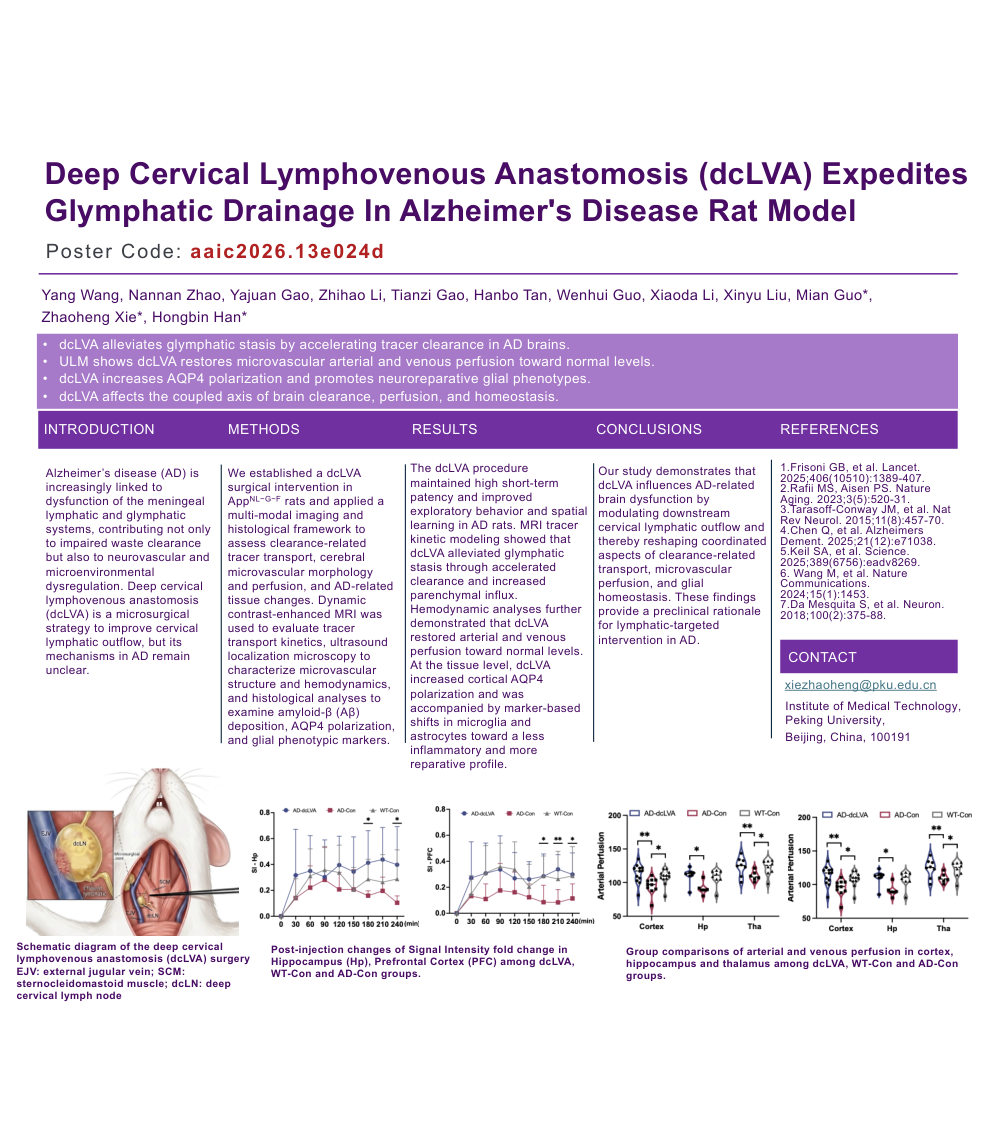
BACKGROUND: Alzheimer’s disease (AD) is increasingly linked to dysfunction of the meningeal lymphatic and glymphatic systems. Deep cervical lymphovenous anastomosis (dcLVA) is a microsurgical strategy to improve cervical lymphatic outflow whose mechanisms remain unclear.
METHODS: We established a dcLVA surgical intervention in AppNL−G−F rats and applied a multi-modal imaging and histological framework to assess clearance-related tracer transport, cerebral microvascular morphology and perfusion, and AD-related tissue changes.
RESULTS: The dcLVA improved behavior in AD rats. MRI tracer kinetic modeling showed alleviated glymphatic stasis and increased parenchymal influx. Hemodynamic showed restored arterial and venous perfusion toward normal levels. Increased cortical AQP4 polarization and was accompanied by marker-based shifts in microglia and astrocytes toward a less inflammatory and more reparative profile.
CONCLUSIONS: Our study demonstrates that dcLVA influences AD-related brain dysfunction by modulating downstream cervical lymphatic outflow and thereby reshaping coordinated aspects of clearance-related transport, microvascular perfusion, and glial homeostasis.
Comments
Email is required but is not shown publicly.
Loading comments...