4,068 posters, 219 videos, 101 topics, 69 sessions, 14,365 authors, 6,128 institutions
ePostersLive by SciGen Technologies S.A. All rights reserved.
Alzheimer's Association International Conference 2026
July 12-15, 2026 | London, United Kingdom, and Online

9270
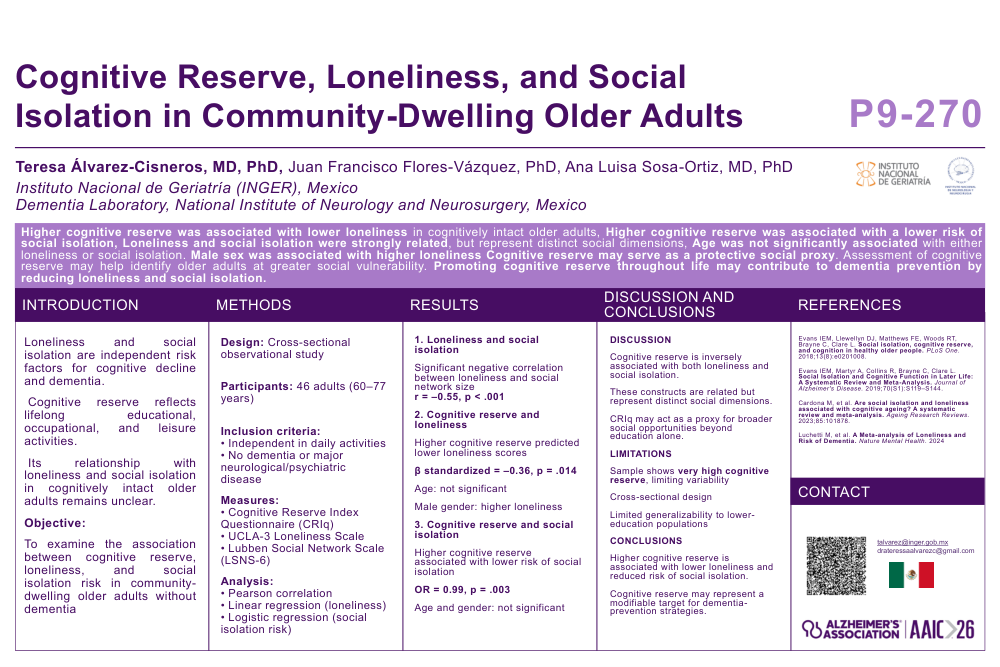
Cognitive Reserve, Loneliness, And Social Isolation In Community-dwelling Older Adults From Mexico
Part of Topic
Loneliness and social isolation are independent risk factors for cognitive decline and dementia. Cognitive reserve reflects lifelong educational,
occupational, and leisure activities. Its relationship with loneliness and social isolation in cognitively intact older adults remains unclear.
Objective: To examine the association between cognitive reserve, loneliness, and socialisolation riskriskin communitycommunity-dwelling older adults without dementia
Design: Cross-sectional observational study
Participants:46 adults (60 60–77years)
Inclusion criteria: Independent in daily activities, no dementia or majorneurological/psychiatricdisease
Measures: Cognitive Reserve Index Questionnaire (CRIq), UCLA-3 Loneliness Scale, Lubben Social Network Scale (LSNS LSNS-6)
Analysis: Pearson correlation, Linear regression (loneliness), Logistic regression (social isolation risk)
Results:
1. Loneliness and social isolation: Significant negative correlation between loneliness and social
network size, r = –0.55, p < .001
2. Cognitive reserve and loneliness: Higher cognitive reserve predicted lower loneliness scores, β standardized = –0.36, p = .014
Age: not significant
Male gender: higher loneliness
3. Cognitive reserve and social isolation: Higher cognitive reserve associated with lower risk of social isolation OR = 0.99, p = .003
Age and gender: not significant
DISCUSSION
Cognitive reserve is inversely associated with both loneliness and social isolation. These constructs are related but represent distinct social dimensions.CRIq may act as a proxy for broader social opportunities beyond education alone.
LIMITATIONS
Sample shows very high cognitive reserve, limiting variability
Cross-sectional design; limited generalizability to lower-education populations
CONCLUSIONS
Higher cognitive reserve is associated with lower loneliness and reduced risk of social isolation.
Cognitive reserve may represent a modifiable target for dementia dementia-prevention strategies.
Comments
Email is required but is not shown publicly.
Loading comments...