4,068 posters, 219 videos, 101 topics, 69 sessions, 14,365 authors, 6,128 institutions
ePostersLive by SciGen Technologies S.A. All rights reserved.
Alzheimer's Association International Conference 2026
July 12-15, 2026 | London, United Kingdom, and Online

6862
Executive Function Markers Of Transition To Amyloid-positive MCI And Progression To Amyloid-positive Dementia
Poster Presenter
Authors
Juhee Chin, Hasom Moon, Sungyeol Kim, Eunhyang Kim, Jun Pyo Kim, Hee Jin Kim, Sang Won Seo, Hyemin Jang
Affiliations
Department of Neurology, Samsung Medical Center, Sungkyunkwan University School of Medicine, Seoul, South Korea, Department of Psychology, Hallym University, Chuncheon, South Korea, Department of Neurology, Asan Medical Center, Seoul, South Korea
Part of Topic
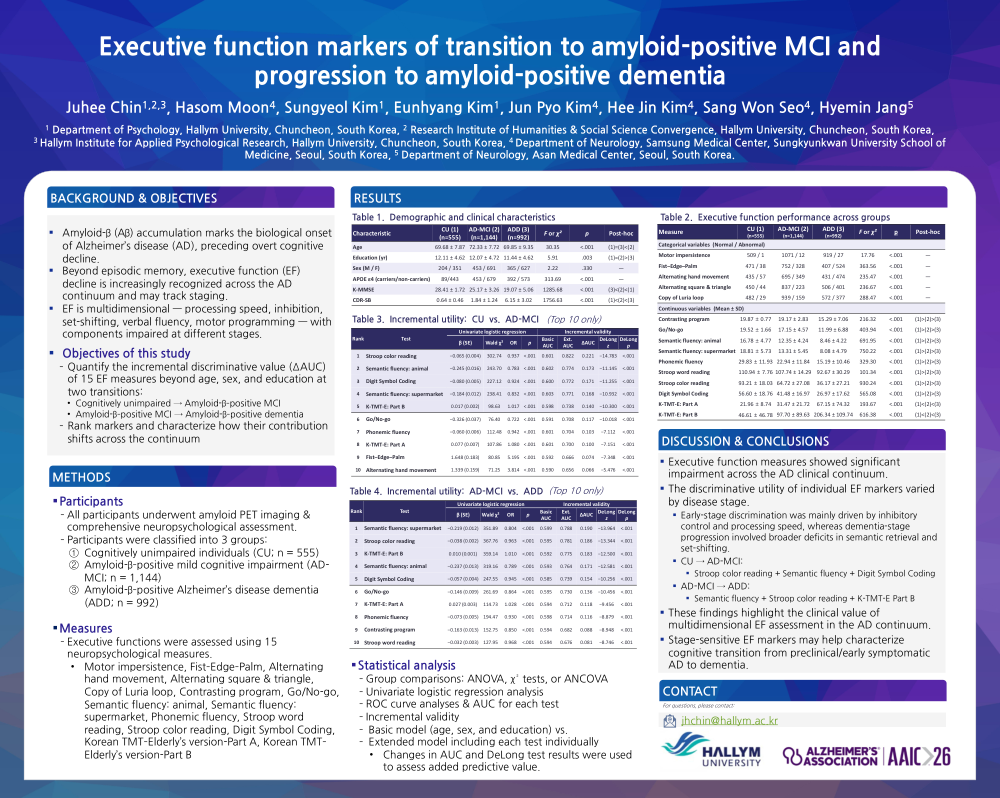
Background. Executive function (EF) decline is increasingly recognized across the Alzheimer’s disease (AD) continuum, but the stage-specific utility of individual EF measures remains unclear. This study examined the incremental discriminative value of 15 EF measures beyond age, sex, and education in distinguishing cognitively unimpaired individuals from amyloid-positive MCI and amyloid-positive MCI from AD dementia.
Methods. This cross-sectional study included cognitively unimpaired individuals (CU; n = 555), amyloid-β–positive mild cognitive impairment (AD-MCI; n = 1,144), and amyloid-β–positive Alzheimer’s disease dementia (ADD; n = 992). All participants underwent amyloid PET imaging and comprehensive neuropsychological assessment. Fifteen EF measures were selected to assess motor programming, inhibition, verbal fluency, processing speed, and set-shifting. Group differences were examined using ANOVA, χ² tests, or ANCOVA. For each diagnostic transition, univariate logistic regression and receiver operating characteristic curve analyses were performed. Incremental validity was evaluated by comparing a demographic model with extended models including each EF measure individually.
Results. EF measures showed significant impairment across the AD clinical continuum. For CU vs. AD-MCI, Stroop color reading showed the greatest incremental discriminative value, followed by semantic fluency, Digit Symbol Coding, and Trail Making Test Part B. For AD-MCI vs. ADD, semantic fluency for supermarket items, Stroop color reading, Trail Making Test Part B, semantic fluency for animals, and Digit Symbol Coding showed the strongest added predictive value. Semantic fluency and Stroop color reading were consistently informative across both disease transitions.
Conclusions. EF markers of amyloid-confirmed AD differ by disease stage. Processing speed and inhibitory control were more prominent in early-stage discrimination, whereas semantic retrieval and set-shifting became increasingly relevant for dementia-stage progression. These findings support the use of stage-sensitive, multidimensional EF assessment in clinical characterization of the AD continuum.
Comments
Email is required but is not shown publicly.
Loading comments...