4,068 posters, 219 videos, 101 topics, 69 sessions, 14,365 authors, 6,128 institutions
ePostersLive by SciGen Technologies S.A. All rights reserved.
Alzheimer's Association International Conference 2026
July 12-15, 2026 | London, United Kingdom, and Online

5393
Diagnostic Accuracy Of Remote Self-administered Digital Cognitive Tests By Clinical Diagnosis And Alzheimer’s Disease PET Biomarkers
Poster Presenter
Authors
Elizabeth A Boots, Alyssa N Kaser, Ryan D Frank, Winnie Z Fan, Teresa J Christianson, John L Stricker, Walter K Kremers, Mary M Machulda, Paula A Aduen, John A Lucas, Gregory S Day, Christian Lachner, Neill Graff-Radford, Nick Corriveau-Lecavalier, Jason Hassenstab, Michelle M Mielke, Clifford R Jack, Bradley F Boeve, Jonathan Graff-Radford, Ronald C Petersen, Nikki H Stricker
Affiliations
Wake Forest University School of Medicine, Mayo Clinic, Washington University in St. Louis
Part of Topic
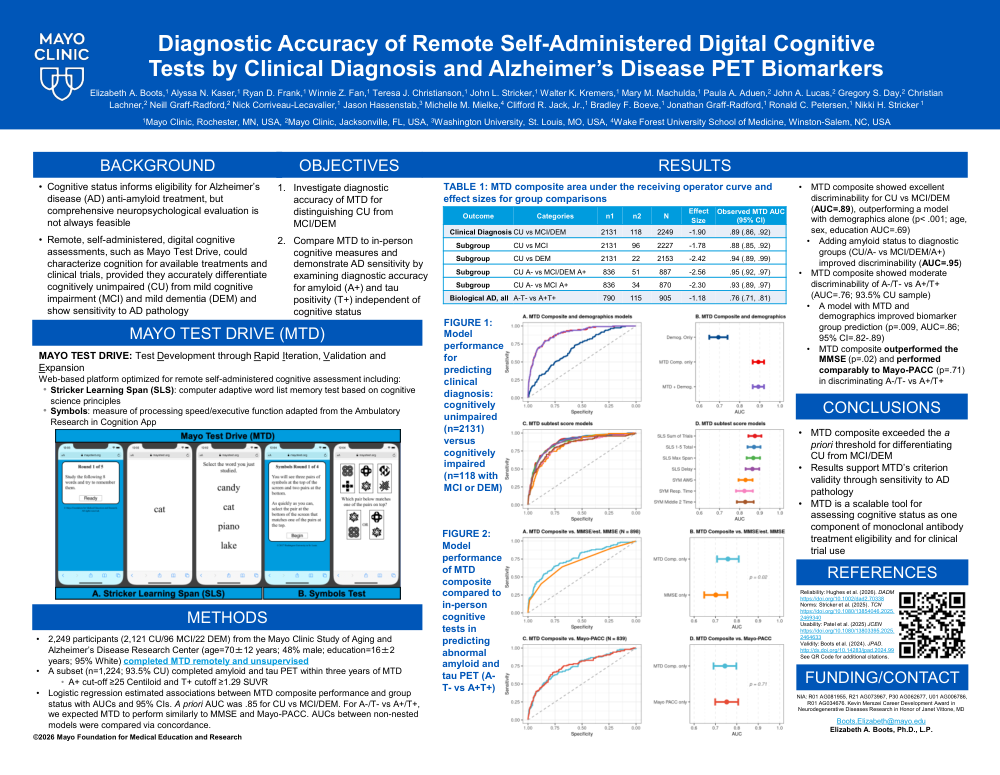
Background: Cognitive status informs eligibility for Alzheimer’s disease (AD) monoclonal antibody treatment, but comprehensive neuropsychological evaluation is not always feasible. Remote, self-administered, digital cognitive assessments, such as Mayo Test Drive (MTD), could characterize cognition for available treatments and clinical trials, provided they accurately differentiate cognitively unimpaired (CU) from mild cognitive impairment (MCI) and mild dementia (DEM) and show sensitivity to AD pathology. We investigated the diagnostic accuracy of MTD for distinguishing CU from MCI/DEM. To compare MTD to in-person cognitive measures and demonstrate sensitivity to AD, we also examined diagnostic accuracy for amyloid (A+) and tau positivity (T+) independent of cognitive status.
Methods: 2,249 participants (2,121 CU/96 MCI/22 DEM) from the Mayo Clinic Study of Aging and Alzheimer’s Disease Research Center (age=70±12 years; 48% male; education=16±2 years; 95% White) completed MTD remotely. A subset (n=1,224) completed amyloid and tau PET within three years of MTD. A+ and T+ cutoffs were ≥25 Centiloid and ≥1.29 SUVR, respectively. Logistic regression estimated associations between MTD composite performance and group status (CU versus MCI/DEM; CU/A- versus MCI/DEM/A+; A-/T- versus A+/T+) with AUCs and 95% CIs. A priori AUC was .85 for CU versus MCI/DEM. For the A-/T- versus A+/T+ comparison, we expected remote MTD to perform similarly to in-person measures (MMSE, Mayo‑PACC). AUCs between non-nested models were compared via concordance.
Results: MTD composite showed excellent discriminability for CU versus MCI/DEM (AUC=.89; Figure 1 and Table 1 provide CIs), outperforming a model with demographics alone (p< .001; age, sex, education AUC=.69). Adding amyloid status to diagnostic groups (CU/A- versus MCI/DEM/A+) improved discriminability (AUC=.95). MTD composite showed moderate discriminability of A-/T- versus A+/T+ (AUC=.76; 93.5% CU sample). A model with MTD and demographics improved biomarker group prediction (p=.009, AUC=.86; 95% CI=.82-.89). MTD composite outperformed the MMSE (p=.02) and performed comparably to Mayo-PACC (p=.71) in discriminating A-/T- versus A+/T+ (Figure 2).
Conclusions: MTD composite exceeded the a priori threshold for differentiating CU from MCI/DEM. Results support MTD’s criterion validity through sensitivity to AD pathology. MTD is a scalable tool for assessing cognitive status as one component of monoclonal antibody treatment eligibility and for clinical trial use.
Comments
Email is required but is not shown publicly.
Loading comments...