4,068 posters, 219 videos, 101 topics, 69 sessions, 14,365 authors, 6,128 institutions
ePostersLive by SciGen Technologies S.A. All rights reserved.
Alzheimer's Association International Conference 2026
July 12-15, 2026 | London, United Kingdom, and Online

3302
Cognitive Trajectories And Risk Factors Of Frontotemporal Dementia Progression:a Two-years Follow-up Study In Peruvian Population
Poster Presenter
Part of Topic
BACKGROUND
• Understanding the clinical course and risk factors for progression in frontotemporal dementia (FTD) is essential for accurate prognosis and informed care. However, longitudinal data on cognitive trajectories and predictors of change remain scarce.
• This study examined the heterogeneity of FTD progression and identified baseline predictors of trajectory groups in a Peruvian cohort.
METHODS
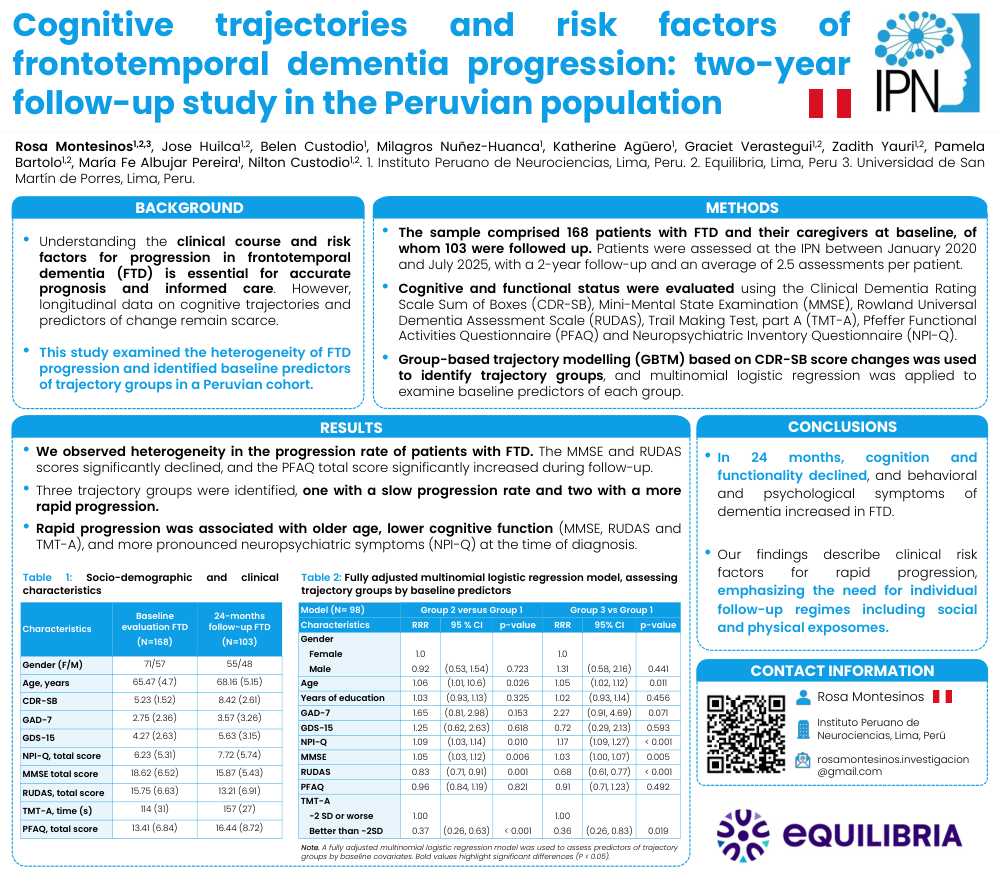
• The sample comprised 168 patients with FTD and their caregivers at baseline, of whom 103 were followed up. Patients were assessed at the IPN between January 2020 and July 2025, with a 2-year follow-up and an average of 2.5 assessments per patient.
• Cognitive and functional status were evaluated using the Clinical Dementia Rating Scale Sum of Boxes (CDR-SB), Mini-Mental State Examination (MMSE), Rowland Universal Dementia Assessment Scale (RUDAS), Trail Making Test, part A (TMT-A), Pfeffer Functional Activities Questionnaire (PFAQ) and Neuropsychiatric Inventory Questionnaire (NPI-Q).
• Group-based trajectory modelling (GBTM) based on CDR-SB score changes was used to identify trajectory groups, and multinomial logistic regression was applied to examine baseline predictors of each group.
RESULTS
• We observed heterogeneity in the progression rate of patients with FTD. The MMSE and RUDAS scores significantly declined, and the PFAQ total score significantly increased during follow-up.
• Three trajectory groups were identified, one with a slow progression rate and two with a more rapid progression.
• Rapid progression was associated with older age, lower cognitive function (MMSE, RUDAS and TMT-A), and more pronounced neuropsychiatric symptoms (NPI-Q) at the time of diagnosis.
CONCLUSIONS
• In 24 months, cognition and functionality declined, and behavioral and psychological symptoms of dementia increased in FTD.
• Our findings describe clinical risk factors for rapid progression, emphasizing the need for individual follow-up regimes including social and physical exposomes.
Comments
Email is required but is not shown publicly.
Loading comments...