4,068 posters, 219 videos, 101 topics, 69 sessions, 14,365 authors, 6,128 institutions
ePostersLive by SciGen Technologies S.A. All rights reserved.
Alzheimer's Association International Conference 2026
July 12-15, 2026 | London, United Kingdom, and Online

4088
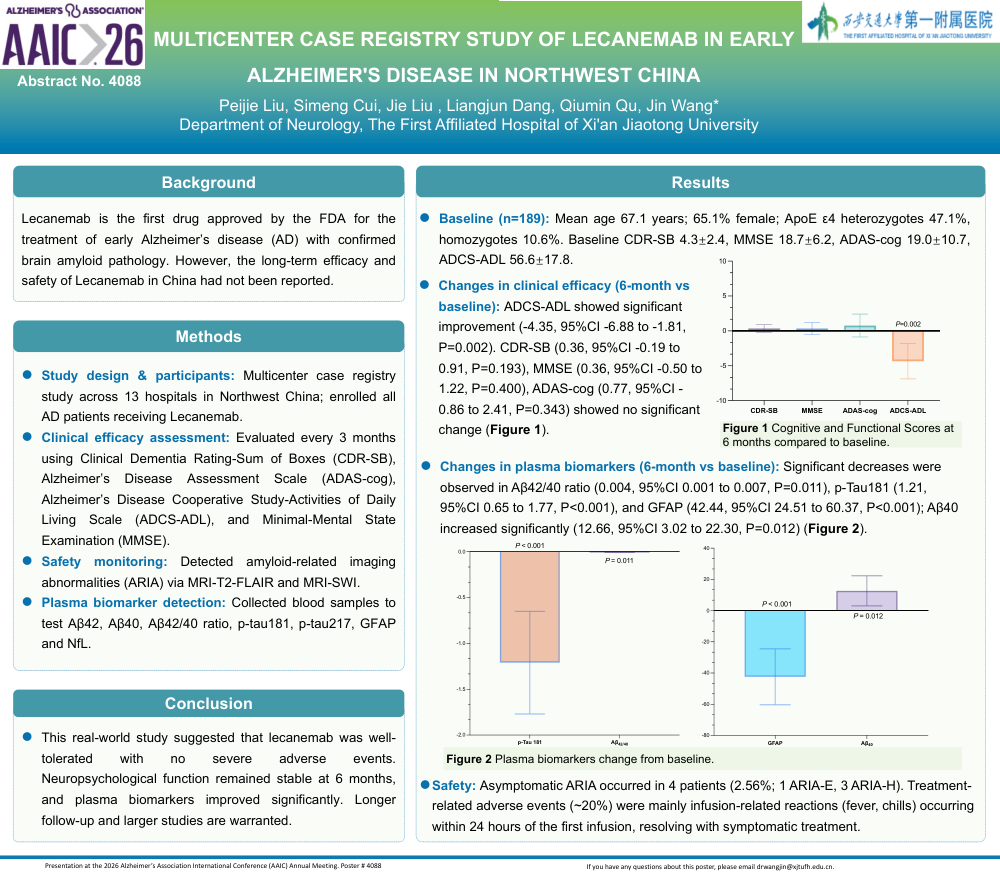
Multicenter Case Registry Study Of Lecanemab In Early Alzheimer's Disease In Northwest China
Poster Presenter
Authors
Part of Topic
Background
Lecanemab is the first drug approved by FDA for the treatment of early Alzheimer’s disease (AD) with confirmed brain amyloid pathology. However, the long-term efficacy and safety of Lecanemab in China had not been reported.
Methods
This is a multicenter case registry study conducted at 13 hospitals in Northwest China. All AD patients treated with Lecanemab were enrolled. The efficacy of Lecanemab was evaluated using Clinical Dementia Rating-Sum of Boxes (CDR-SB), Alzheimer’s Disease Assessment Scale (ADAS-cog), Alzheimer’s Disease Cooperative Study-Activities of Daily Living Scale (ADCS-ADL), and Minimal-Mental State Examination (MMSE) every 3 months. Amyloid-related imaging abnormalities (ARIA) were monitored via MRI-T2-FLAIR and MRI-SWI sequences. Blood samples were collected to evaluate changes in plasma biomarkers (including Aβ42, Aβ40, Aβ42/40, p-tau181, p-tau217, GFAP, and NfL).
Results
189 participants received Lecanemab treatment until April 1, 2026, all of whom were confirmed Aβ-positive by CSF or PET scans. The mean age was 67.1 years (range 37-88), with 123 (65.1%) female participants. The mean years of education was 11.9 years. Among the participants, 20 (10.6%) were homozygous for the ApoE ε4 allele, and 89 (47.1%) were heterozygous. At baseline, the CDR-SB score was 4.3±2.4, the MMSE score was 18.7±6.2, the ADAS-cog score was 19.0±10.7, and the ADCS-ADL score was 56.6±17.8.
There were 94 participants completed the 3-month follow-up, 58 participants completed the 6-month follow-up, 33 participants completed the 9-month follow-up, and 21 participants completed the 12-month follow-up. The longest follow-up duration was 80 weeks.
The change in CDR-SB at 6 months compare to baseline was 0.36 (95% CI -0.19 to 0.91, P=0.193), for the MMSE score was 0.36 (95% CI -0.50 to 1.22, P=0.400), for the ADAS-cog score was 0.77 (95% CI -0.86 to 2.41, P=0.343), and for ADCS-ADL -4.35 (95% CI -6.88 to -1.81, P=0.002).
The plasma Aβ42/40 ratio decreased by 0.004 (95% CI 0.001 to 0.007, P=0.011), plasma Aβ40 increased by 12.66 (95% CI 3.02 to 22.30, P=0.012), p-Tau 181 decreased by 1.21 (95% CI 0.65 to 1.77, P<0.001), and GFAP decreased by 42.44 (95% CI 24.51 to 60.37, P<0.001) at 6 months compared to baseline, whereas other plasma biomarkers showed no significant changes.
Only 4 asymptomatic ARIA (2. 56%, 1 ARIA-E and 3 ARIA-H) have been reported. Approximately 20% of patients reported treatment-related adverse events, primarily infusion-related reactions at the first infusion, such as fever and chills, which typically occurred within 24 hours post-infusion and were alleviated with symptomatic treatment.
Conclusion
This real-world study suggests that Lecanemab is well-tolerated in clinical use in Northwest China, with manageable adverse effects, and no severe adverse events have been reported to date. The neuropsychological scales remain stable during the 6-month follow-up, with males having more efficacy. Plasma biomarkers showed significant improvement after treatment. A long-term follow-up and a large sample are needed.
Comments
Email is required but is not shown publicly.
Loading comments...