4,068 posters, 219 videos, 101 topics, 69 sessions, 14,365 authors, 6,128 institutions
ePostersLive by SciGen Technologies S.A. All rights reserved.
Alzheimer's Association International Conference 2026
July 12-15, 2026 | London, United Kingdom, and Online

7206
I-CONECT: Daily remote one-to-one conversations as tools to stimulate cognition
Poster Presenter
Authors
Hiroko Dodge, Chao-Yi Wu, Liu Chen, Kexin Yu, David Lahna, Daniel Schwarz, Lisa Silbert, I-CONECT Team
Affiliations
, Harvard Medical School, Massachusetts General Hospital, Boston, MA, University of Texas Southwestern Medical Center, Dallas, TX, Oregon Health & Science University, Portland, OR, Oregon Health & Science University and VA Portland Health System, Portland, OR
Part of Topic
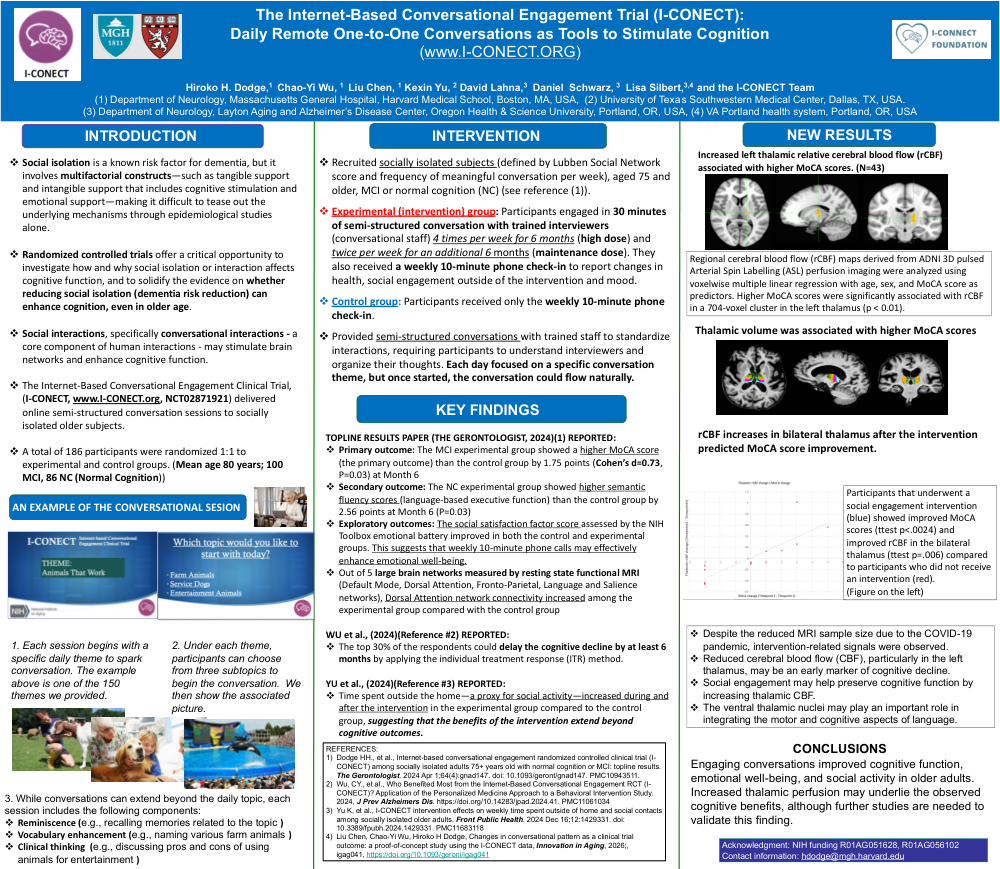
Objective: A recently completed behavioral intervention demonstrated improvements in global cognitive function and social activity through frequent remote conversational interactions among socially isolated older adults (≥75 years).¹⁻⁴ We conducted an exploratory study to examine its effects on regional cerebral blood flow (rCBF).
Methods: The Internet-Based Conversational Engagement Clinical Trial (I-CONECT, NCT02871921) provided 30-minute conversational video sessions with trained interviewers, four times per week for six months among socially isolated participants. Due to the COVID-19 pandemic and the resulting research hiatus, 43 of 186 randomized participants underwent 3T MRI ASL at baseline, and 13 participants (intervention, N = 6; control, N = 7) had a second MRI. Multiple voxelwise linear regressions were performed within GM voxels with rCBF z-score as the dependent variable and age, sex and MOCA as regressors with cluster size thresholding for multiple comparison corrections. Baseline rCBF z-scores were subtracted from rCBF from the coregistered second visit scan and then coregistered to the MNI template. Multiple voxelwise linear regression was repeated in the same manner using age, sex and change in rCBF between the timepoints as predictors of change in MOCA.
Results: Higher MOCA score was associated with increased rCBF cluster in the left thalamus (p<.01). Greater MOCA score improvement over time was associated with increased rCBF cluster in the thalamus, bilaterally (p<.05). Participants who underwent social engagement intervention (n=6) showed improved MOCA scores (p<.0024) and improved rCBF in the bilateral thalamus (p=.006) compared to participants who did not receive the intervention (n=7).
Conclusion: Improved global cognition in socially isolated older adults following regular participation in video conversations may be related to enhanced cognitive reserve secondary to relative increases in blood flow in the thalamus, a structure known to be related to cognitive performance and loneliness in older individuals.
REFERENCES:
1) Dodge HH., et al., Internet-based conversational engagement randomized controlled clinical trial (I-CONECT) among socially isolated adults 75+ years old with normal cognition or MCI: topline results. The Gerontologist. 2024 Apr 1;64(4):gnad147. doi: 10.1093/geront/gnad147. PMC10943511.
2) Wu, CY., et al., Who Benefited Most from the Internet-Based Conversational Engagement RCT (I-CONECT)? Application of the Personalized Medicine Approach to a Behavioral Intervention Study. 2024, J Prev Alzheimers Dis. https://doi.org/10.14283/jpad.2024.41. PMC11061034
3) Yu K, et al., I-CONECT intervention effects on weekly time spent outside of home and social contacts among socially isolated older adults. Front Public Health. 2024 Dec 16;12:1429331. doi: 10.3389/fpubh.2024.1429331. PMC11683118
4) Liu Chen, Chao-Yi Wu, Hiroko H Dodge, Changes in conversational pattern as a clinical trial outcome: a proof-of-concept study using the I-CONECT data, Innovation in Aging, 2026;, igag041, https://doi.org/10.1093/geroni/igag041
Comments
Email is required but is not shown publicly.
Loading comments...