4,068 posters, 219 videos, 101 topics, 69 sessions, 14,365 authors, 6,128 institutions
ePostersLive by SciGen Technologies S.A. All rights reserved.
Alzheimer's Association International Conference 2026
July 12-15, 2026 | London, United Kingdom, and Online

6026
Association Of Performance On The Cogstate Brief Battery With Ptau217 In Cognitively Unimpaired Older Adults
Poster Presenter
Authors
Kaycee Sink, Annie Aitken, Svenja Wacker, Paul Maruff, Kaycee Sink, A4 Research Group
Affiliations
, Cogstate
Part of Topic
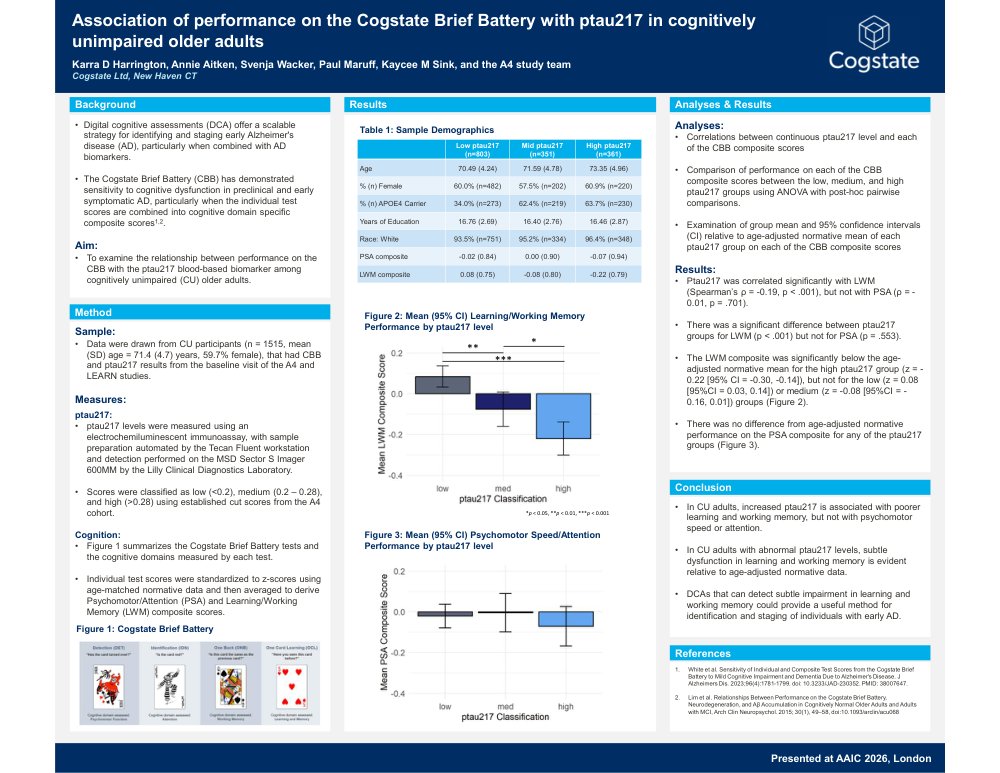
Background: Digital cognitive assessments (DCA) offer a scalable strategy for identifying and staging early Alzheimer's disease (AD), particularly when combined with AD biomarkers. The Cogstate Brief Battery (CBB) has demonstrated sensitivity to cognitive dysfunction in preclinical and early symptomatic AD. The aim of this study was to examine the relationship between performance on the CBB with the ptau217 blood-based biomarker among cognitively unimpaired (CU) older adults.
Methods: CBB and ptau217 data were available for CU participants (n = 1515, mean (SD) age = 71.4 (4.7) years, 59.7% female) from the baseline visit of the A4 and LEARN studies. The CBB learning/working memory (LWM) and psychomotor/attention (PSA) composite scores were expressed as z-scores using age-matched normative data. Ptau217 scores were classified as low, medium, and high using established cut scores from the A4 cohort. Analyses examined correlations between continuous ptau217 level and each of the CBB composite scores and compared performance on the CBB composites between the low, medium, and high ptau217 groups.
Results: Ptau217 was correlated significantly with LWM (Spearman’s ρ = -0.19, p < .001), but not with PSA (ρ = -0.01, p = .701). There was a significant difference between ptau217 groups for LWM (p < .001) but not for PSA (p = .553). Examination of group means and 95% confidence intervals (CI) indicated that the LWM composite was significantly below the age-adjusted normative mean for the high ptau217 group (z = -0.22 [95% CI = -0.30, -0.14]), but not for the low (z = 0.08 [95%CI = 0.03, 0.14]) or medium (z = -0.08 [95%CI = -0.16, 0.01]) groups. There was no difference from age-adjusted normative performance on the PSA composite for any of the ptau217 groups.
Conclusion: In CU adults, increased ptau217 is associated with poorer learning and working memory, but not with psychomotor speed or attention. In CU adults with abnormal ptau217 levels, subtle dysfunction in learning and working memory is evident relative to age-adjusted normative data. DCAs that can detect subtle impairment in learning and working memory could provide a useful method for identification and staging of individuals with early AD.
Comments
Email is required but is not shown publicly.
Loading comments...