4,068 posters, 219 videos, 101 topics, 69 sessions, 14,365 authors, 6,128 institutions
ePostersLive by SciGen Technologies S.A. All rights reserved.
Alzheimer's Association International Conference 2026
July 12-15, 2026 | London, United Kingdom, and Online

10865
Genetic Counseling In Early Onset Dementia: Factors Related With Genetic Status Disclosure
Poster Presenter
Authors
Alexander Navarro, Juan Camilo Becerra, Alejandro Espinosa Rojas, Claudia Ramos, Claudia Madrigal, Yudy León, Mauricio Arcos Burgos, David Aguillón, Jorge Llibre Guerra
Affiliations
Grupo de Neurociencias de Antioquia (GNA), Facultad de Medicina, Universidad de Antioquia, Medellín, Colombia, Washington University School of Medicine, St. Louis, MO, USA
Part of Topic
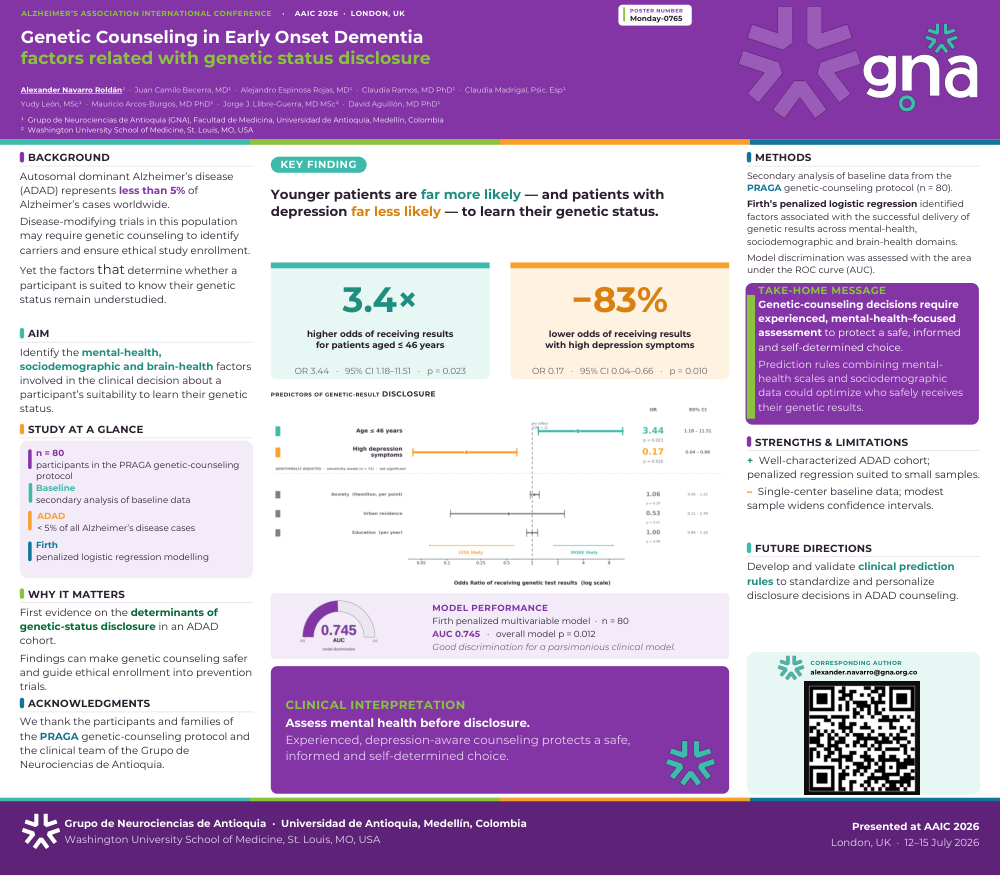
Background: Autosomal dominant Alzheimer's disease (ADAD) accounts for fewer than 5% of Alzheimer's disease cases but plays a critical role in prevention trials. Genetic counseling is essential to identify mutation carriers and ensure ethical disclosure of genetic information. However, factors influencing whether individuals are considered suitable to receive their genetic results remain poorly understood.
Objective: To identify mental health, sociodemographic, and brain health factors associated with the clinical decision to disclose genetic test results in individuals at risk for ADAD.
Methods: We conducted a secondary analysis of baseline data from 80 participants enrolled in the PRAGA genetic counseling protocol. Firth's penalized logistic regression was used to evaluate predictors of successful genetic result disclosure. Model performance was assessed using the area under the receiver operating characteristic curve (AUC).
Results: Participants aged 46 years or younger had significantly higher odds of receiving their genetic results (OR 3.44, 95% CI 1.18–11.51, p = 0.023). In contrast, participants with higher depressive symptoms were significantly less likely to receive disclosure (OR 0.17, 95% CI 0.04–0.66, p = 0.010). The final model demonstrated good discrimination (AUC = 0.745).
Conclusions: Mental health, particularly depressive symptoms, and younger age are important determinants of genetic result disclosure in ADAD genetic counseling. Incorporating standardized mental health assessment into counseling protocols may improve the safety, ethical conduct, and personalization of disclosure decisions while supporting participant selection for prevention trials.
Keywords: Autosomal dominant Alzheimer's disease; Genetic counseling; Genetic testing; Disclosure; Depression; Early-onset dementia; Precision medicine.
Comments
Email is required but is not shown publicly.
Loading comments...