4,068 posters, 219 videos, 101 topics, 69 sessions, 14,365 authors, 6,128 institutions
ePostersLive by SciGen Technologies S.A. All rights reserved.
Alzheimer's Association International Conference 2026
July 12-15, 2026 | London, United Kingdom, and Online

5034
Trajectory Of Apathy And Its Association With Cognition And Everyday Functioning In Alzheimer’s Disease
Poster Presenter
Authors
Anne Wessels, Sophie van der Landen, Mukrabe Tewolde, Sterre de Boer, Janne Papma, Craig Ritchie, John Harrison, Hanneke Rhodius-Meester, Everard Vijverberg, Yolande Pijnenburg, André Aleman, Sietske Sikkes, Roos Jutten
Affiliations
Alzheimer Center Amsterdam, Department of Neurology, Amsterdam Neuroscience, Amsterdam UMC, the Netherlands, Department of Neurology & dept. of Internal Medicine, Erasmus Medical Center, Rotterdam, the Netherlands, Centre for Dementia Prevention, University of Edinburgh, Edinburgh, UK, Metis Cognition Ltd, Wiltshire, UK & Institute of Psychiatry, Psychology & Neuroscience, King’s College London, London, UK, Alzheimer Center Amsterdam, Department of Neurology, Amsterdam Neuroscience, Amsterdam UMC, the Netherlands & Department of Geriatric Medicine, Oslo University Hospital, Oslo, Norway, Faculty of Psychology and Neuroscience, Maastricht University, The Netherlands
Part of Topic
Background
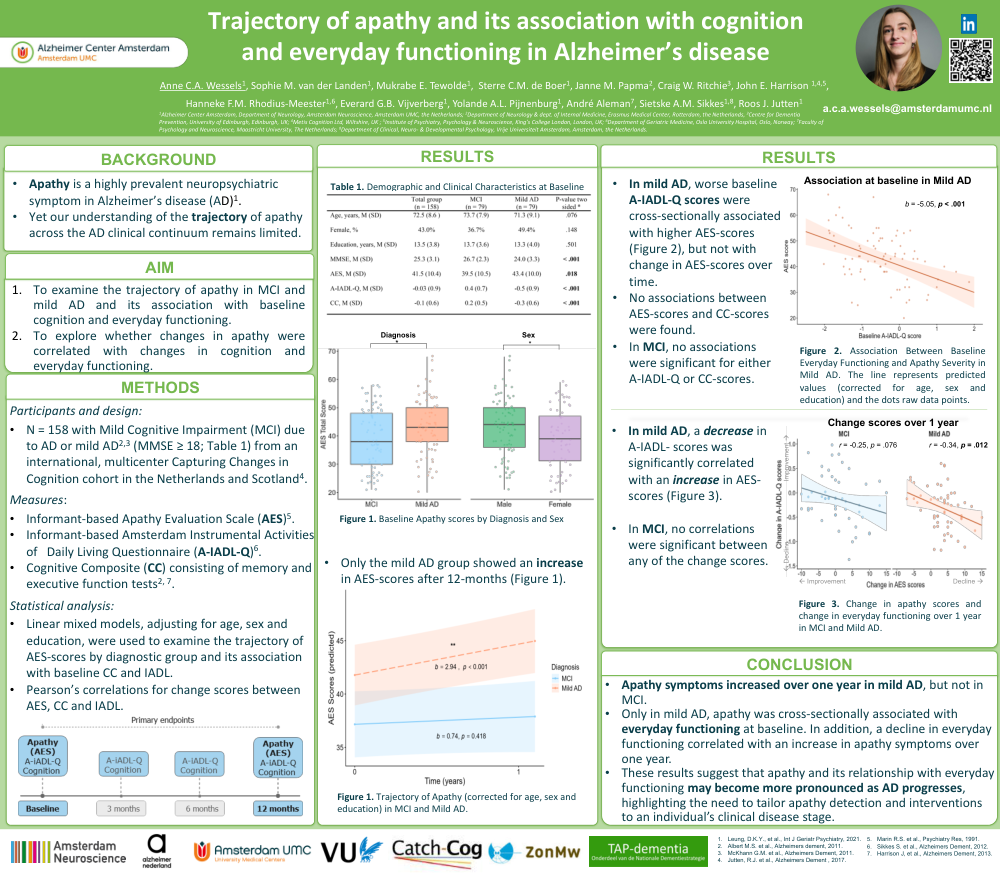
Apathy is a highly prevalent neuropsychiatric symptom in Alzheimer’s disease (AD)1. Yet our understanding of the trajectory of apathy across the AD clinical continuum remains limited.
Aim
1. To examine the trajectory of apathy in MCI and AD and its association with baseline cognition and everyday functioning.
2. To explore whether changes in apathy were correlated with changes in cognition and everyday functioning.
Methods
Participants and design: N = 158 with MCI due to AD or mild AD2,3 (MMSE ≥ 18; Table 1) from an international, multicenter Capturing Changes in Cognition cohort in the Netherlands and Scotland4.
Measures: Informant-based Apathy Evaluation Scale (AES)5. Informant-based Amsterdam Instrumental Activities of Daily Living Questionnaire (A-IADL-Q)6. Cognitive Composite (CC) consisting of memory and executive function tests2, 7.
Statistical analysis: Linear mixed models, adjusting for age, sex and education, were used to examine the trajectory of AES-scores by diagnostic group and its association with baseline CC and IADL. Pearson’s correlations for change scores between AES, CC and IADL.
Results
Only the mild AD group showed an increase in AES-scores after 12-months (Figure 1).
In mild AD, worse baseline A IADL-Q scores were cross sectionally associated with higher AES-scores (Figure 2), but not with change in AES-scores over time. No associations between AES scores and CC-scores were found. In MCI, no associations were significant for either A-IADL-Q or CC-scores.
In mild AD, a decrease in A IADL- scores was significantly correlated with an increase in AES-scores (Figure 3). In MCI, no correlations were significant between any of the change scores.
Conclusion
Apathy symptoms increased over one year in mild AD, but not in MCI. Only in mild AD, apathy was cross-sectionally associated with everyday functioning at baseline. In addition, a decline in everyday functioning was correlated with an increase in apathy symptoms over one year. These results suggest that apathy and its relationship with everyday functioning may become more pronounced as AD progresses, highlighting the importance of tailoring apathy detection and interventions to an individual’s clinical disease stage.
Comments
Email is required but is not shown publicly.
Loading comments...