4,068 posters, 219 videos, 101 topics, 69 sessions, 14,365 authors, 6,128 institutions
ePostersLive by SciGen Technologies S.A. All rights reserved.
Alzheimer's Association International Conference 2026
July 12-15, 2026 | London, United Kingdom, and Online

7178
Clinical Onset Patterns And Symptom Associations In Prodromal Dementia With Lewy Bodies
Poster Presenter
Part of Topic
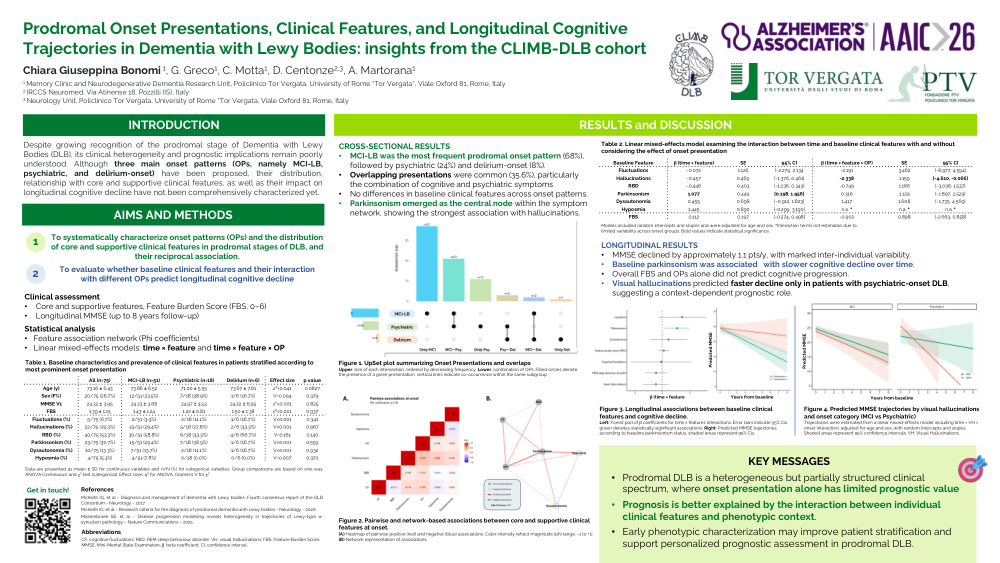
Background: Dementia with Lewy bodies (DLB) is characterized by a prolonged prodromal stage marked by heterogeneous clinical onset presentations (OPs). However, the distribution, co-occurrence, and prognostic implications of core and supportive clinical features at onset remain underexplored. We aimed to characterize prodromal OPs and associated clinical features in a longitudinally confirmed DLB cohort and to examine their relationship with cognitive decline.
Methods: Patients were enrolled from the prospective CLIMB-DLB observational cohort at the Memory Clinic of Policlinico Tor Vergata (Rome), upon fulfilling consensus criteria for probable DLB. Patients were stratified by main OP (MCI-LB, psychiatric-onset, delirium-onset). Core (cognitive fluctuations [CF], visual hallucinations [VH], REM sleep behavior disorder [RBD], parkinsonism) and supportive (hyposmia, dysautonomia) features were coded at the prodromal stage. Pairwise associations were assessed using φ coefficients and odds ratios (ORs). Longitudinal cognitive trajectories were examined using linear mixed-effects models with random intercepts and slopes, adjusted for age and sex.
Results: Among 75 patients (mean age 73.2±6.4 years; 26.7% female), MCI-LB was the most frequent OP (51/75, 68%), followed by psychiatric (18/75, 24%) and delirium onset (6/75, 8%); 35.6% exhibited overlapping presentations. No significant differences in feature prevalence emerged across OPs. Symptom associations were generally small-to-moderate; the strongest was between parkinsonism and VH (φ=0.27; OR 3.35, 95% CI 1.04–11.12; p=0.028). Overall MMSE declined by −1.14 points/year (SE=0.21, p<0.001), with substantial inter-individual variability (random slope SD=1.03). Baseline parkinsonism was associated with slower annual MMSE decline (β=1.08, 95% CI 0.20–1.96), whereas other features and cumulative feature burden were not significant predictors. A significant three-way interaction indicated that VH were associated with steeper decline in psychiatric-onset DLB (β=−2.34, 95% CI −4.61 to −0.07).
Conclusions: Prodromal DLB is a heterogeneous but partially structured clinical spectrum, with frequent overlap between onset presentations and modest clustering of core features. Main OPs alone had limited prognostic value for cognitive trajectories. Instead, specific clinical features – particularly parkinsonism and VH within defined phenotypic contexts – were associated with longitudinal decline. These findings suggest that early disease progression may be better understood through multidimensional phenotypic configurations rather than categorical onset labels, with potential implications for stratification and trial design.
Comments
Email is required but is not shown publicly.
Loading comments...