4,068 posters, 219 videos, 101 topics, 69 sessions, 14,365 authors, 6,128 institutions
ePostersLive by SciGen Technologies S.A. All rights reserved.
Alzheimer's Association International Conference 2026
July 12-15, 2026 | London, United Kingdom, and Online

7320
Potential Effects Of Sodium Reformulation On Dementia Burden In Australia: A Modelling Study
Poster Presenter
Authors
Briar McKenzie, Tazman Davies, Kathy Trieu, Liping Huang, Daisy Coyle, Seb Walsh, Janet Maccora, Linda Cobiac, Lennert Veerman, Mark Woodward, Bruce Neal, Jason Wu, Carol Brayne, Matti Marklund, Ruth Peters
Affiliations
The George Institute for Global Health, UNSW, Sydney, Australia, Cambridge Public Health, University of Cambridge, Cambridge, UK, Nuffield Department of Population Health, University of Oxford, Oxford, UK, Public Health & Economics Modelling group, School of Medicine and Dentistry, Griffith University, Gold Coast, Australia, Center for Human Nutrition, Department of International Health, Johns Hopkins Bloomberg School of Public Health, Baltimore, MD, USA
Part of Topic
Potential Effects Of Sodium Reformulation On Dementia Burden In Australia: A Modelling Study
Introduction:
Mid-life high blood pressure increases dementia risk (1,2). Sodium reduction is an established strategy to lower blood pressure, targeting cardiovascular disease burden (3,4). However, potential benefits in terms of population level dementia risk and burden remain under researched.
The aim of the present study was to estimate the health effect of population level sodium reduction for the dementia syndrome in Australia, by 1) mandating the World Health Organization (WHO) sodium benchmarks for packaged foods (5) and 2) mandating the current voluntary Australian Healthy Food Partnership (HFP) targets (6).
Methods:
A proportional multistate lifetable model (7) was used to simulate dementia specific effects of 1) mandatory WHO sodium benchmarks (apply to 58 food groups) (5), and 2) mandatory HFP targets (apply to 27 food groups) (6), versus current packaged-food sodium levels. Blood pressure and dementia data came from the 2019 Global Burden of Disease Study (8). The effect of sodium reduction on blood pressure and blood pressure on dementia risk was modelled based on meta-analyses of randomised trials (2,4). Outcomes were incident dementia cases averted and health adjusted life years (HALYs) gained among Australians aged 20+ years, at 10 years and over the population lifetime.
Results:
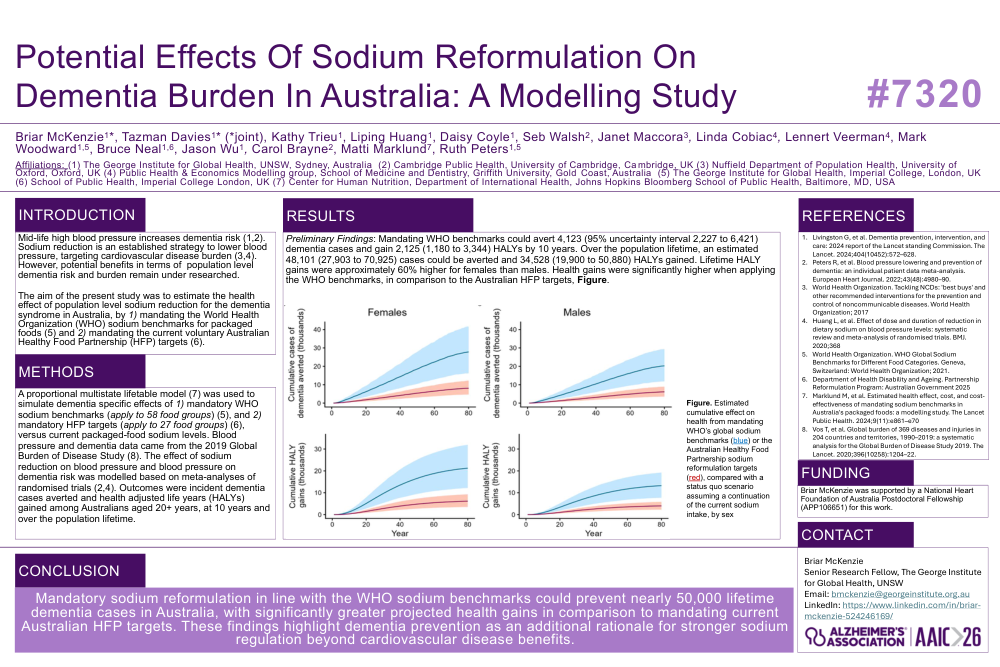
Preliminary Findings: Mandating WHO benchmarks could avert 4,123 (95% uncertainty interval 2,227 to 6,421) dementia cases and gain 2,125 (1,180 to 3,344) HALYs by 10 years. Over the population lifetime, an estimated 48,101 (27,903 to 70,925) cases could be averted and 34,528 (19,900 to 50,880) HALYs gained. Lifetime HALY gains were approximately 60% higher for females than males. Health gains were significantly higher when applying the WHO benchmarks, in comparison to the Australian HFP targets, Figure.
Conclusion:
Mandatory sodium reformulation in line with the WHO sodium benchmarks could prevent nearly 50,000 lifetime dementia cases in Australia, with significantly greater projected health gains in comparison to mandating current Australian HFP targets. These findings highlight dementia prevention as an additional rationale for stronger sodium regulation beyond cardiovascular disease benefits.
References:
Comments
Email is required but is not shown publicly.
Loading comments...