4,068 posters, 219 videos, 101 topics, 69 sessions, 14,365 authors, 6,128 institutions
ePostersLive by SciGen Technologies S.A. All rights reserved.
Alzheimer's Association International Conference 2026
July 12-15, 2026 | London, United Kingdom, and Online

5130
Exploring Associations Between REM Sleep And Next-day Cognition In Lewy Body Dementia; A Cross-sectional Observational Study
Poster Presenter
Authors
Devan Mair, Victoria Gabb, Jonathan Blackman, Hamish Morrison, Nicholas Turner, Elizabeth Coulthard
Affiliations
Part of Topic
Introduction
Attentional fluctuations are a hallmark of Lewy Body Dementia (LBD), but their neurobiological basis is unclear. Abnormalities of REM sleep are well described in LBD. Here, we ask whether daily variability in cognitive function is explained by REM sleep quality the night before in LBD.
We investigated whether
i) REM sleep duration and latency were reduced in LBD
ii) REM duration and latency predicted poorer next‑day attention and executive function in LBD, compared with Alzheimer’s disease (AD) and age‑matched controls.
Methods
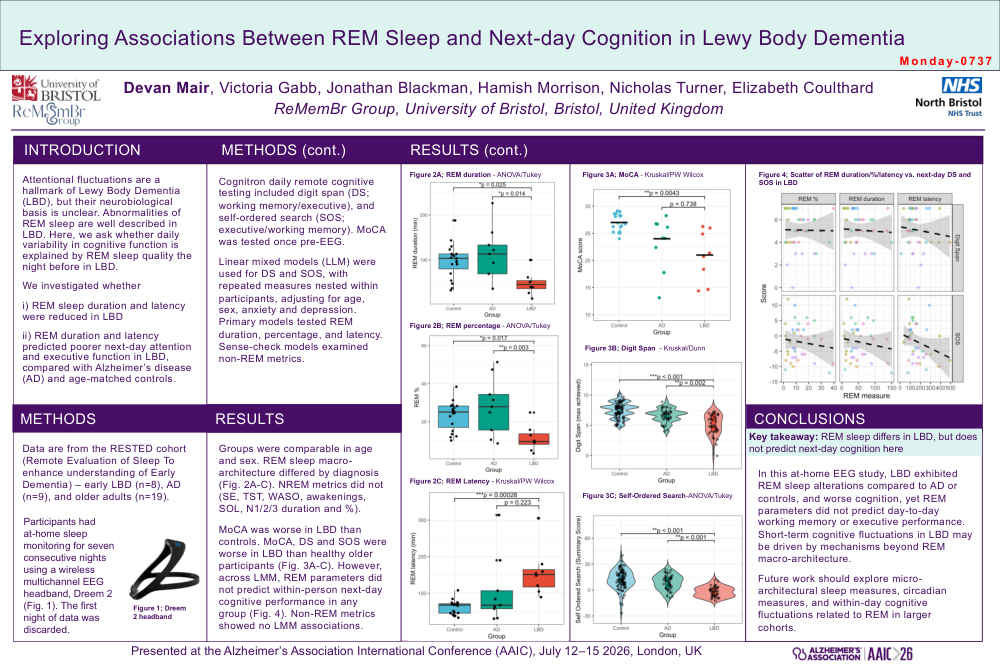
Data are from the RESTED cohort (Remote Evaluation of Sleep To enhance understanding of Early Dementia) – early LBD (n=8), AD (n=9), and older adults (n=19). Participants had at‑home sleep monitoring for seven consecutive nights using a wireless multichannel EEG headband, Dreem 2 (Fig. 1). The first night of data was discarded.
Cognitron daily remote cognitive testing included digit span (DS; working memory/executive), and self‑ordered search (SOS; executive/working memory). MoCA was tested once pre-EEG. Linear mixed models (LLM) were used for DS and SOS, with repeated measures nested within participants, adjusting for age, sex, anxiety and depression. Primary models tested REM duration, percentage, and latency. Sense‑check models examined non-REM metrics.
Results
Groups were comparable in age and sex. REM sleep macro-architecture differed by diagnosis (Fig. 2A-C). NREM metrics did not (SE, TST, WASO, awakenings, SOL, N1/2/3 duration and %). MoCA was worse in LBD than controls. MoCA, DS and SOS were worse in LBD than healthy older participants (Fig. 3A-C). However, across LMM, REM parameters did not predict within‑person next‑day cognitive performance in any group (Fig. 4). Non‑REM metrics showed no LMM associations.
Conclusions
Key takeaway: REM sleep differs in LBD, but does not predict next-day cognition here
In this at‑home EEG study, LBD exhibited REM sleep alterations compared to AD or controls, and worse cognition, yet REM parameters did not predict day‑to‑day working memory or executive performance. Short‑term cognitive fluctuations in LBD may be driven by mechanisms beyond REM macro-architecture. Future work should explore micro-architectural sleep measures, circadian measures, and within-day cognitive fluctuations related to REM in larger cohorts.
Comments
Email is required but is not shown publicly.
Loading comments...