4,068 posters, 219 videos, 101 topics, 69 sessions, 14,365 authors, 6,128 institutions
ePostersLive by SciGen Technologies S.A. All rights reserved.
Alzheimer's Association International Conference 2026
July 12-15, 2026 | London, United Kingdom, and Online

4728
Multi-Omics And Ai-Driven Insights Into Lecanemab Effectiveness And Safety In Chinese Alzheimer’S Disease Patients
Part of Topic
Background:
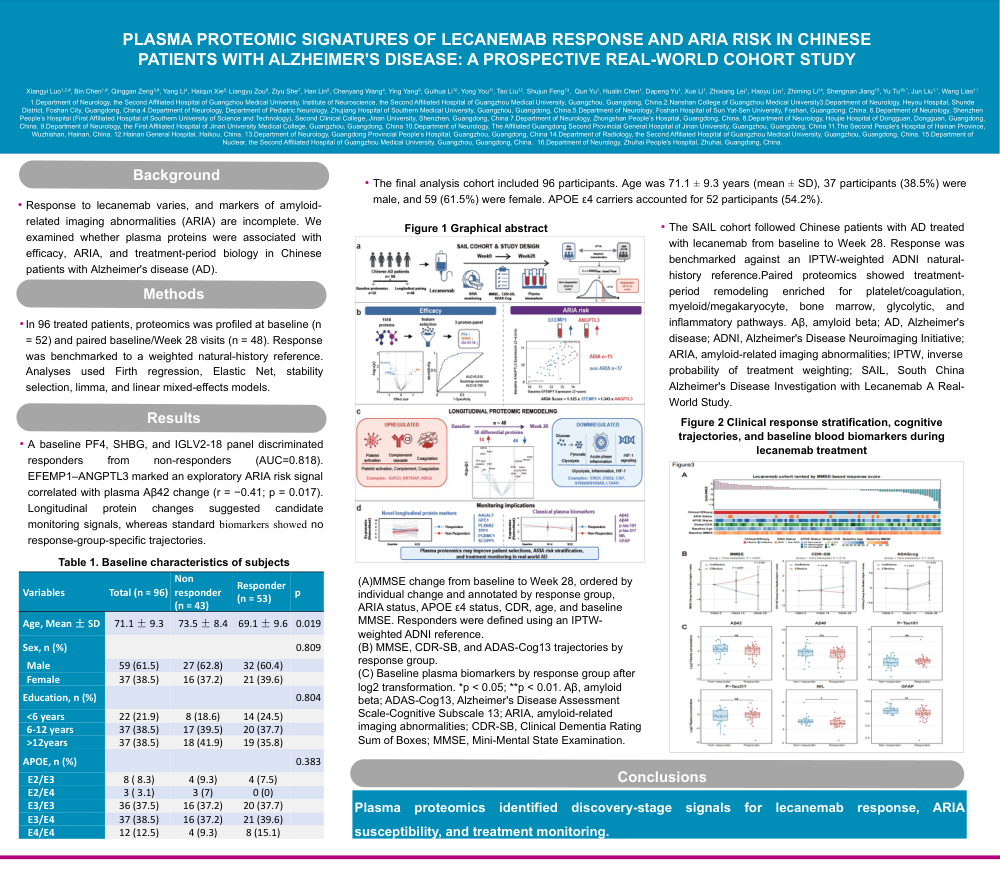
Response to lecanemab varies, and markers of amyloid-related imaging abnormalities (ARIA) are incomplete. We examined whether plasma proteins were associated with efficacy, ARIA, and treatment-period biology in Chinese patients with Alzheimer's disease (AD).
Methods:
In 96 treated patients, proteomics was profiled at baseline (n = 52) and paired baseline/Week 28 visits (n = 48). Response was benchmarked to a weighted natural-history reference. Analyses used Firth regression, Elastic Net, stability selection, limma, and linear mixed-effects models.
Result:
A baseline PF4, SHBG, and IGLV2-18 panel discriminated responders from non-responders (AUC=0.818). EFEMP1–ANGPTL3 marked an exploratory ARIA risk signal correlated with plasma Aβ42 change (r = −0.41; p = 0.017). Longitudinal protein changes suggested candidate monitoring signals, whereas standard biomarkers showed no response-group-specific trajectories.
Conclusion:
Plasma proteomics identified discovery-stage signals for lecanemab response, ARIA susceptibility, and treatment monitoring.
Comments
Email is required but is not shown publicly.
Loading comments...