4,068 posters, 219 videos, 101 topics, 69 sessions, 14,365 authors, 6,128 institutions
ePostersLive by SciGen Technologies S.A. All rights reserved.
Alzheimer's Association International Conference 2026
July 12-15, 2026 | London, United Kingdom, and Online

7202
Neural Basis Of Cognitive Intervention Via Photo-Integrated Conversation Moderated By Robots (PICMOR) Program
Part of Topic
Background: The completed randomized controlled trial on PICMOR program (UMIN Clinical Trials Registry, identifier UMIN000036667), provided world-first evidence of a face-to-face topic-based structured group conversation moderated by robots on cognitive function in healthy older adults. Topline results were published in 2021. This presentation discusses neural bases of intervention found on the analysis of Magnetic resonance imaging (MRI) data.
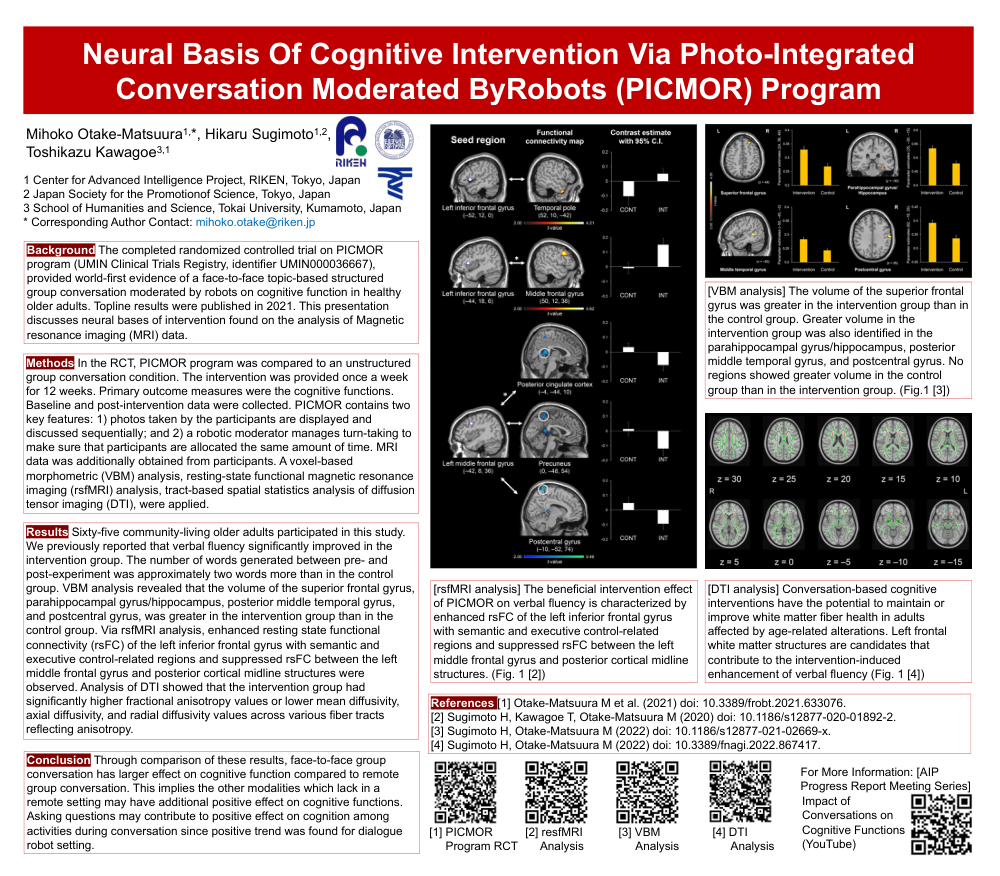
Methods: In the RCT, PICMOR program was compared to an unstructured group conversation condition. The intervention was provided once a week for 12 weeks. Primary outcome measures were the cognitive functions. Baseline and post-intervention data were collected. PICMOR contains two key features: 1) photos taken by the participants are displayed and discussed sequentially; and 2) a robotic moderator manages turn-taking to make sure that participants are allocated the same amount of time. MRI data was additionally obtained from participants. A voxel-based morphometric (VBM) analysis, resting-state functional magnetic resonance imaging (rsfMRI) analysis, tract-based spatial statistics analysis of diffusion tensor imaging (DTI), were applied.
Results: Sixty-five community-living older adults participated in this study. We previously reported that verbal fluency significantly improved in the intervention group. The number of words generated between pre- and post-experiment was approximately two words more than in the control group. VBM analysis revealed that the volume of the superior frontal gyrus, parahippocampal gyrus/hippocampus, posterior middle temporal gyrus, and postcentral gyrus, was greater in the intervention group than in the control group. Via rsfMRI analysis, enhanced resting state functional connectivity (rsFC) of the left inferior frontal gyrus with semantic and executive control-related regions and suppressed rsFC between the left middle frontal gyrus and posterior cortical midline structures were observed. Analysis of DTI showed that the intervention group had significantly higher fractional anisotropy values or lower mean diffusivity, axial diffusivity, and radial diffusivity values across various fiber tracts reflecting anisotropy.
Conclusion: The analysis results of MRI data show that there exists region with larger neural volume, enhanced or inhibited reFC related to verbal fluency, and anisotropic fiber tracts in the intervention group compared to the control group. Two key features of PICMOR may enhance inherent efficacy in unstructured group conversation.
Comments
Email is required but is not shown publicly.
Loading comments...