4,068 posters, 219 videos, 101 topics, 69 sessions, 14,365 authors, 6,128 institutions
ePostersLive by SciGen Technologies S.A. All rights reserved.
Alzheimer's Association International Conference 2026
July 12-15, 2026 | London, United Kingdom, and Online

1426
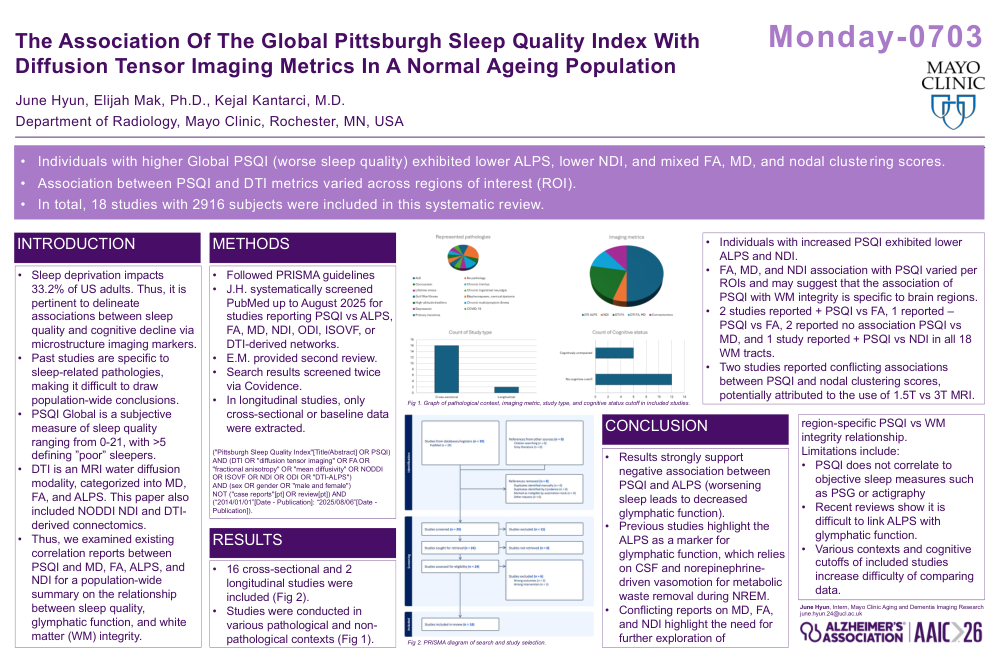
The Association Of The Global Pittsburgh Sleep Quality Index With Diffusion Tensor Imaging Metrics In A Normal Ageing Population
Poster Presenter
Authors
Affiliations
Part of Topic
Background: To assess whether an association exists between the patient-reported Pittsburgh Sleep Quality Index global score (PSQI) and diffusion tensor imaging (DTI) metrics in a population with normal aging.
Methods: Peer-reviewed, full-text observational studies of any design and language associating DTI free anisotropy (FA), mean diffusivity (MD), analysis along the perivascular space (ALPS), DTI-derived graph theory, neurite orientation dispersion and density imaging (NODDI), neurite density index (NDI), orientation dispersion index (ODI), and volume fraction of Gaussian isotropic diffusion (ISOVF) with PSQI were included. Case reports, reviews, or autopsy studies were excluded. PubMed was systematically searched through August 2025, adhering to the above inclusion and exclusion criteria. Results were screened and synthesized through Covidence according to the Preferred Reporting Items for Systematic Reviews and Meta-Analyses (PRISMA) guidelines.
Results: In total, 18 studies were included with 2916 subjects. Individuals with greater PSQI (poor sleep) exhibited lower ALPS, lower NDI, and mixed FA, MD, and nodal clustering scores. The association between PSQI and DTI metrics varied across the white matter tracts and gray matter regions of interest.
Conclusion: PSQI may be a subjective marker for glymphatic system function in normal aging populations. However, mixed FA, MD, and DTI-derived network analysis association with PSQI suggests the need for comprehensive region-based studies to determine the association between sleep quality and white matter microstructure. Further sex-based association of PSQI with DTI metrics could address the increased sleep disturbances often found in women and their impact on brain health.
Comments
Email is required but is not shown publicly.
Loading comments...