4,068 posters, 219 videos, 101 topics, 69 sessions, 14,365 authors, 6,128 institutions
ePostersLive by SciGen Technologies S.A. All rights reserved.
Alzheimer's Association International Conference 2026
July 12-15, 2026 | London, United Kingdom, and Online

9457
Diagnostic Accuracy Of CTseg Segmentation Software For Dementia In Pacific Peoples Living In Aotearoa New Zealand
Poster Presenter
Authors
Affiliations
Part of Topic
Diagnostic accuracy of CTseg segmentation software for dementia in Pacific peoples living in Aotearoa New Zealand
Why this matters
• Pacific peoples in AotearoaNew Zealand experience a disproportionate dementia burden.1
• They tend to develop dementia at a younger age and are often diagnosed later.2
• Routine CT scans are accessible; automated volumetry could make case-finding scalable.
• CTsegis an automated tool that extracts brain volumes from routine non-contrast CT scans.3
• CTseg has previously shown moderate accuracy for dementia case-finding in NZ Europeans.4
Objective
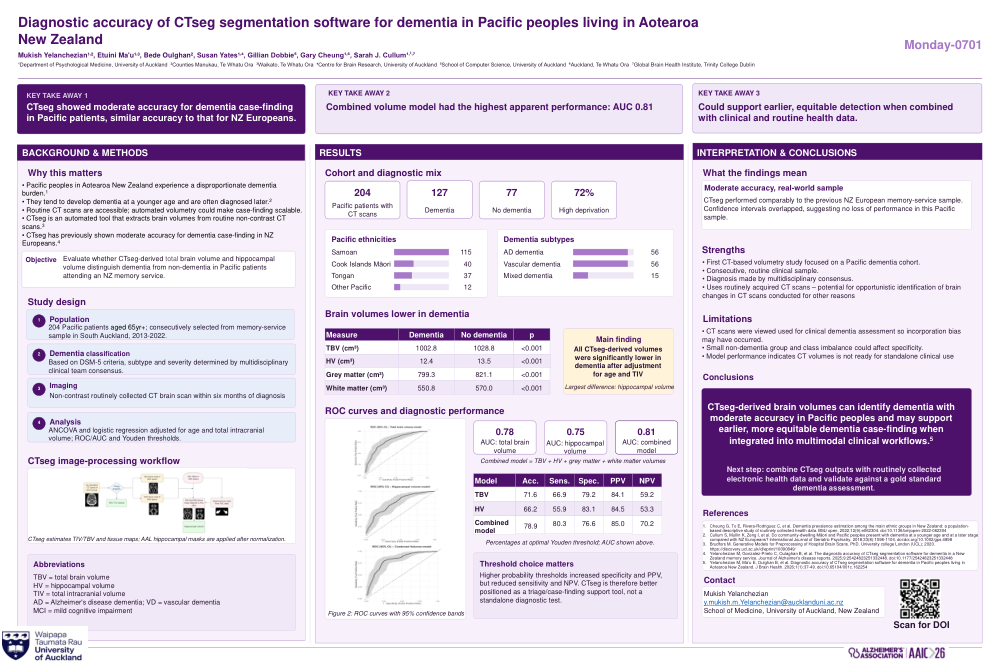
Evaluate whether CTseg-derived totalbrain volume and hippocampal volume distinguish dementia from non-dementia in Pacific patients attending an NZ memory service.
Study design
1
Population
204 Pacific patients aged 65yr+; consecutively selected from memory-service sample in South Auckland, 2013-2022.
2
Dementiaclassification
Based on DSM-5 criteria, subtype and severity determined by multidisciplinary clinical team consensus.
3
Imaging
Non-contrast routinely collected CT brain scan within six months of diagnosis
4
Analysis
ANCOVA and logistic regression adjusted for age and total intracranial volume; ROC/AUC and Youden thresholds.
CTseg image-processing workflow
CTseg estimates TIV/TBV and tissue maps; AAL hippocampal masks are applied after normalization.
Abbreviations
TBV = total brain volume
HV = hippocampal volume
TIV = total intracranial volume
AD = Alzheimer's disease dementia; VD = vascular dementia
MCI = mild cognitive impairment
Cohort and diagnostic mix
204
Pacific patients with CT scans
127
Dementia
77
No dementia
72%
High deprivation
Pacificethnicities
Samoan
115
Cook Islands Māori
40
Tongan
37
Other Pacific
12
Dementia subtypes
AD dementia
56
Vasculardementia
56
Mixed dementia
15
Main finding
All CTseg-derived volumes were significantly lower in dementia after adjustment for age and TIV
Largest difference: hippocampal volume
ROC curves and diagnostic performance
Threshold choice matters
Higher probability thresholds increased specificity and PPV, but reduced sensitivity and NPV. CTseg is therefore better positioned as a triage/case-finding support tool, not a standalone diagnostic test.
What the findings mean
Moderate accuracy, real-world sample
CTseg performed comparably to the previous NZ European memory-service sample. Confidence intervals overlapped, suggesting no loss of performance in this Pacific sample.
Strengths
• First CT-based volumetry study focused on a Pacific dementia cohort.
• Consecutive, routine clinical sample.
• Diagnosis made by multidisciplinary consensus.
• Uses routinely acquired CT scans –potential for opportunistic identification of brain changes in CT scans conducted for other reasons
Limitations
• CT scans were viewed used for clinical dementia assessment so incorporation bias may have occurred.
• Small non-dementia group and class imbalance could affect specificity.
• Model performance indicates CT volumes is not ready for standalone clinical use
Conclusions
CTseg-derived brain volumes can identify dementia with moderate accuracy in Pacific peoples and may support earlier, more equitable dementia case-finding when integrated into multimodal clinical workflows.5
Next step: combine CTseg outputs with routinely collected electronic health data and validate against a gold standard dementia assessment.
Contact
Mukish Yelancheziany.mukish.m.Yelanchezian@aucklanduni.ac.nz
School of Medicine, University of Auckland, New Zealand
Scan for DOI
.
Comments
Email is required but is not shown publicly.
Loading comments...