4,068 posters, 219 videos, 101 topics, 69 sessions, 14,365 authors, 6,128 institutions
ePostersLive by SciGen Technologies S.A. All rights reserved.
Alzheimer's Association International Conference 2026
July 12-15, 2026 | London, United Kingdom, and Online

1980
Predicting Cerebrovascular Burden From Blood-brain Barrier Water Exchange In A Geriatric Cohort
Poster Presenter
Authors
Beatriz Padrela, Majon Muller, Amnah Mahroo, Tormod Faldby, Frederik Barkhof, Jan Petr, Henk-Jan Mutsaerts
Affiliations
Department of Radiology and Nuclear Medicine, Amsterdam Neuroscience, Amsterdam University Medical Center, Location VUmc, Amsterdam, the Netherlands, Department of Internal Medicine, Section Geriatrics, Amsterdam UMC, Boelelaan 1117, Amsterdam, the Netherlands., Krembil Research Institute, University Health Network, Toronto, Canada, Department of Neurology, Akershus University Hospital, Oslo, Norway, Department of Radiology and Nuclear Medicine, Amsterdam Neuroscience, Amsterdam University Medical Center, Location VUmc, Amsterdam, the Netherlands., Helmholtz-Zentrum Dresden-Rossendorf, Institute of Radiopharmaceutical Cancer Research, Dresden, Germany
Part of Topic
Introduction:
Blood–brain barrier (BBB) dysfunction and cerebral hypoperfusion are increasingly implicated in cerebral small-vessel disease (cSVD) and late-life cognitive impairment. Although these processes accelerate after age 60, in vivo characterization of the BBB and vascular physiology in geriatric memory-clinic populations remains limited. Advanced arterial spin labeling (ASL) techniques now enable simultaneous assessment of cerebral blood flow (CBF), arterial transit time (ATT), and BBB water-exchange time (Tex), offering potential biomarkers of vascular cognitive impairment (VCI). We investigated whether the mean and spatial variability of BBB-ASL metrics are associated with white-matter hyperintensity (WMH) burden in late life.
Methods:
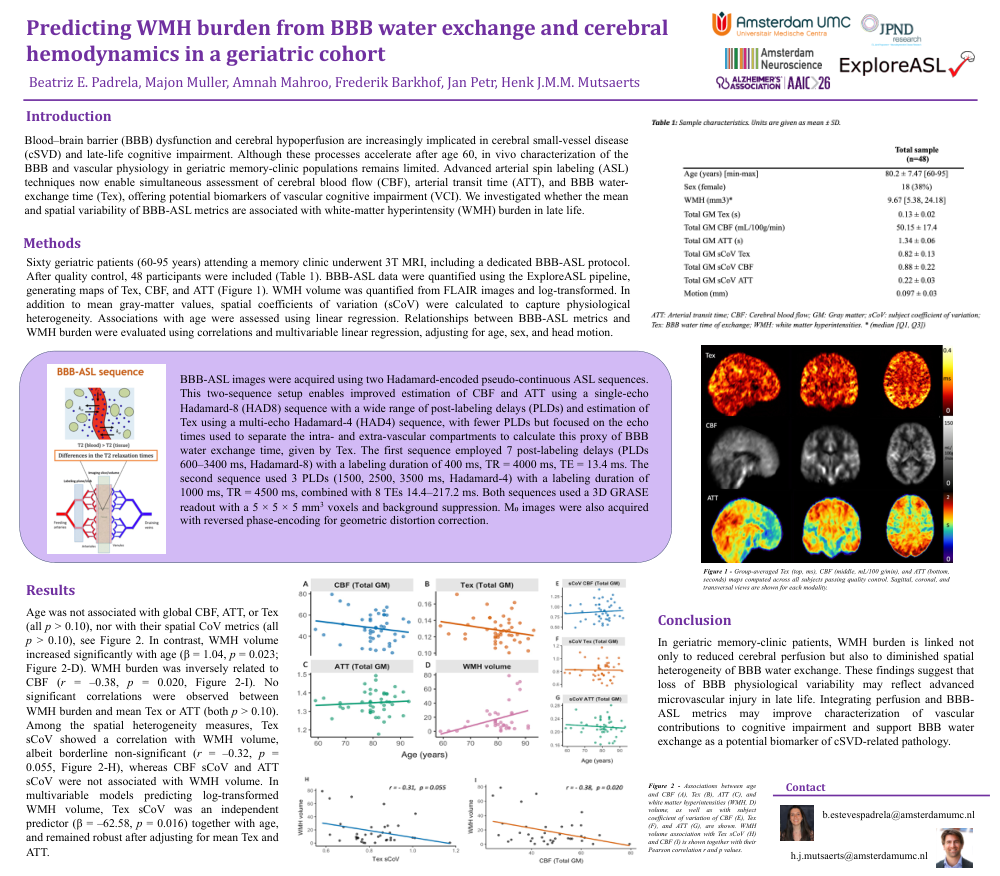
Sixty geriatric patients (60-95 years) attending a memory clinic underwent 3T MRI, including a dedicated BBB-ASL protocol. After quality control, 48 participants were included (Table 1). BBB-ASL data were quantified using the ExploreASL pipeline, generating maps of Tex, CBF, and ATT (Figure 1). WMH volume was quantified from FLAIR images and log-transformed. In addition to mean gray-matter values, spatial coefficients of variation (sCoV) were calculated to capture physiological heterogeneity. Associations with age were assessed using linear regression. Relationships between BBB-ASL metrics and WMH burden were evaluated using correlations and multivariable linear regression, adjusting for age, sex, and head motion.
BBB-ASL images were acquired using two Hadamard-encoded pseudo-continuous ASL sequences. This two-sequence setup enables improved estimation of CBF and ATT using a single-echo Hadamard-8 (HAD8) sequence with a wide range of post-labeling delays (PLDs) and estimation of Tex using a multi-echo Hadamard-4 (HAD4) sequence, with fewer PLDs but focused on the echo times used to separate the intra- and extra-vascular compartments to calculate this proxy of BBB water exchange time, given by Tex. The first sequence employed 7 post-labeling delays (PLDs 600–3400 ms, Hadamard-8) with a labeling duration of 400 ms, TR = 4000 ms, TE = 13.4 ms. The second sequence used 3 PLDs (1500, 2500, 3500 ms, Hadamard-4) with a labeling duration of 1000 ms, TR = 4500 ms, combined with 8 TEs 14.4–217.2 ms. Both sequences used a 3D GRASE readout with a 5 × 5 × 5 mm3 voxels and background suppression. M₀ images were also acquired with reversed phase-encoding for geometric distortion correction.
Results:
Age was not associated with global CBF, ATT, or Tex (all p > 0.10), nor with their spatial CoV metrics (all p > 0.10), see Figure 2. In contrast, WMH volume increased significantly with age (β = 1.04, p = 0.023; Figure 2-D). WMH burden was inversely related to CBF (r = –0.38, p = 0.020, Figure 2-I). No significant correlations were observed between WMH burden and mean Tex or ATT (both p > 0.10). Among the spatial heterogeneity measures, Tex sCoV showed a correlation with WMH volume, albeit borderline non-significant (r = –0.32, p = 0.055, Figure 2-H), whereas CBF sCoV and ATT sCoV were not associated with WMH volume. In multivariable models predicting log-transformed WMH volume, Tex sCoV was an independent predictor (β = –62.58, p = 0.016) together with age, and remained robust after adjusting for mean Tex and ATT.
Conclusion:
In geriatric memory-clinic patients, WMH burden is linked not only to reduced cerebral perfusion but also to diminished spatial heterogeneity of BBB water exchange. These findings suggest that loss of BBB physiological variability may reflect advanced microvascular injury in late life. Integrating perfusion and BBB-ASL metrics may improve characterization of vascular contributions to cognitive impairment and support BBB water exchange as a potential biomarker of cSVD-related pathology.
Comments
Email is required but is not shown publicly.
Loading comments...