4,068 posters, 219 videos, 101 topics, 69 sessions, 14,365 authors, 6,128 institutions
ePostersLive by SciGen Technologies S.A. All rights reserved.
Alzheimer's Association International Conference 2026
July 12-15, 2026 | London, United Kingdom, and Online

10219
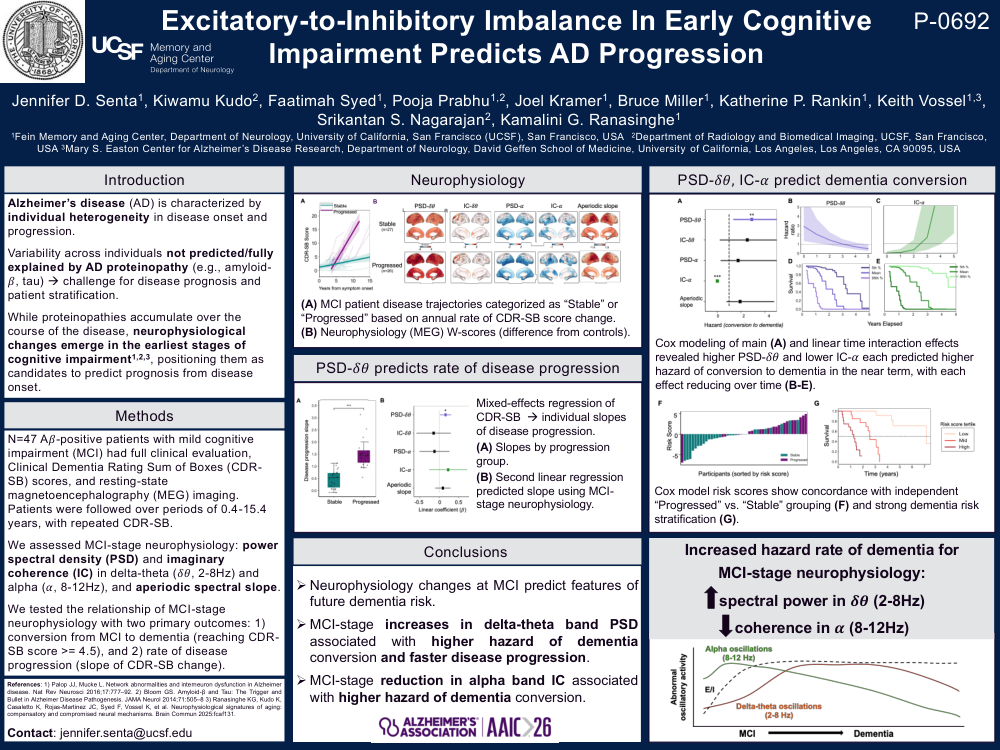
Excitatory-to-inhibitory Imbalance In Early Cognitive Impairment Predicts AD Progression
Poster Presenter
Authors
Jennifer Senta, Kiwamu Kudo, Faatimah Syed, Pooja Prabhu, Joel Kramer, Bruce Miller, Katherine Rankin, Keith Vossel, Srikantan Nagarajan, Kamalini Ranasinghe
Affiliations
Fein Memory and Aging Center, Department of Neurology, University of California, San Francisco (UCSF), San Francisco, USA, Department of Radiology and Biomedical Imaging, UCSF, San Francisco, USA, Fein Memory and Aging Center, Department of Neurology, University of California, San Francisco (UCSF), San Francisco, USA, Fein Memory and Aging Center, Department of Neurology, University of California, San Francisco (UCSF), San Francisco, USA, Fein Memory and Aging Center, Department of Neurology, University of California, San Francisco (UCSF), San Francisco, USA, Mary S. Easton Center for Alzheimer’s Disease Research, Department of Neurology, David Geffen School of Medicine, University of California, Los Angeles, Los Angeles, CA 90095, USA
Part of Topic
Alzheimer’s disease (AD) is characterized by individual heterogeneity in disease onset and progression.
Variability across individuals not predicted/fully explained by AD proteinopathy (e.g., amyloid-β, tau) -> challenge for disease prognosis and patient stratification.
While proteinopathies accumulate over the course of the disease, neurophysiological changes emerge in the earliest stages of cognitive impairment, positioning them as candidates to predict prognosis from disease onset.
Comments
Email is required but is not shown publicly.
Loading comments...