4,068 posters, 219 videos, 101 topics, 69 sessions, 14,365 authors, 6,128 institutions
ePostersLive by SciGen Technologies S.A. All rights reserved.
Alzheimer's Association International Conference 2026
July 12-15, 2026 | London, United Kingdom, and Online

3858
Multimodal Neuroimaging Biomarkers Of Vascular Contributions To Cognitive Aging In Women With Coronary Microvascular Dysfunction
Poster Presenter
Authors
Part of Topic
Background
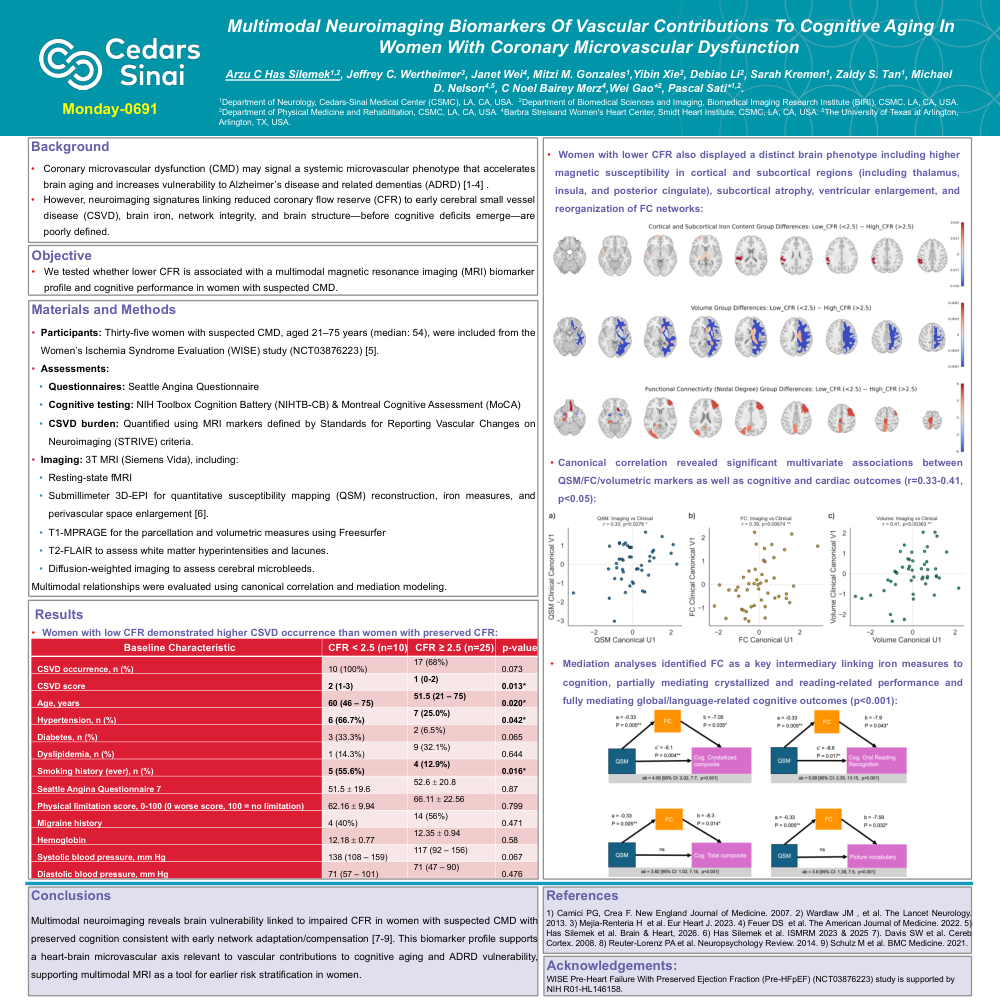
Coronary microvascular dysfunction (CMD) may signal a systemic microvascular phenotype that accelerates brain aging and increases vulnerability to Alzheimer’s disease and related dementias (ADRD). However, neuroimaging signatures linking reduced coronary flow reserve (CFR) to early cerebral small vessel disease (CSVD), brain iron, network integrity, and brain structure—before cognitive deficits emerge—are poorly defined.
Objective
We tested whether lower CFR is associated with a multimodal magnetic resonance imaging (MRI) biomarker profile and cognitive performance in women with suspected CMD.
Materials and Methods
Thirty-five women with suspected CMD, aged 21–75 years (median: 54), were included from the Women’s Ischemia Syndrome Evaluation (WISE) study (NCT03876223). Assessments included the Seattle Angina Questionnaire, NIH Toolbox Cognition Battery, and Montreal Cognitive Assessment. CSVD burden was quantified using STRIVE-defined MRI markers. Brain MRI was performed at 3T and included resting-state fMRI, submillimeter 3D-EPI for QSM reconstruction/iron measures/perivascular space enlargement, T1-MPRAGE for FreeSurfer-based parcellation and volumetrics, T2-FLAIR for white matter hyperintensities and lacunes, and diffusion-weighted imaging for cerebral microbleeds. Multimodal relationships were evaluated using canonical correlation and mediation modeling.
Results
Women with low CFR demonstrated higher CSVD occurrence and higher CSVD burden than women with preserved CFR. Lower CFR was also associated with a distinct brain phenotype, including higher magnetic susceptibility in cortical and subcortical regions, subcortical atrophy, ventricular enlargement, and functional connectivity network reorganization. Canonical correlation revealed significant multivariate associations between QSM, functional connectivity, and volumetric markers, as well as cognitive and cardiac outcomes. Mediation analyses identified functional connectivity as a key intermediary linking iron measures to cognition.
Conclusions
Multimodal neuroimaging revealed a brain vulnerability profile associated with impaired CFR in women with suspected CMD, despite preserved cognition. These findings support a heart–brain microvascular axis relevant to vascular contributions to cognitive aging and ADRD vulnerability and suggest that multimodal MRI may aid earlier risk stratification in women.
Comments
Email is required but is not shown publicly.
Loading comments...