4,068 posters, 219 videos, 101 topics, 69 sessions, 14,365 authors, 6,128 institutions
ePostersLive by SciGen Technologies S.A. All rights reserved.
Alzheimer's Association International Conference 2026
July 12-15, 2026 | London, United Kingdom, and Online

10178
Characterizing Early Structural Mri Signatures Of Prodromal Dementia With Lewy Bodies: Preliminary Voxel-based Morphometry Findings
Poster Presenter
Authors
Desirée Conti, Giulia Zazzaro, Massimiliano Panigutti, Giulia Bechi Gabrielli, Marco Serrentino, Micaela Sepe Monti, Giuseppina Talarico, Marco Canevelli, Giuseppe Bruno, Gaspare Galati, Fabrizia D'Antonio
Affiliations
a. Cognitive and Motor Rehabilitation and Neuroimaging Unit, IRCCS Santa Lucia Foundation, Rome, Italy; b. Department of Psychology, Sapienza University of Rome, Rome, Italy; c. PhD Program in Behavioral Neuroscience, Sapienza University of Rome, Rome, Italy, a. Cognitive and Motor Rehabilitation and Neuroimaging Unit, IRCCS Santa Lucia Foundation, Rome, Italy; b. Department of Psychology, Sapienza University of Rome, Rome, Italy, d. Department of Human Neuroscience, Sapienza University of Rome, Rome, Italy; e. Giustino Fortunato University, Benevento, Italy, d. Department of Human Neuroscience, Sapienza University of Rome, Rome, Italy, a. Cognitive and Motor Rehabilitation and Neuroimaging Unit, IRCCS Santa Lucia Foundation, Rome, Italy
Part of Topic
Characterizing early structural MRI signatures of prodromal dementia with Lewy bodies: preliminary Voxel-based morphometry findings
Background. Prodromal dementia with Lewy bodies (pro-DLB) has recently emerged as a critical target for early diagnosis and preventive strategies in neurodegenerative disorders. Despite growing interest, the identification of robust neuroimaging biomarkers at this stage remains challenging, particularly considering the clinical heterogeneity of the disease. Pro-DLB may present with different phenotypical onsets, most commonly mild cognitive impairment (MCI-DLB) or predominant psychiatric symptoms (PSY), whose neurobiological substrates are still poorly understood. The present ongoing study aims to: I. characterize gray matter (GM) alterations associated with pro-DLB compared with healthy aging and prodromal Alzheimer’s disease (MCI-AD), and II. clarify whether distinct patterns of brain atrophy differentiate the main phenotypical onsets of pro-DLB.
Methods. We enrolled 54 patients, including 20 MCI-DLB, 15 PSY, and 20 MCI-AD patients, along with 16 healthy controls (HC). All participants underwent comprehensive structural and functional MRI acquisition. A preliminary voxel-based morphometry (VBM) analysis was conducted using CAT12 implemented in SPM12. Group differences in gray matter volume (GMV) were assessed using a one-way ANOVA, comparing pro-DLB subgroups, MCI-AD, and HC.
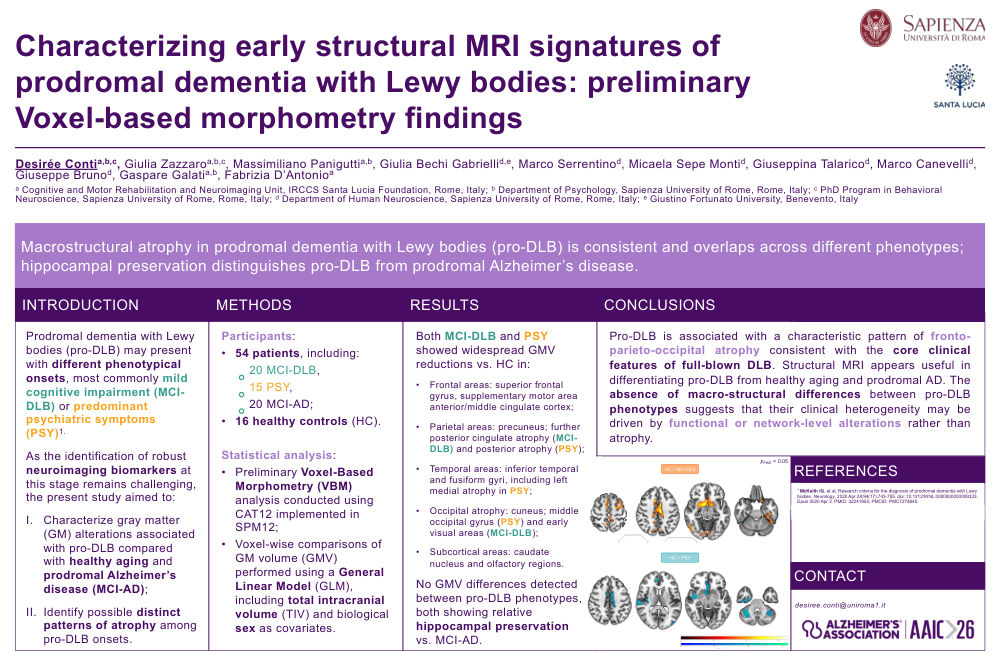
Results. Relative to HC, both MCI-DLB and PSY patients showed widespread GMV reductions involving frontal, parietal, and occipital regions. Frontal atrophy encompassed the superior frontal gyrus, supplementary motor area, and anterior/middle cingulate cortex. Parietal involvement included the precuneus, with additional posterior parietal atrophy in PSY patients and posterior cingulate involvement in MCI-DLB. Temporal GMV reductions were mainly confined to inferior temporal and fusiform gyri, although PSY patients also exhibited left medial temporal involvement. Occipital atrophy affected the cuneus, extending to early visual cortices in MCI-DLB and to the middle occipital gyrus in PSY. Subcortical GM loss involved the caudate nucleus and olfactory regions. No significant GMV differences were detected between pro-DLB phenotypes, both showing relative hippocampal preservation compared with MCI-AD.
Conclusions. Pro-DLB is associated with a characteristic pattern of fronto-parieto-occipital atrophy consistent with the core clinical features of full-blown DLB. Structural MRI appears useful in differentiating pro-DLB from healthy aging and prodromal AD. The absence of macro-structural differences between pro-DLB phenotypes suggests that their clinical heterogeneity may be driven by functional or network-level alterations rather than atrophy.
Comments
Email is required but is not shown publicly.
Loading comments...