4,068 posters, 219 videos, 101 topics, 69 sessions, 14,365 authors, 6,128 institutions
ePostersLive by SciGen Technologies S.A. All rights reserved.
Alzheimer's Association International Conference 2026
July 12-15, 2026 | London, United Kingdom, and Online

4591
Rationale And Design Of Predictom Advanced Mri Protocol
Poster Presenter
Authors
Ana Beatriz Solana, Brice Fernandez, David J Lythgoe, Fernando O Zelaya, Steve CR Williams, David Shin, Dan Rettman, Florian Wiesinger, Jose de Arcos, Suchandrima banergee, PREDICTOM Consortium
Affiliations
GE HealthCare, Munich, Germany, GE HealthCare, Buc, France, King's College London, London, UK, GE HealthCare, Menlo Park, CA, USA, GE HealthCare, Rochester, MN, USA, GE HealthCare, Valencia, Spain, predictom.eu
Part of Topic
Background
The PREDICTOM project (Prediction of Neurodegenerative Disease using an AI-driven Screening Platform, www.predictom.eu) is an EU-funded initiative aimed at developing novel biomarkers to identify individuals at high risk of Alzheimer’s disease (AD)¹. This work describes the rationale and design of an advanced MRI protocol implemented at four of seven PREDICTOM clinical centers, complementing the harmonized state-of-the-art protocol².
Methods
The study will acquire MRI data from 615 participants (target ratio: 80% higher risk / 20% lower risk), all healthy and aged ≥50 years. Seven European centers equipped with 3T scanners from two vendors and six models will collect harmonized state-of-the-art MRI data².
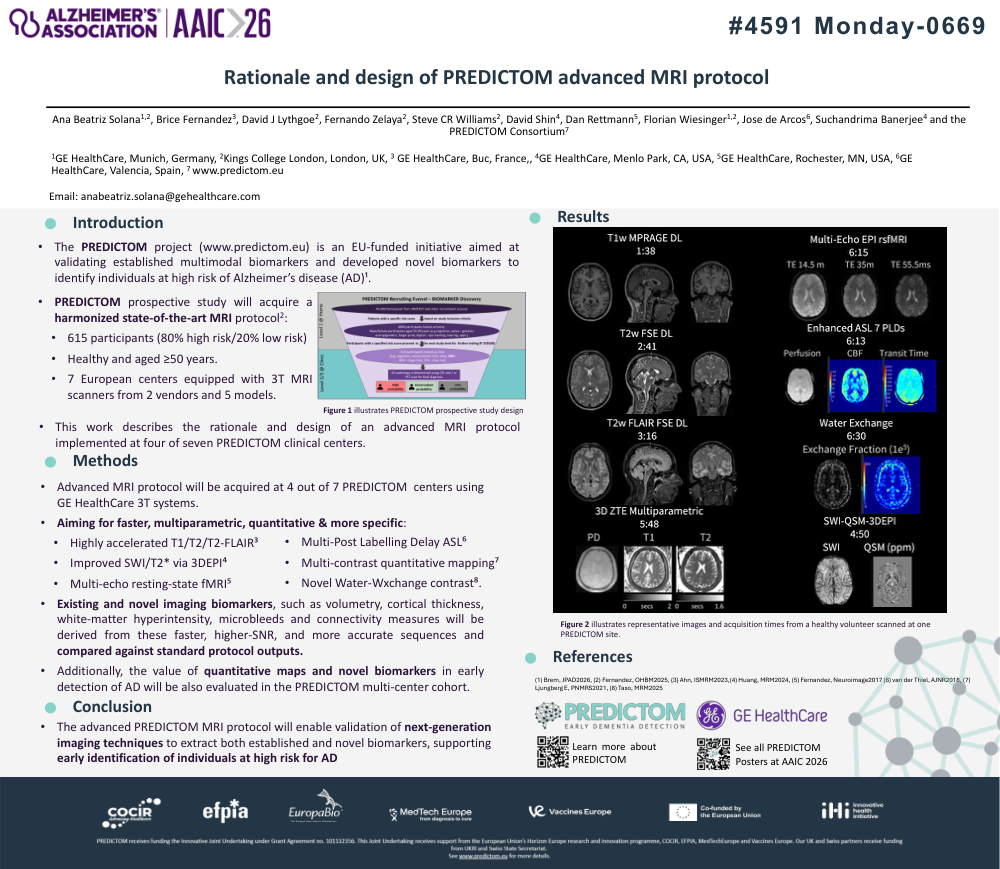
In addition, four centers using GE HealthCare 3T systems will implement an advanced MRI protocol evolving from conventional sequences (T1, T2, T2-FLAIR, SWI/T2*, DWI) and advanced scans (resting-state fMRI, ASL, MRS) to a next-generation workflow featuring: Highly accelerated T1/T2/T2-FLAIR with deep-learning reconstruction³, improved SWI/T2 via 3D EPI⁴*, multi-echo resting-state fMRI⁵, enhanced ASL with seven PLDs⁶, multi-contrast quantitative mapping⁷ and a novel water-exchange contrast⁸.
Results
Figure 1 illustrates representative images and acquisition times from a healthy volunteer scanned at a PREDICTOM site. Existing and novel imaging biomarkers, such as volumetry, cortical thickness, white-matter hyperintensity, microbleeds or connectivity measures will be derived from these faster, higher-SNR, and more accurate sequences and compared against standard protocol outputs. Additionally, the value of quantitative maps and novel biomarkers in early detection of AD will be also evaluated in the PREDICTOM multi-center cohort.
Conclusion
The advanced PREDICTOM MRI protocol enables validation of next-generation imaging techniques to extract both established and novel biomarkers, supporting early identification of individuals at high risk for AD
(1) Brem, AAIC2024, (2) Fernandez, OHBM2025, {3} Ahn, ISMRM2023,(4) Huang, MRM2024, (5) Fernandez, Neuroimage2017 (6) van der Thiel, AJNR2018, (7) Ljungberg E, PNMRS2021, (8) Taso, MRM2025
Keywords: MRI, early detection, Alzheimer’s Disease
Learning Objective: Towards next generation MRI protocols for early AD prediction
Comments
Email is required but is not shown publicly.
Loading comments...