4,068 posters, 219 videos, 101 topics, 69 sessions, 14,365 authors, 6,128 institutions
ePostersLive by SciGen Technologies S.A. All rights reserved.
Alzheimer's Association International Conference 2026
July 12-15, 2026 | London, United Kingdom, and Online

9046
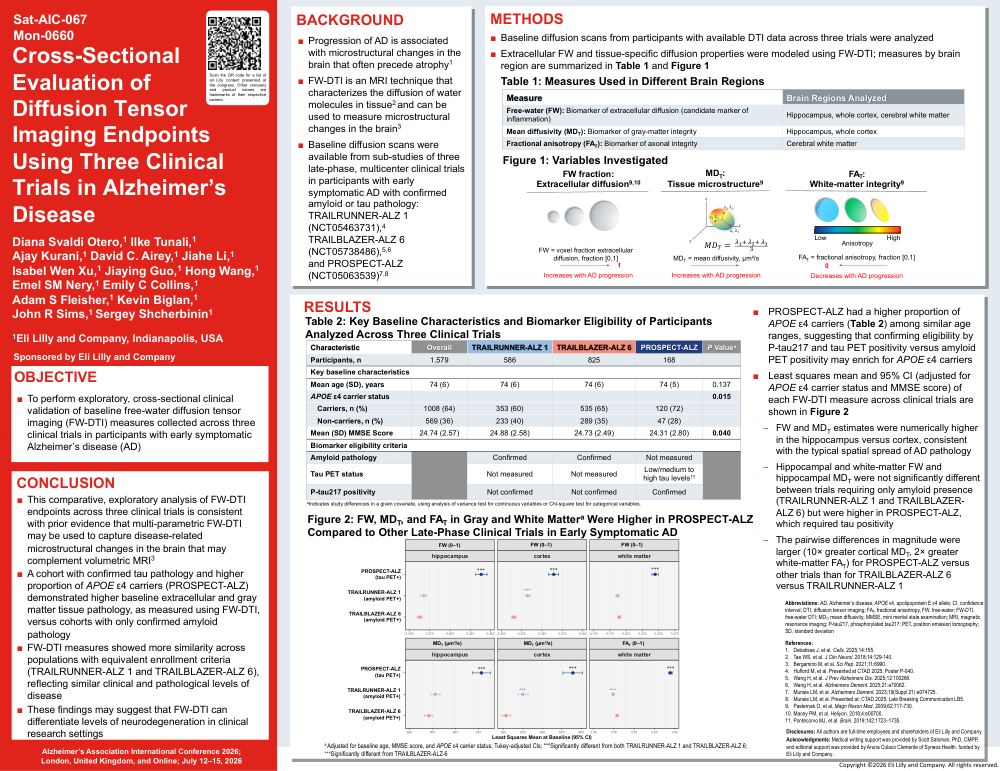
Cross-sectional Evaluation Of Diffusion Tensor Imaging Endpoints Using Three Clinical Trials In Alzheimer’S Disease
Poster Presenter
Authors
Diana Otero, Ilke Tunali, Ajay Kurani, David Aurey, Jiahe Li, Isabel Xu, Jiaying Guo, Hong Wang, Emel Nery, Emily Collins, Adam Fleisher, Kevin Biglan, John Sims, Sergey Shcherbinin
Affiliations
Part of Topic
Cross-Sectional Evaluation of Diffusion Tensor Imaging Endpoints Using Three Clinical Trials in Alzheimer’s Disease
Diana Svaldi Otero,1 Ilke Tunali,1 Ajay Kurani,1 David C. Airey,1 Jiahe Li,1 Isabel Wen Xu,1 Jiaying Guo,1 Hong Wang,1 Emel SM Nery,1 Emily C Collins,1 Adam S Fleisher,1 Kevin Biglan,1 John R Sims,1 Sergey Shcherbinin1
1Eli Lilly and Company, Indianapolis, USA
Sponsored by Eli Lilly and Company
OBJECTIVE
BACKGROUND
Progression of AD is associated with microstructural changes in the brain that often precede atrophy1
FW-DTI is an MRI technique that characterizes the diffusion of water molecules in tissue2 and can be used to measure microstructural changes in the brain3
Baseline diffusion scans were available from sub-studies of three late-phase, multicenter clinical trials in participants with early symptomatic AD with confirmed amyloid or tau pathology:
TRAILRUNNER-ALZ 1 (NCT05463731),4
TRAILBLAZER-ALZ 6 (NCT05738486),5,6
and PROSPECT-ALZ (NCT05063539)7,8
METHODS
Baseline diffusion scans from participants with available DTI data across three trials were analyzed
Extracellular FW and tissue-specific diffusion properties were modeled using FW-DTI; measures by brain region are summarized in Table 1 and Figure 1
Table 1: Measures Used in Different Brain Regions
Figure 1: Variables Investigated
RESULTS
Table 2: Key Baseline Characteristics and Biomarker Eligibility of Participants Analyzed Across Three Clinical Trials
Figure 2: FW, MDT, and FAT in Gray and White Mattera Were Higher in PROSPECT-ALZ Compared to Other Late-Phase Clinical Trials in Early Symptomatic AD
PROSPECT-ALZ had a higher proportion of APOE ε4 carriers (Table 2) among similar age ranges, suggesting that confirming eligibility by P-tau217 and tau PET positivity versus amyloid PET positivity may enrich for APOE ε4 carriers
Least squares mean and 95% CI (adjusted for APOE ε4 carrier status and MMSE score) of each FW-DTI measure across clinical trials are shown in Figure 2
FW and MDT estimates were numerically higher in the hippocampus versus cortex, consistent with the typical spatial spread of AD pathology
Hippocampal and white-matter FW and hippocampal MDT were not significantly different between trials requiring only amyloid presence (TRAILRUNNER-ALZ 1 and TRAILBLAZER-ALZ 6) but were higher in PROSPECT-ALZ, which required tau positivity
The pairwise differences in magnitude were larger (10× greater cortical MDT, 2× greater white-matter FAT) for PROSPECT-ALZ versus other trials than for TRAILBLAZER-ALZ 6 versus TRAILRUNNER-ALZ 1
CONCLUSION
Comments
Email is required but is not shown publicly.
Loading comments...