4,068 posters, 219 videos, 101 topics, 69 sessions, 14,365 authors, 6,128 institutions
ePostersLive by SciGen Technologies S.A. All rights reserved.
Alzheimer's Association International Conference 2026
July 12-15, 2026 | London, United Kingdom, and Online

8811
Associations Between Daytime Napping, Cognition And Imaging Measures Of Neurodegeneration: An Insight 46 Study
Poster Presenter
Authors
Meera Sonara, Josh King-Robson, Kirsty Lu, William Coath, David Cash, Ian Malone, Jonathan Schott
Affiliations
Dementia Research Centre, UCL Queen Square Institute of Neurology, University College London, London, UK, Dementia Research Centre, UCL Queen Square Institute of Neurology, University College London, London, UK; UK Dementia Research Institute, University College London, London, UK, Dementia Research Centre, UCL Queen Square Institute of Neurology, University College London, London, UK; UK Dementia Research Institute, University College London, London, UK, Department of Medicine, School of Medicine and Public Health, University of Wisconsin, USA
Part of Topic
Background: Daytime napping is increasingly common in later life and has been associated with neurodegenerative disease, however prior studies have reported mixed findings and associations with cognitive outcomes and brain pathology remain unclear. We examine whether daytime napping was associated with brain volume, hippocampal volume, amyloid status, and cognitive performance in a predominantly healthy older adult cohort.
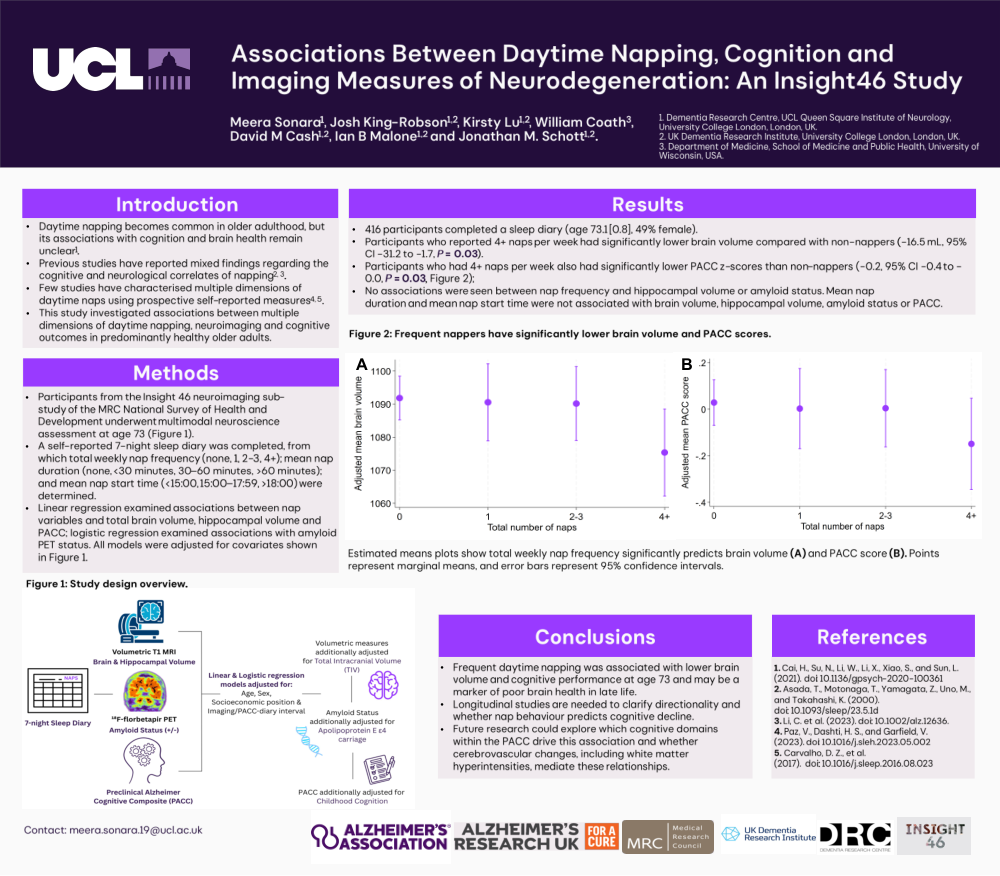
Methods: Participants from the Insight 46 neuroimaging sub-study of the MRC National Survey of Health and Development underwent multimodal neuroscience assessment at age 73. Participants completed a 7-night sleep diary, from which total weekly nap frequency (none, 1, 2-3, 4+); mean duration (none, <30 minutes, 30-60 minutes, >60 minutes); and mean start time (<15:00, 15:00-17:59, >18:00) were determined. Hippocampal and whole brain volume and amyloid status (positive/negative) were derived from volumetric T1 MRI, and 18 F-florbetapir amyloid-PET. Cognition was assessed using the Preclinical Alzheimer Cognitive Composite (PACC). Linear regression examined associations between nap variables and total brain volume, hippocampal volume and PACC. Logistic regression examined associations with amyloid PET status. All models were adjusted for age, sex, socioeconomic position and interval between imaging/PACC and sleep diary. We additionally adjusted volumetric measures for total intracranial volume, amyloid status for apolipoprotein E ε4 carriage, and PACC for childhood cognition.
Results: 416 participants completed a sleep diary, mean [SD] age 73.1 [0.8], 49% female (Table 1). Participants who reported 4+ naps per week had significantly lower brain volume compared with non-nappers (-16.5 mL, 95% CI = -31.2 to −1.7, P = 0.03), and had significantly lower PACC z-scores than non-nappers (−0.2, 95% CI = −0.4 to -0.0, P = 0.03, Table 2, Figure 1); no associations were seen with hippocampal volume or amyloid status. Mean nap duration and mean nap start time were not associated with brain volume or amyloid status.
Conclusion: Frequent daytime napping was associated with lower brain volume and cognitive performance at age 73, and in late life, may be a marker of poor brain health. Longitudinal studies are needed to clarify directionality and whether nap behaviour predicts cognitive decline.
Comments
Email is required but is not shown publicly.
Loading comments...