4,068 posters, 219 videos, 101 topics, 69 sessions, 14,365 authors, 6,128 institutions
ePostersLive by SciGen Technologies S.A. All rights reserved.
Alzheimer's Association International Conference 2026
July 12-15, 2026 | London, United Kingdom, and Online

6500
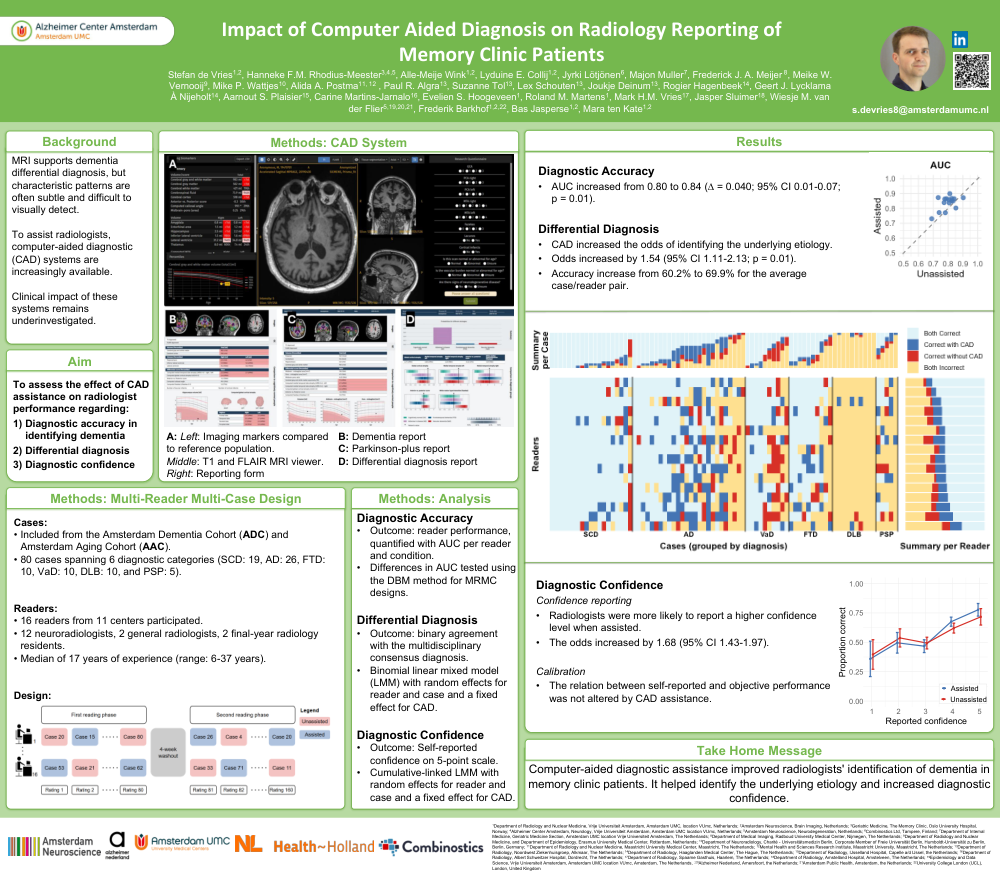
Clinical Impact Of Computer Aided MRI Diagnosis For Patients Suspected Of Dementia
Poster Presenter
Authors
Stefan de Vries, Hanneke Rhodius-Meester, Alle-Meije Wink, Lyduine Collij, Jyrki Lötjönen, Majon Muller, Wiesje van der Flier, Frederik Barkhof, Bas Jasperse, Mara ten Kate
Affiliations
Department of Radiology and Nuclear Medicine, Vrije Universiteit Amsterdam, Amsterdam UMC, location VUmc, Netherlands; Amsterdam Neuroscience, Brain Imaging, Netherlands, 3Geriatric Medicine, The Memory Clinic, Oslo University Hospital, Norway; Alzheimer Center Amsterdam, Neurology, Vrije Universiteit Amsterdam, Amsterdam UMC location VUmc, Netherlands; Amsterdam Neuroscience, Neurodegeneration, Netherlands,, Combinostics Ltd, Tampere, Finland, Department of Internal Medicine, Geriatric Medicine Section, Amsterdam UMC location Vrije Universiteit Amsterdam, The Netherlands, Amsterdam Neuroscience, Neurodegeneration, Netherlands; Epidemiology and Data Science, Vrije Universiteit Amsterdam, Amsterdam UMC location VUmc, Amsterdam, The Netherlands; Alzheimer Nederland, Amersfoort, the Netherlands; Amsterdam Public Health, Amsterdam, the Netherlands, Department of Radiology and Nuclear Medicine, Vrije Universiteit Amsterdam, Amsterdam UMC, location VUmc, Netherlands; Amsterdam Neuroscience, Brain Imaging, Netherlands; University College London (UCL), London, United Kingdom
Part of Topic
Background:
MRI supports dementia differential diagnosis, but characteristic patterns are often subtle and difficult to visually detect.
To assist radiologists, computer-aided diagnostic (CAD) systems are increasingly available.
Clinical impact of these systems remains underinvestigated.
Aim:
To assess the effect of CAD assistance on radiologist performance regarding:
Cases:
Readers:
Analysis:
Diagnostic Accuracy
Differential Diagnosis
Diagnostic Confidence
Diagnostic Accuracy
Differential Diagnosis
Diagnostic Confidence
Confidence reporting
Calibration
Computer-aided diagnostic assistance improved radiologists' identification of dementia in memory clinic patients. It helped identify the underlying etiology and increased diagnostic confidence.
Comments
Email is required but is not shown publicly.
Loading comments...