Loading...

4,068 posters, 219 videos, 101 topics, 69 sessions, 14,365 authors, 6,128 institutions

ePostersLive by SciGen Technologies S.A. All rights reserved.

Alzheimer's Association International Conference 2026

July 12-15, 2026 | London, United Kingdom, and Online

Alzheimer's Association International Conference 2026 banner

5129

Predictors And Cognitive Consequences Of Regional White Matter Hyperintensity Volume And Progression In A British Population Cohort Study
Poster Presenter

Thomas Brown

Authors

Thomas Brown, Jennifer Nicholas, Sarah-Naomi James, Ian Malone, William Coath, Kirsty Lu, Meera Sonara, Anjali Raghavan, Rebecca Street, Heidi Murray-Smith, David Cash, Frederik Barkhof, Marcus Richards, Jonathan Schott, Carole Sudre, Josephine Barnes

Affiliations

Dementia Research Centre, Queen Square Institute of Neurology, University College London, London, UK, Department of Medical Statistics, London School of Hygiene and Tropical Medicine, London, UK, Dementia Research Centre, Queen Square Institute of Neurology, University College London, London, UK; Unit for Lifelong Health and Ageing, Department of Population Science and Experimental Medicine, University College London, London, UK, Dementia Research Centre, Queen Square Institute of Neurology, University College London, London, UK; School of Medicine and Public Health, University of Wisconsin-Madison, Madison, USA, Dementia Research Centre, Queen Square Institute of Neurology, University College London, London, UK; UK Dementia Research Institute at UCL, University College London, London, UK, Dementia Research Centre, Queen Square Institute of Neurology, University College London, London, UK; Department of Radiology & Nuclear Medicine, Amsterdam UMC, Vrije Universiteit, the Netherlands; Hawkes Institute, Department of Medical Physics and Biomedical Engineering, University College London, London, UK, Unit for Lifelong Health and Ageing, Department of Population Science and Experimental Medicine, University College London, London, UK, Dementia Research Centre, Queen Square Institute of Neurology, University College London, London, UK; Unit for Lifelong Health and Ageing, Department of Population Science and Experimental Medicine, University College London, London, UK; Hawkes Institute, Department of Medical Physics and Biomedical Engineering, University College London, London, UK; School of Biomedical Engineering and Imaging Sciences, King's College London, London, UK

Part of Topic

Predictors and Cognitive Consequences of Regional White Matter Hyperintensity Volume and Progression in a British Population Cohort Study


Background: 

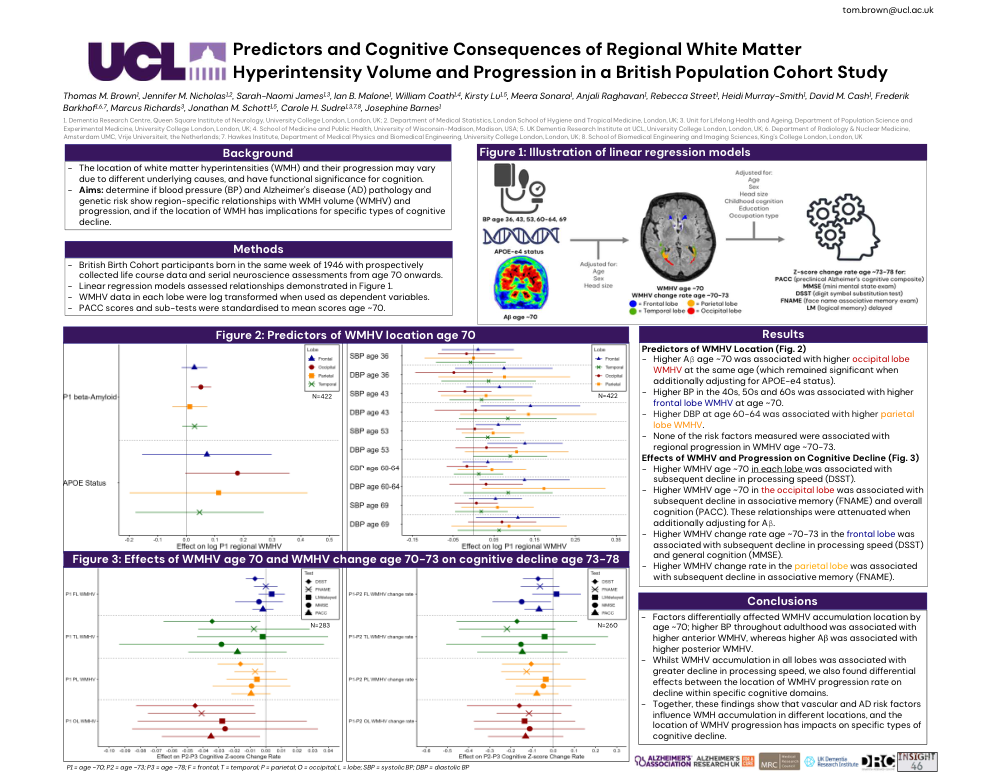
-The location of white matter hyperintensities (WMH) and their progression may vary due to different underlying causes, and have functional significance for cognition.
-Aims: determine if blood pressure (BP) and Alzheimer’s disease (AD) pathology and genetic risk show region-specific relationships with WMH volume (WMHV) and progression, and if the location of WMH has implications for specific types of cognitive decline.
 
Methods: 
-British Birth Cohort participants born in the same week of 1946 with prospectively collected life course data and serial neuroscience assessments from age 70 onwards.
-Linear regression models assessed relationships demonstrated in Figure 1.
-WMHV data in each lobe were log transformed when used as dependent variables.
-PACC scores and sub-tests were standardised to mean scores age ~70.
 
Results:

Predictors of WMHV Location (Fig. 2)

-Higher Aβ age ~70 was associated with higher occipital lobe WMHV at the same age (which remained significant when additionally adjusting for APOE-e4 status).
-Higher BP in the 40s, 50s and 60s was associated with higher frontal lobe WMHV at age ~70.
-Higher DBP at age 60-64 was associated with higher parietal lobe WMHV.
-None of the risk factors measured were associated with regional progression in WMHV age ~70-73.

Effects of WMHV and Progression on Cognitive Decline (Fig. 3)

-Higher WMHV age ~70 in each lobe was associated with subsequent decline in processing speed (DSST).
-Higher WMHV age ~70 in the occipital lobe was associated with subsequent decline in associative memory (FNAME) and overall cognition (PACC). These relationships were attenuated when additionally adjusting for Aβ.
-Higher WMHV change rate age ~70-73 in the frontal lobe was associated with subsequent decline in processing speed (DSST) and general cognition (MMSE).
-Higher WMHV change rate in the parietal lobe was associated with subsequent decline in associative memory (FNAME).
 
Conclusions:
-Factors differentially affected WMHV accumulation location by age ~70; higher BP throughout adulthood was associated with higher anterior WMHV, whereas higher Aβ was associated with higher posterior WMHV.
-Whilst WMHV accumulation in all lobes was associated with greater decline in processing speed, we also found differential effects between the location of WMHV progression rate on decline within specific cognitive domains.
-Together, these findings show that vascular and AD risk factors influence WMH accumulation in different locations, and the location of WMHV progression has impacts on specific types of cognitive decline.

Comments

Email is required but is not shown publicly.

Loading comments...

aaic2026 banner
Copyright © 2015-2026, ePostersLive® SciGen is a registered trademark of SciGen Technologies S.A. Patent pending.

This website and third-party tools we use rely on cookies for the best user experience. By selecting "I agree", you agree to cookie usage as described in our Privacy Policy.