4,068 posters, 219 videos, 101 topics, 69 sessions, 14,365 authors, 6,128 institutions
ePostersLive by SciGen Technologies S.A. All rights reserved.
Alzheimer's Association International Conference 2026
July 12-15, 2026 | London, United Kingdom, and Online

6041
Cerebrovascular Deficits And Cognitive Impairment In Elderly Patients With Long Covid
Poster Presenter
Authors
Bria Fiebiger, Athena Ye, Kelly Ristow, Alexander Cohen, Halle Berres, Laura Umfleet, Sara Swanson, Malgorzata Franczak, Yang Wang
Affiliations
null,
Part of Topic
Older adults with Long COVID commonly exhibit persistent cognitive deficits in attention, working memory, and processing speed1
Cognitive profiles overlap with vascular cognitive impairment and prodromal dementia syndromes
Emerging evidence implicates cerebrovascular dysfunction (CBF/CVR) as a key pathophysiologic mechanism2,3
The network-level convergence of CBF and CVR abnormalities and their relationship to cognitive decline in aging populations remain poorly characterized4
Participants
Cross-sectional study of adults aged ≥50 years with Long COVID (met criteria with persistent symptoms ≥3 months post–confirmed infection) and healthy controls
Mean time since SARS-CoV-2 infection : 2.7 years
CBF cohort:
Long COVID (n = 60; mean age 60.1 ± 7.1 years; 90% female)
Controls (n = 79; mean age 62.0 ± 6.6 years; 78% female)
CVR cohort:
Long COVID (n = 72; mean age 60.9 ± 7.7 years; 79% female)
Controls (n = 61; mean age 62.1 ± 7.4 years; 66% female)
Measurement Techniques
Arterial spin labeling MRI (CBF)
Breath-hold fMRI (CVR)
Voxel-wise and network-level analyses
Standardized neuropsychological assessments
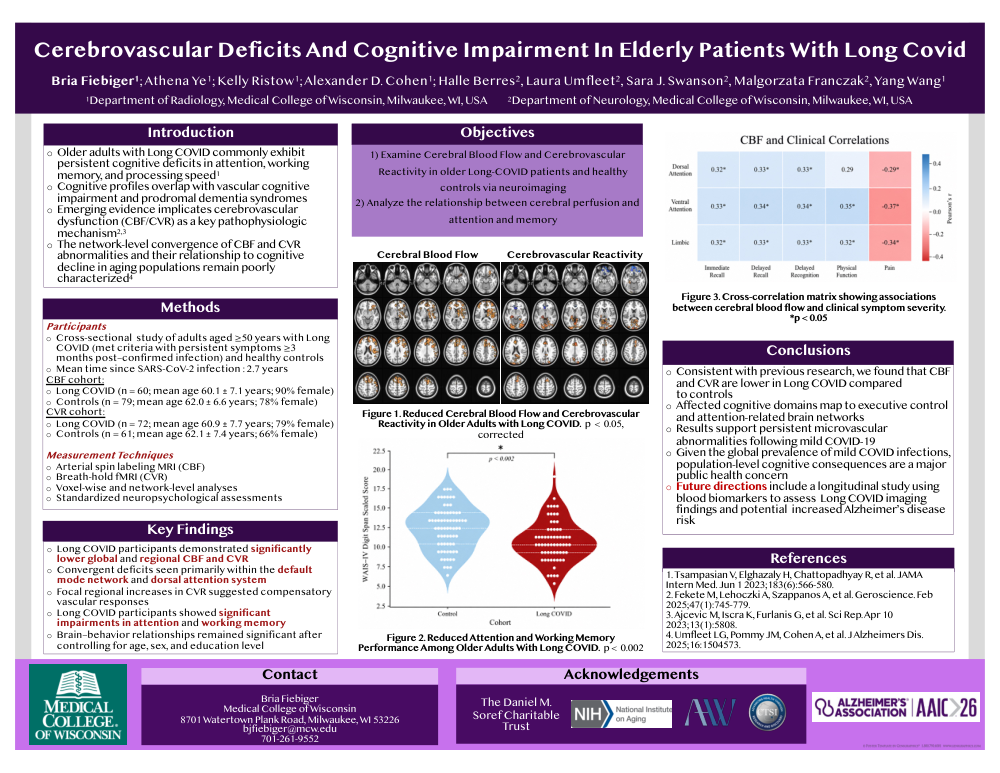
Long COVID participants demonstrated significantly lower global and regional CBF and CVR
Convergent deficits seen primarily within the default mode network and dorsal attention system
Focal regional increases in CVR suggested compensatory vascular responses
Long COVID participants showed significant impairments in attention and working memory
Brain–behavior relationships remained significant after controlling for age, sex, and education level
Consistent with previous research, we found that CBF and CVR are lower in Long COVID compared to controls
Affected cognitive domains map to executive control and attention-related brain networks
Results support persistent microvascular abnormalities following mild COVID-19
Given the global prevalence of mild COVID infections, population-level cognitive consequences are a major public health concern
Future directions include a longitudinal study using blood biomarkers to assess Long COVID imaging findings and potential increased Alzheimer’s disease risk
Comments
Email is required but is not shown publicly.
Loading comments...