4,068 posters, 219 videos, 101 topics, 69 sessions, 14,365 authors, 6,128 institutions
ePostersLive by SciGen Technologies S.A. All rights reserved.
Alzheimer's Association International Conference 2026
July 12-15, 2026 | London, United Kingdom, and Online

9788
Perceived Stress And Purpose In Life In Relation To Cognitive Performance And Functional Severity Among Persons With Dementia
Poster Presenter
Part of Topic
Perceived Stress and Purpose in Life in Relation to Cognitive Performance and Functional Severity among persons with dementia
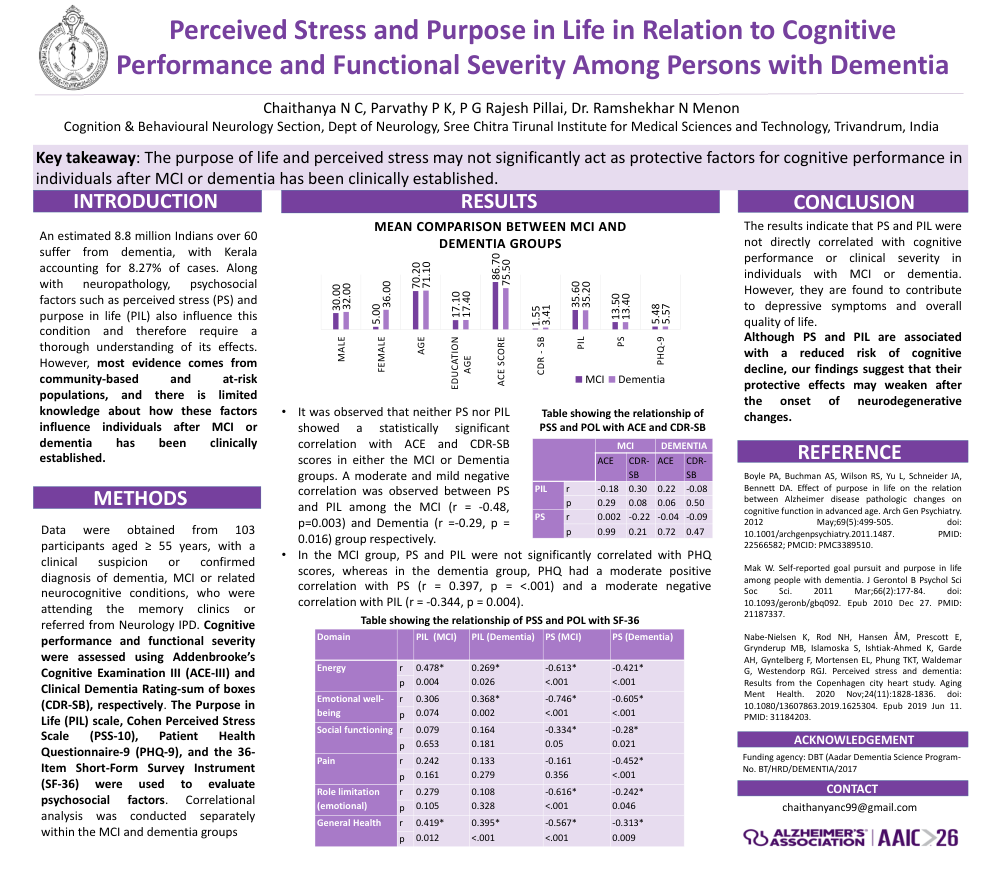
An estimated 8.8 million Indians over 60 suffer from dementia, with Kerala accounting for 8.27% of cases. Along with neuropathology, psychosocial factors such as perceived stress (PS) and purpose in life (PIL) also influence this condition and therefore require a thorough understanding of its effects.
Objective: To investigate the association of perceived stress and purpose in life with cognitive performance and functional severity in patients with MCI and dementia.
Method: Data were obtained from 103 participants aged ≥ 55 years, with a clinical suspicion or confirmed diagnosis of dementia, MCI or related neurocognitive conditions, who were attending the memory clinics or referred from Neurology IPD. Cognitive performance and functional severity were assessed using Addenbrooke’s Cognitive Examination III (ACE-III) and Clinical Dementia Rating-sum of boxes (CDR-SB), respectively. The Purpose in Life (PIL) scale, Cohen Perceived Stress Scale (PSS-10), Patient Health Questionnaire-9 (PHQ-9), and the 36-Item Short-Form Survey Instrument (SF-36) were used to evaluate psychosocial factors. Results were analysed using Jamovi 2.6.44.
Results: It was observed that neither PS nor PIL showed a statistically significant correlation with ACE and CDR-SB scores in either the MCI or Dementia groups. A moderate and mild negative correlation was observed between PS and PIL among the MCI (r = -0.48, p=0.003) and Dementia (r =-0.29, p = 0.016) groups, respectively. In the MCI group, PS and PIL were not significantly correlated with PHQ scores, whereas in the dementia group, PHQ had a moderate positive correlation with PS (r = 0.397, p = <.001) and a moderate negative correlation with PIL (r = -0.344, p = 0.004). PS displayed a negative correlation with domains of health related of quality of life among both MCI and dementia groups. Whereas, PIL showed a positive correlation with various SF-36 domains among both groups.
Conclusion: The results indicate that PS and PIL were not directly correlated with cognitive performance or clinical severity in individuals with MCI or dementia. However, they are found to contribute to depressive symptoms and overall quality of life.
Comments
Email is required but is not shown publicly.
Loading comments...