4,068 posters, 219 videos, 101 topics, 69 sessions, 14,365 authors, 6,128 institutions
ePostersLive by SciGen Technologies S.A. All rights reserved.
Alzheimer's Association International Conference 2026
July 12-15, 2026 | London, United Kingdom, and Online

8776
Physical Fitness And Its Relationship With Brain Age And Pace Of Aging: Findings From The Agueda And Heart-brain Trials
Poster Presenter
Authors
Javier Sanchez-Martinez, Patricio Solis-Urra, Angel Toval, Andrea Coca-Pulido, Kirk I. Erickson, Francisco B. Ortega, Irene Esteban-Cornejo
Affiliations
Faculty of Sport Sciences, Sport and Health University Research Institute (iMUDS), University of Granada, Granada, Spain., Neuroscience Institute Orlando, AdventHealth Research Institute, Orlando, FL, USA; Faculty of Education and Social Sciences, Andrés Bello University, Viña del Mar, Chile., Neuroscience Institute Orlando, AdventHealth Research Institute, Orlando, FL, USA; Department of Psychology, University of Pittsburgh, Pittsburgh, PA, USA., Faculty of Sport Sciences, Sport and Health University Research Institute (iMUDS), University of Granada, Granada, Spain; Centro de Investigación Biomédica en Red Fisiopatología de la Obesidad y Nutrición, Instituto de Salud Carlos III, Madrid, Spain., Faculty of Sport Sciences, Sport and Health University Research Institute (iMUDS), University of Granada, Granada, Spain; Instituto de Investigación Biosanitaria (ibs.GRANADA), Granada, Spain.
Part of Topic
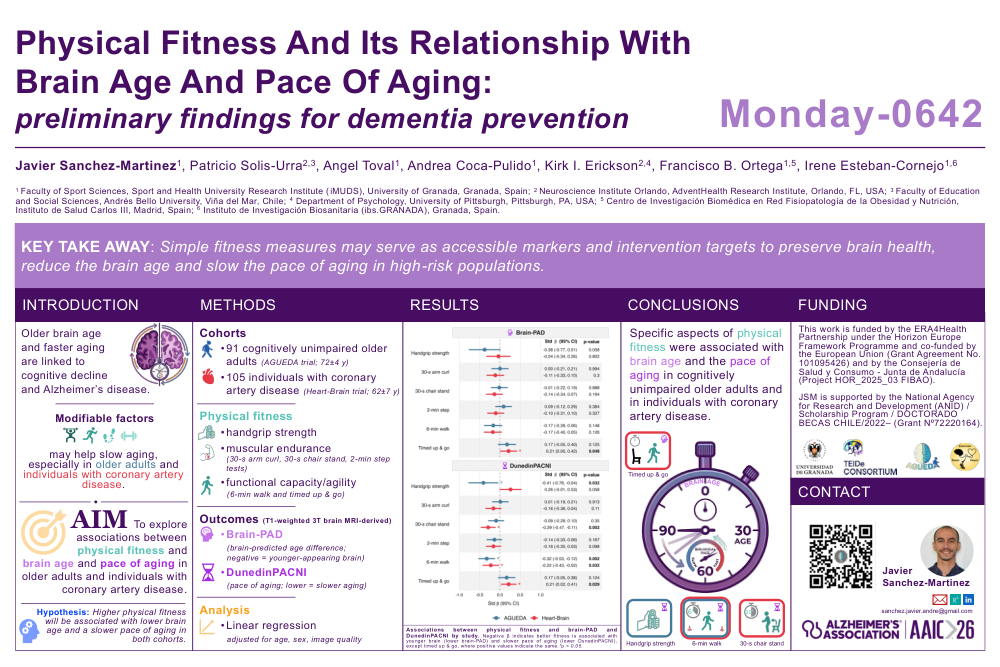
Title: Physical Fitness And Its Relationship With Brain Age And Pace Of Aging: preliminary findings for dementia prevention.
Background: Older brain age and a faster pace of aging are associated with cognitive decline and Alzheimer’s disease. Identifying modifiable factors, such as physical condition, related to these aging metrics may help identify interventions to slow aging and reduce cognitive decline, particularly in vulnerable populations such as older adults and individuals with coronary artery disease (CAD). We examined associations of physical fitness parameters with brain age and pace of aging in two different cohorts, older adults and individuals with CAD.
Methods: Baseline data were included from 91 cognitively unimpaired older adults from the AGUEDA trial (71.8 ± 3.9 years) and 105 individuals with CAD from the Heart-Brain trial (62.1 ± 6.6 years). Physical fitness was assessed using maximal handgrip strength, lower-body muscular endurance (30-s chair stand and 2-min step tests), upper-body muscular endurance (arm curl test), and functional capacity and agility (6-min walk and timed up & go [TUG] tests). T1-weighted 3T brain MRI scans were acquired. Brain-predicted age di"erence (brain-PAD), in which negative values indicate a brain that appears younger than its chronological age, and the Dunedin Pace of Aging Calculated from NeuroImaging (DunedinPACNI), in which lower scores indicate slower aging, were derived from T1-weighted images. Linear regression analyses were adjusted for age, sex, and image quality rating.
Results: Associations are illustrated in Figure 1. In older adults, no associations were found between physical fitness parameters and brain-PAD (standardized β = -0.38 to 0.17, p > 0.05), whereas greater handgrip strength and better 6-min walk performance were associated with lower DunedinPACNI (slower aging). In individuals with CAD, better TUG performance was associated with lower brain-PAD (younger brain age), and better performance on the 30-s chair stand, 6-min walk and TUG tests was linked to lower pace of aging.
Conclusion: Specific aspects of physical fitness were associated with brain age and the pace of aging in cognitively unimpaired older adults and in individuals with CAD. Clinically, simple fitness measures may serve as accessible markers and intervention targets to preserve brain health, and slow brain and global aging in high-risk populations.
Comments
Email is required but is not shown publicly.
Loading comments...