4,068 posters, 219 videos, 101 topics, 69 sessions, 14,365 authors, 6,128 institutions
ePostersLive by SciGen Technologies S.A. All rights reserved.
Alzheimer's Association International Conference 2026
July 12-15, 2026 | London, United Kingdom, and Online

10421
Physical Activity And Cognitive Function In Latino Adults In The U.S.: A Scoping Review Of Evidence, Disparities, And Research Gaps
Poster Presenter
Authors
Affiliations
Part of Topic
Physical Activity and Cognitive Function in Latino Adults in the U.S.: A Scoping Review of Evidence, Disparities, and Research Gaps
Diana Morales1, Christian Corral1, Manuel Muñoz II1, Yuliana Soto2, Jacqueline Guzman3, Susan Aguiñaga1
1University of Illinois Urbana Champaign, IL, USA
2University of Illinois Chicago
3Wisconsin Medical College, WI, USA
Abstract
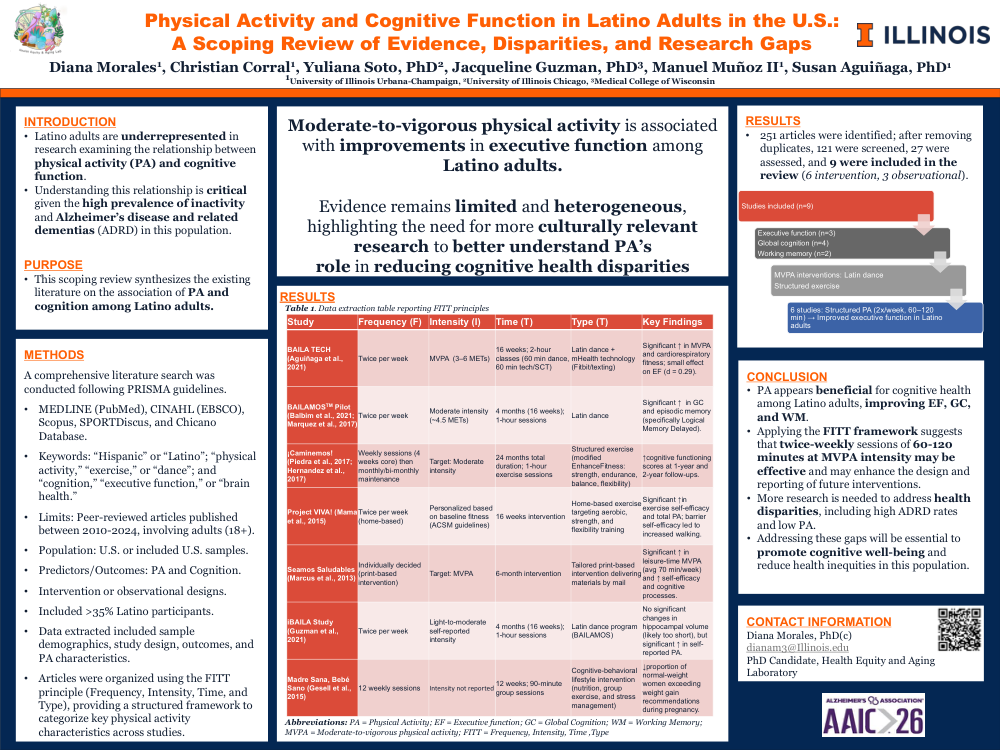
Background: Latino adults are underrepresented in research examining the relationship between physical activity (PA) and cognitive function. Understanding this relationship is critical given the high prevalence of inactivity and Alzheimer’s disease (AD) in this population. This scoping review synthesizes the existing literature on the association of PA on cognition among Latino adults.
Methods: A PRISMA-guided literature search covered MEDLINE (PubMed), CINAHL (EBSCO), Scopus, SPORTDiscus, and Chicano Database, using keywords like “Hispanic” or “Latino”; “physical activity,” “exercise,” or “dance”; and “cognition,” “executive function,” or “brain health.” Limits included peer-reviewed articles from 2010-2024, involving adults (18+). Eligible studies in the U.S. or with U.S. samples examined PA and cognition as predictors or outcomes, used intervention or observational designs, and had >35% Latino participants. Data included demographics, study design, outcomes, and PA details.
Results: 251 articles were identified; after removing duplicates, 121 were screened, 27 were assessed, and 9 were included in the review (6 intervention, 3 observational). Studies focused on cognitive outcomes: 3 on executive function (EF), 4 on global cognition (GC), and 2 on episodic and working memory (E+WM). Intervention studies implemented moderate-to-vigorous-intensity (MVPA) activities, such as Latin dance or structured exercise. 6 studies reported that structured PA (2x/week, 60-120 minutes) improved EF in Latino adults. Interventions lasted 16 weeks, sufficient to improve E+WM but likely too short to detect brain structural changes. Both study types showed EF improvements linked to higher PA, with culturally relevant activities like Latin dance enhancing GC. 2 studies showed small effects or improvements limited to self-reported PA, but studies indicate regular MVPA, especially when culturally relevant, can benefit cognitive health among Latino adults. Variability in assessments and measurement methods highlights the need for standardization in future research.
Conclusions: PA benefits cognitive health in Latino adults, improving EF, GC, and WM. Using the FITT framework, twice-weekly sessions of 60-120 minutes at MVPA may be effective and improve future intervention designs. More research is needed to address high AD rates and low PA, which are key to promoting cognitive health and reducing disparities.
Comments
Email is required but is not shown publicly.
Loading comments...