4,068 posters, 219 videos, 101 topics, 69 sessions, 14,365 authors, 6,128 institutions
ePostersLive by SciGen Technologies S.A. All rights reserved.
Alzheimer's Association International Conference 2026
July 12-15, 2026 | London, United Kingdom, and Online

829
Traumatic Brain Injury, Depression And Sleep Dysfunction In Former Professional Rugby Players
Poster Presenter
Authors
Axel AS Laurell, Maria-Eleni Dounavi, Audrey Low, Elijah Mak, Maja Swirska, Graciela Muniz-Terrera, Benjamin R Underwood, Yves Dauvilliers, Ivan Koychev, Brian A Lawlor, Lorina Naci, Paresh Malhotra, William Stewart, Craig W Ritchie, John T O’Brien
Affiliations
Department of Psychiatry, University of Cambridge, Addenbrooke's Hospital, Hills Road, Cambridge, CB2 2QQ, United Kingdom, Department of Psychiatry, University of Cambridge, Addenbrooke's Hospital, Hills Road, Cambridge, CB2 2QQ, United Kingdom., Department of Radiology, Mayo Clinic, Rochester, USA., Ohio University Heritage College of Osteopathic Medicine, Ohio University, Athens, OH 45701, USA, Sleep-Wake Disorders Center, Department of Neurology, Gui-de-Chauliac Hospital, CHU Montpellier Université de Montpellier, 80 Av. Augustin Fliche, 34295 Montpellier, France., Department of Psychiatry, University of Oxford, Warneford Hospital, Oxford, OX3 7JX, United Kingdom., Trinity College Dublin, Dublin, D02 X9W9, Ireland., Department of Brain Sciences, Imperial College London, Burlington Danes, The Hammersmith Hospital, Du Cane Road, London, W12 0NN, United Kingdom., Department of Neurosurgery, Penn Center for Brain Injury and Repair, Perelman School of Medicine, University of Pennsylvania, Philadelphia, United States., University of St Andrews, St Andrews, KY16 9AJ, UK.
Part of Topic
Background
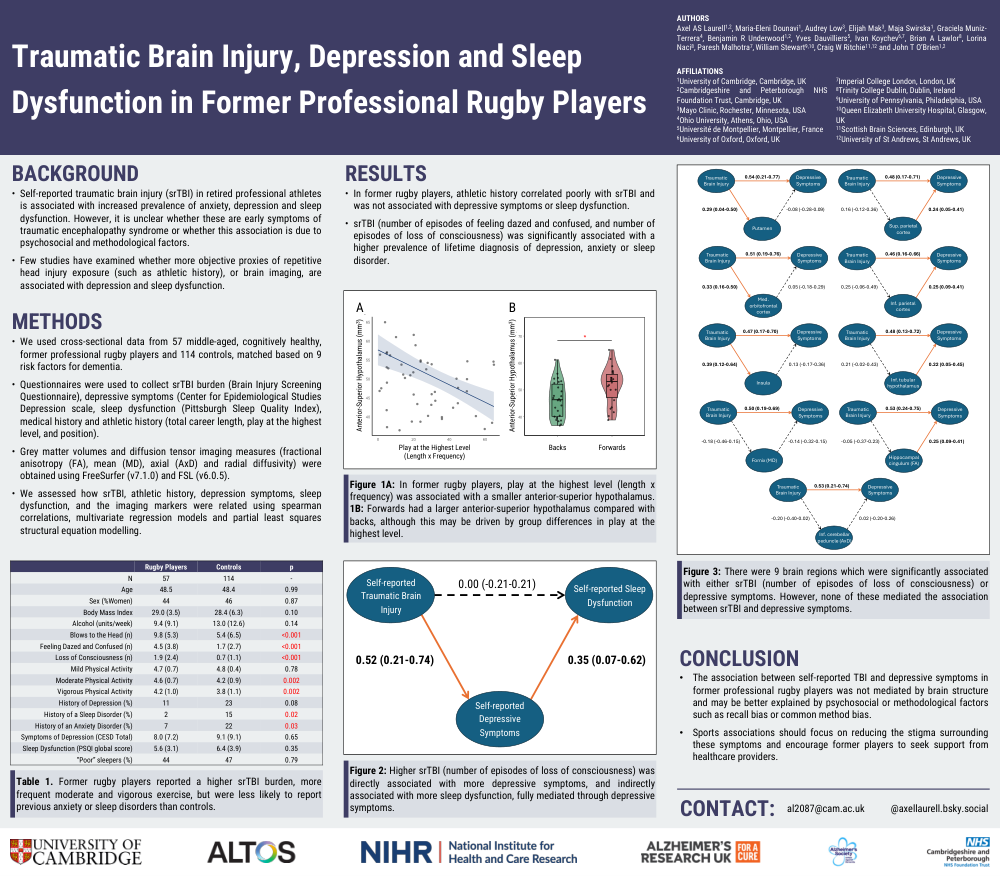
While traumatic brain injury (TBI) is associated with subsequent depressive symptoms and sleep dysfunction, it is uncertain whether these symptoms are mediated by early neurodegeneration in specific brain regions or by psychosocial stressors.
Methods
We used cross-sectional data from 57 middle-aged, cognitively healthy, former professional rugby players and 114 propensity score matched controls. TBI burden (number of episodes of loss of consciousness), depressive symptoms and sleep dysfunction were assessed using self-reported questionnaires (Brain Injury Screening Questionnaire, Center for Epidemiological Studies Depression scale, Pittsburgh Sleep Quality Index). Grey matter volumes (GMVs), which were normalised to total intracranial volume, and diffusion tensor imaging (DTI) measures (fractional anisotropy (FA), mean (MD), axial (AxD) and radial diffusivity (RD)) were obtained using FreeSurfer (v7.1.0) and FSL (v6.0.5). Spearman correlations, uncorrected for multiple comparisons, were used to identify imaging markers which were significantly associated with either TBI burden or depressive symptoms. Partial least square structural equational modelling was used to test whether TBI burden was associated with depressive symptoms and sleep dysfunction, and whether this was mediated through differences in the significant imaging markers.
Results
Former rugby players reported a higher TBI burden (1.9vs.0.7,p<0.001), more frequent moderate (4.6vs.4.2,p=0.002) and vigorous (4.2vs.3.8,p=0.002) exercise, but were less likely to report previous sleep disorders (2%vs.15%,p=0.02), anxiety disorders (7%vs.22%,p=0.03), or depression (11%vs.23%,p=0.08) than controls. In former rugby players, there was a strong direct association between TBI burden and depressive symptoms (B:0.52[95%CI:0.21-0.74]), and a moderate indirect association between TBI and sleep dysfunction, mediated through depressive symptoms (B:0.18[95%CI:0.03-0.39]). Higher TBI burden was associated with lower AxD of the inferior cerebellar peduncle (r=-0.28,p=0.03), while more depressive symptoms were associated with higher FA of the hippocampal cingulum (r=0.27,p=0.04) and lower MD of the fornix (r=-0.28,p=0.03). Neither were associated with RD or any GMVs. Furthermore, none of the significant imaging markers mediated the association between TBI burden and depressive symptoms.
Conclusion
TBI burden was strongly associated with depressive symptoms in former rugby players, and both factors correlated with DTI measures. However, imaging markers did not explain the relationship between TBI and depression, suggesting that psychosocial stressors may be more important.
Comments
Email is required but is not shown publicly.
Loading comments...