4,068 posters, 219 videos, 101 topics, 69 sessions, 14,365 authors, 6,128 institutions
ePostersLive by SciGen Technologies S.A. All rights reserved.
Alzheimer's Association International Conference 2026
July 12-15, 2026 | London, United Kingdom, and Online

3786
Longitudinal Characterization Of Whole-brain Magnetic Susceptibility In Community-dwelling Older Adults
Part of Topic
Background:
Quantitative susceptibility mapping (QSM) is sensitive to tissue properties related to iron accumulation and myelin content, both of which are implicated in late-life brain aging and neurodegenerative vulnerability. While cross-sectional studies have reported age-related differences in magnetic susceptibility, the longitudinal evolution of whole-brain susceptibility in community-based older adults remains insufficiently characterized.
Methods:
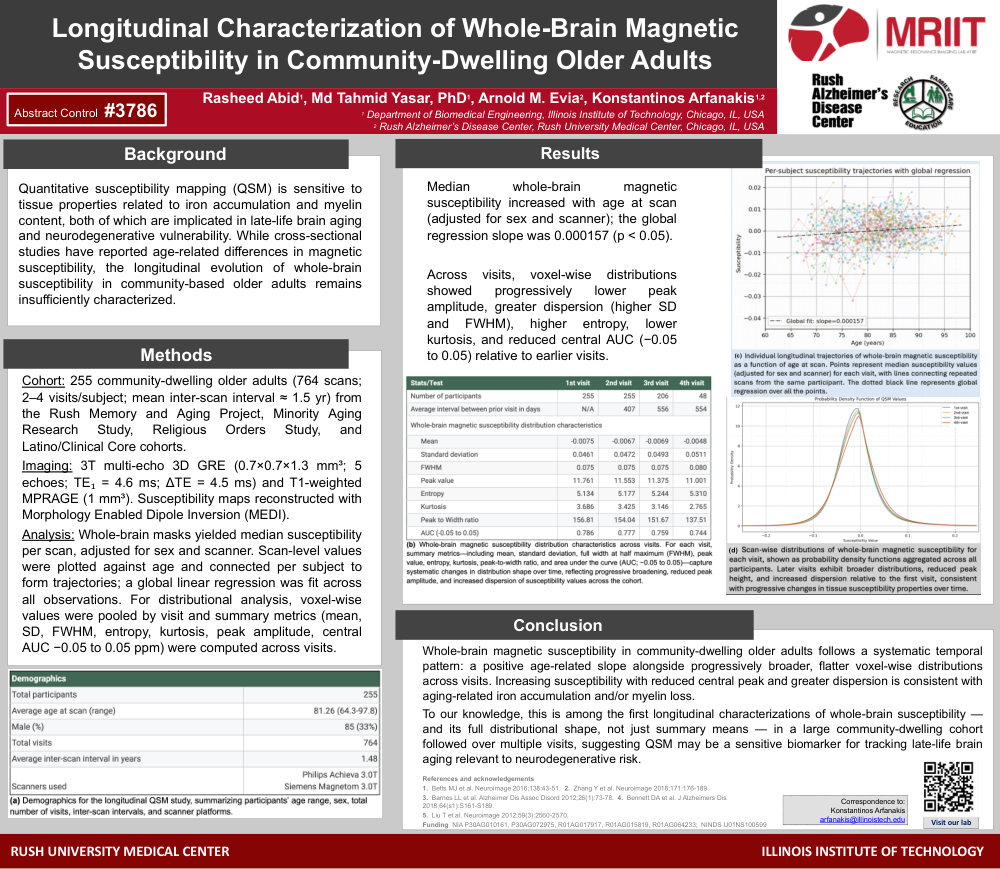
Cohort: 255 community-dwelling older adults (764 scans; 2–4 visits/subject; mean inter-scan interval ≈ 1.5 yr) from the Rush Memory and Aging Project, Minority Aging Research Study, Religious Orders Study, and Latino/Clinical Core cohorts.
Imaging: 3T multi-echo 3D GRE (0.7×0.7×1.3 mm³; 5 echoes; TE₁ = 4.6 ms; ΔTE = 4.5 ms) and T1-weighted MPRAGE (1 mm³). Susceptibility maps reconstructed with Morphology Enabled Dipole Inversion (MEDI).
Analysis: Whole-brain masks yielded median susceptibility per scan, adjusted for sex and scanner. Scan-level values were plotted against age and connected per subject to form trajectories; a global linear regression was fit across all observations. For distributional analysis, voxel-wise values were pooled by visit and summary metrics (mean, SD, FWHM, entropy, kurtosis, peak amplitude, central AUC −0.05 to 0.05 ppm) were computed across visits.
Results:
Median whole-brain magnetic susceptibility increased with age at scan (adjusted for sex and scanner); the global regression slope was 0.000157 (p < 0.05).
Across visits, voxel-wise distributions showed progressively lower peak amplitude, greater dispersion (higher SD and FWHM), higher entropy, lower kurtosis, and reduced central AUC (−0.05 to 0.05) relative to earlier visits.
Conclusion:
Whole-brain magnetic susceptibility in community-dwelling older adults follows a systematic temporal pattern: a positive age-related slope alongside progressively broader, flatter voxel-wise distributions across visits. Increasing susceptibility with reduced central peak and greater dispersion is consistent with aging-related iron accumulation and/or myelin loss.
To our knowledge, this is among the first longitudinal characterizations of whole-brain susceptibility — and its full distributional shape, not just summary means — in a large community-dwelling cohort followed over multiple visits, suggesting QSM may be a sensitive biomarker for tracking late-life brain aging relevant to neurodegenerative risk.
Comments
Email is required but is not shown publicly.
Loading comments...