4,068 posters, 219 videos, 101 topics, 69 sessions, 14,365 authors, 6,128 institutions
ePostersLive by SciGen Technologies S.A. All rights reserved.
Alzheimer's Association International Conference 2026
July 12-15, 2026 | London, United Kingdom, and Online

4619
Older Age And Heart Disease Are Associated With A Faster Increase In ARTS
Poster Presenter
Authors
Ana Tomash, Khalid Saifulah, Md Tahmid Yasar, Maude Wagner, Arnold M. Evia, David A. Bennett, Julie A. Schneider, Konstantinos Arfanakis
Affiliations
Rush Alzheimer’s Disease Center, Rush University Medical Center, Chicago, IL, Biomedical Engineering, Illinois Institute of Technology, Chicago, IL
Part of Topic
INTRODUCTION
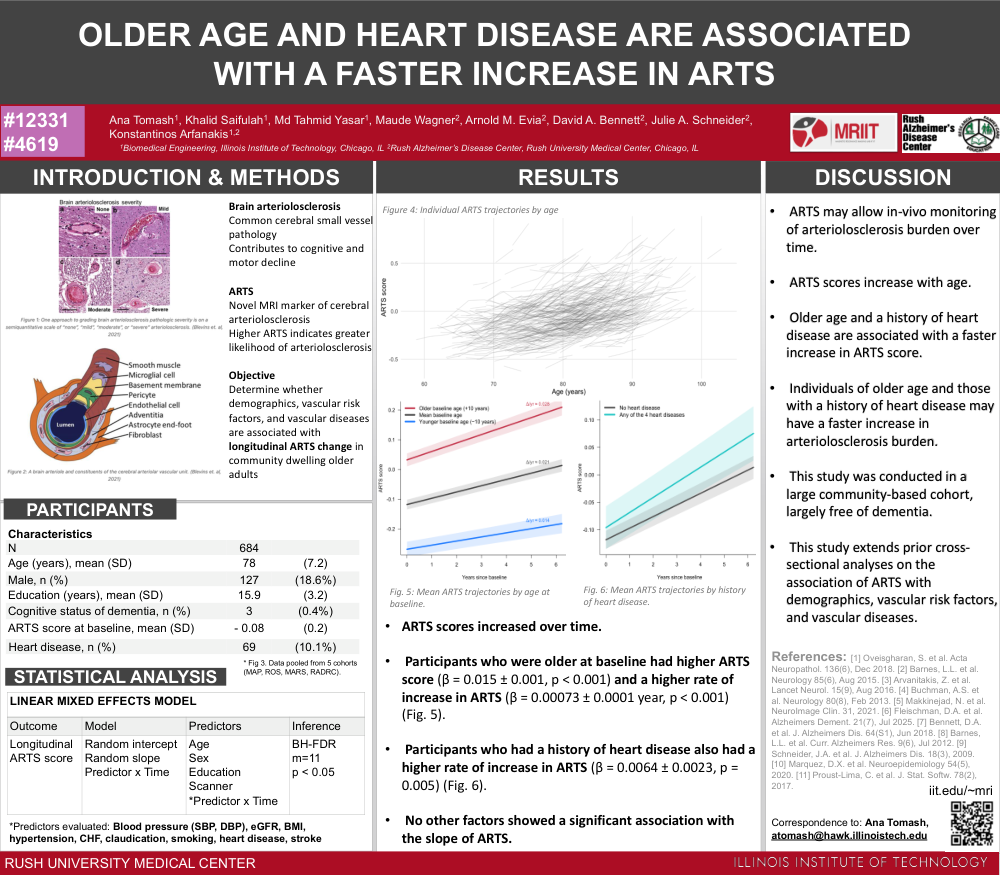
Brain arteriolosclerosis is a common small vessel pathology contributing to cognitive decline. ARTS is a novel in-vivo MRI-based marker linked to the likelihood of brain arteriolosclerosis. While cross-sectional studies link ARTS to demographic and vascular risk factors (VRFs), determinants of its longitudinal progression remain unknown. We examined associations of demographics, VRFs, and vascular diseases with longitudinal change in ARTS in community-based older adults.
METHODS
Older adults from five community-based cohort studies of aging (Rush Memory and Aging Project, Religious Orders Study, Minority Aging Research Study, Latino Core, and Clinical Core of the Rush Alzheimer's Disease Research Center) underwent 3T MRI, with each participant contributing at least two scans. ARTS scores were computed at each visit using an automated pipeline. Separate linear mixed-effects models with ARTS as the dependent variable were fit for all baseline predictors and their interaction with time. Models were adjusted for demographics and scanner, including interactions with time. False-discovery rate correction was applied (m = 11, p < 0.05).
RESULTS
A total of 684 older adults (Fig. 3) were included in this study, with longitudinal follow-up spanning up to 11 years (Fig. 4). ARTS scores increased over time (Fig. 4). Participants who were older at baseline had higher ARTS score (β = 0.015 ± 0.001, p < 0.001) and a higher rate of increase in ARTS (β = 0.00073 ± 0.0001 year-1, p < 0.001) (Fig. 5). Participants who had a history of heart disease also had a higher rate of increase in ARTS (β = 0.0064 ± 0.0023, p = 0.005) (Fig. 6). No other factors showed a significant association with the slope of ARTS.
CONCLUSION
Older age and a history of heart disease are associated with accelerated in vivo progression of cerebral arteriolosclerosis in a large community cohort of older adults largely free of dementia. These findings indicate faster arteriolar deterioration in individuals with systemic vascular disease and demonstrate that ARTS is sensitive to within-person changes in arteriolosclerosis burden over time.
ACKNOWLEDGMENTS
This study was supported by the following grants:
National Institute on Aging (NIA): R01AG064233, R01AG067482, R01AG017917, R01AG015819, RF1AG022018, R01AG056405, R01AG052200, P30AG010161, P30AG072975
National Institute of Neurological Disorders and Stroke (NINDS): UH2-UH3NS100599, U01NS100599
Comments
Email is required but is not shown publicly.
Loading comments...