4,068 posters, 219 videos, 101 topics, 69 sessions, 14,365 authors, 6,128 institutions
ePostersLive by SciGen Technologies S.A. All rights reserved.
Alzheimer's Association International Conference 2026
July 12-15, 2026 | London, United Kingdom, and Online

4743
MRI Biomarkers Reflect Early Alzheimer's Disease Progression
Poster Presenter
Authors
Part of Topic
Background & Rationale
Alzheimer's disease (AD) represents one of the most pressing public health challenges of our time, with global prevalence continuing to rise. Despite recent regulatory approvals, broadly effective disease-modifying treatments remain elusive. The urgent need for novel therapeutic strategies has driven interest in non-pharmacological approaches targeting the neural mechanisms underlying memory consolidation.
In this randomized, sham-controlled trial, we test whether ultra-high-frequency light stimulation that induces sharp wave ripples can thereby slow disease progression in a mild cognitive impairment (MCI) cohort. Participants received one hour of daily home-based stimulation over six months.
We focus on the entorhinal cortex (EC) as our primary region of interest. It is the principal gateway between neocortex and hippocampus, and one of the earliest, most reliable structural markers of AD progression. Here, we report MRI outcomes evaluating entorhinal integrity as a biomarker of treatment response.
Methods
| Parameter | Detail |
|---|---|
| Design | Ongoing single-center RCT, Charité Berlin |
| Target N | 36 participants across 6 months |
| MRI | Siemens Prisma 3T |
| Processing | FreeSurfer longitudinal pipeline |
| Statistical model | ANCOVA: EC thickness (T2) ~ EC thickness (T1) + age + sex + education + group |
Interim sample (3 months, N = 17):
- Sham (n = 9): age 65.7 ± 9.2 years | 5 female, 4 male | education 7.2 ± 2.3 years
- Stim (n = 8): age 70.0 ± 6.9 years | 4 female, 4 male | education 6.5 ± 2.6 years
Results
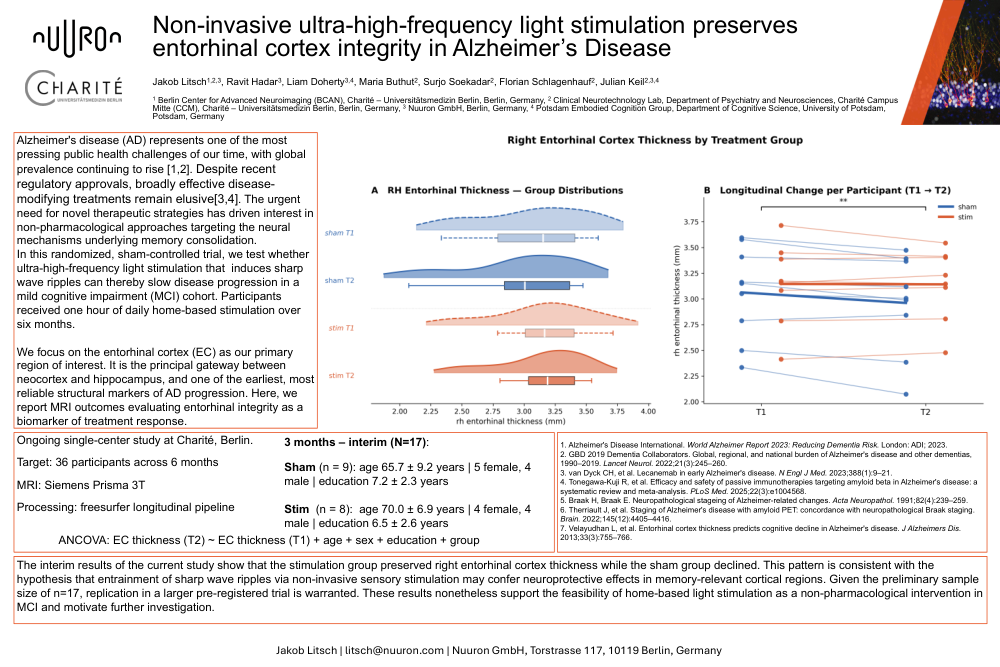
Two figures are presented showing Right Entorhinal Cortex Thickness by Treatment Group:
- Panel A — Group distributions (violin/box plots) of RH entorhinal thickness at T1 and T2 for sham and stimulation groups, showing a downward shift in the sham group and relative maintenance in the stimulation group.
- Panel B — Individual longitudinal trajectories (T1 → T2) per participant, with a statistically significant group difference marked (p < .01). Sham participants show declining thickness; stimulation participants show preserved or stable thickness.
Conclusion
The interim results of the current study show that the stimulation group preserved right entorhinal cortex thickness while the sham group declined. This pattern is consistent with the hypothesis that entrainment of sharp wave ripples via non-invasive sensory stimulation may confer neuroprotective effects in memory-relevant cortical regions. Given the preliminary sample size of n = 17, replication in a larger pre-registered trial is warranted. These results nonetheless support the feasibility of home-based light stimulation as a non-pharmacological intervention in MCI and motivate further investigation.
References
- Alzheimer's Disease International. World Alzheimer Report 2023: Reducing Dementia Risk. London: ADI; 2023.
- GBD 2019 Dementia Collaborators. Global, regional, and national burden of Alzheimer's disease and other dementias, 1990–2019. Lancet Neurol. 2022;21(3):245–260.
- van Dyck CH, et al. Lecanemab in early Alzheimer's disease. N Engl J Med. 2023;388(1):9–21.
- Tonegawa-Kuji R, et al. Efficacy and safety of passive immunotherapies targeting amyloid beta in Alzheimer's disease: a systematic review and meta-analysis. PLoS Med. 2025;22(3):e1004568.
- Braak H, Braak E. Neuropathological stageing of Alzheimer-related changes. Acta Neuropathol. 1991;82(4):239–259.
- Therriault J, et al. Staging of Alzheimer's disease with amyloid PET: concordance with neuropathological Braak staging. Brain. 2022;145(12):4405–4416.
- Velayudhan L, et al. Entorhinal cortex thickness predicts cognitive decline in Alzheimer's disease. J Alzheimers Dis. 2013;33(3):755–766.
Contact: Jakob Litsch | litsch@nuuron.com | Nuuron GmbH, Torstrasse 117, 10119 Berlin, Germany
Comments
Email is required but is not shown publicly.
Loading comments...