4,068 posters, 219 videos, 101 topics, 69 sessions, 14,365 authors, 6,128 institutions
ePostersLive by SciGen Technologies S.A. All rights reserved.
Alzheimer's Association International Conference 2026
July 12-15, 2026 | London, United Kingdom, and Online

9824
Machine Learning Classification Of Superagers Using Structural Connectivity, Functional Connectivity And Structure-function Coupling
Poster Presenter
Authors
Part of Topic
Machine Learning Classification of Superagers Using Structural Connectivity, Functional Connectivity and Structure-Function Coupling
Background
Episodic memory decline is common after age 60 – but not inevitable
Superagers retain memory performance typical of adults 30 to 40 years younger
Objectives
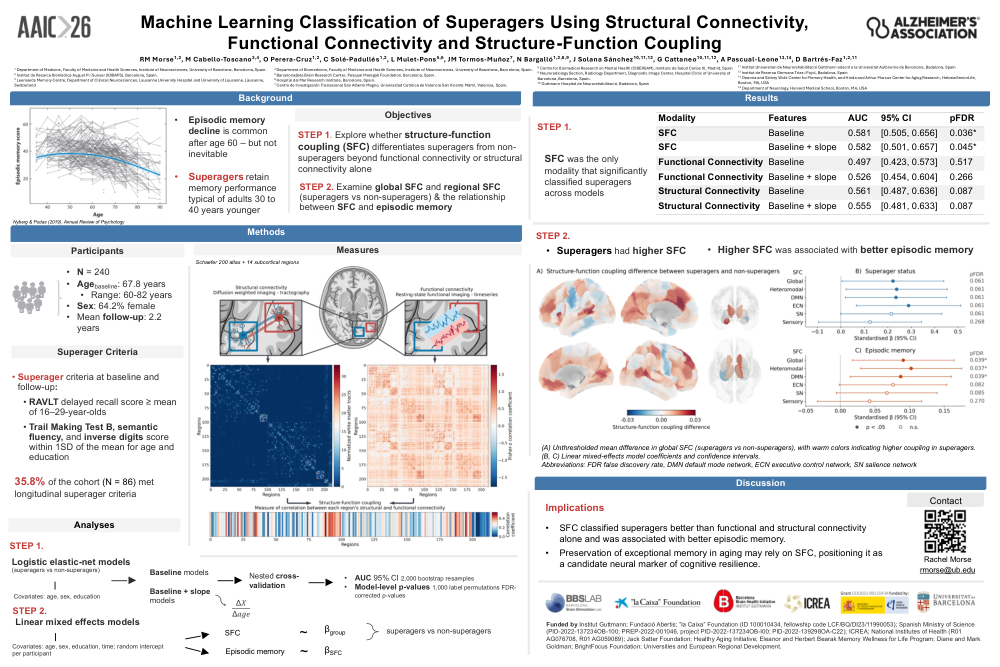
STEP 1. Explore whether structure-function coupling (SFC) differentiates superagers from non-superagers beyond functional connectivity or structural connectivity alone
STEP 2. Examine global SFC and regional SFC (superagers vs non-superagers) & the relationship between SFC and episodic memory
Methods
Participants
N = 240
Age baseline: 67.8 years
Range: 60-82 years
Sex: 64.2% female
Mean follow-up: 2.2 years
Superager Criteria
Superager criteria at baseline and follow-up: RAVLT delayed recall score ≥ mean of 16–29-year-olds
Trail Making Test B, semantic fluency, and inverse digits score within 1SD of the mean for age and education
35.8% of the cohort (N = 86) met longitudinal superager criteria
Measures
Schaefer 200 atlas + 14 subcortical regions
Structural connectivity — Diffusion weighted imaging - tractography
Functional connectivity — Resting-state functional imaging - timeseries
Structure-function coupling — Measure of correlation between each region's structural and functional connectivity
Analyses
STEP 1.
Logistic elastic-net
Covariates: age, sex, education
Baseline models
Baseline + slope models
Nested cross-validation
AUC 95% CI 2,000 bootstrap resamples
Model-level p-values 1,000 label permutations
FDR-corrected p-values
STEP 2.
Linear mixed effects models
Covariates: age, sex, education, time; random intercept per participant
SFC
Episodic memory
superagers vs. non-superagers
Results
SFC was the only modality that significantly classified superagers across models
Superagers had higher SFC
Higher SFC was associated with better episodic memory
(A) Unthresholded mean difference in global SFC (superagers vs non-superagers), with warm colors indicating higher coupling in superagers. (B, C) Linear mixed-effects model coefficients and confidence intervals. Abbreviations: FDR false discovery rate, DMN default mode network, ECN executive control network, SN salience network
Discussion
Implications
SFC classified superagers better than functional and structural connectivity alone and was associated with better episodic memory.
Preservation of exceptional memory in aging may rely on SFC, positioning it as a candidate neural marker of cognitive resilience.
Comments
Email is required but is not shown publicly.
Loading comments...