4,068 posters, 219 videos, 101 topics, 69 sessions, 14,365 authors, 6,128 institutions
ePostersLive by SciGen Technologies S.A. All rights reserved.
Alzheimer's Association International Conference 2026
July 12-15, 2026 | London, United Kingdom, and Online

2914
A Neuro-symbolic Agentic Framework For Enhancing Diagnostic Safety In Alzheimer’S Disease
Poster Presenter
Part of Topic
Video
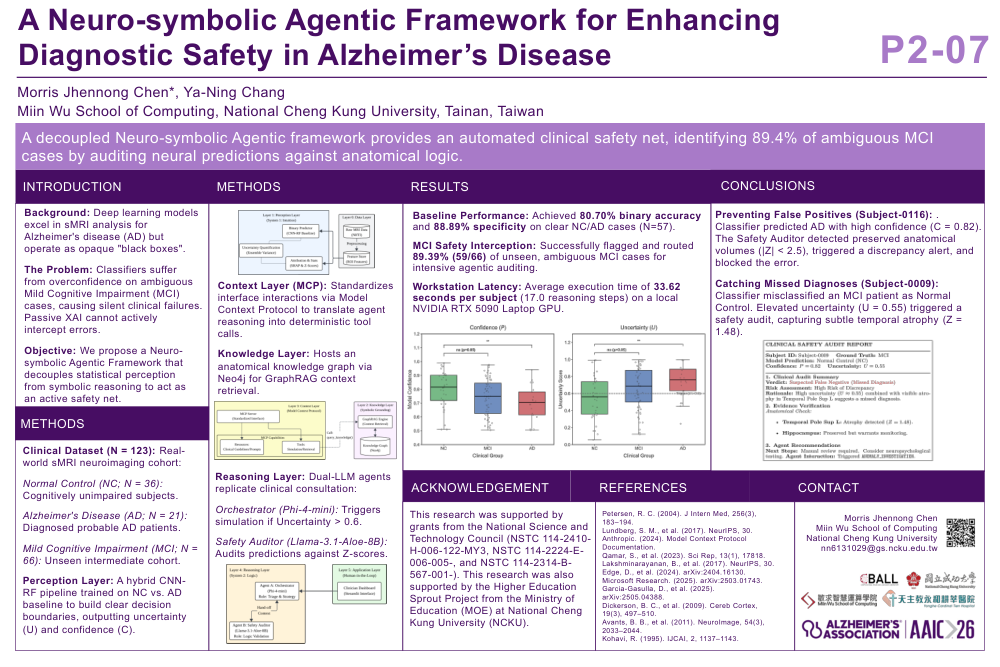
Title: A Neuro-symbolic Agentic Framework For Enhancing Diagnostic Safety In Alzheimer’S Disease
Authors: Morris Jhennong Chen, Ya-Ning Chang
Abstract:
Background: Deep learning models show great promise in Alzheimer’s diagnosis but are hindered by their "black-box" nature, often leading to silent failures. Traditional Explainable AI (XAI) offers passive visualizations but lacks logical enforcement. To address this, we propose a Neuro-Symbolic Agentic Framework designed to act as an active "Clinical Safety Auditor," explicitly validating predictions against anatomical knowledge.
Methods: The framework decouples diagnosis into a Perception Layer (CNN-RF) and a Reasoning Layer (utilizing specialized LLM-agents). This architecture enables logic-driven safety auditing and counterfactual verification via the Model Context Protocol (MCP). Validated on a clinical dataset collected from Cardinal Tien Hospital (N=123: 36 NC, 21 AD, 66 MCI), the perception model was trained strictly on a binary baseline (NC vs. AD), treating MCI cases as unknown anomalies. The Safety Auditor employs counterfactual simulation—perturbing input features (e.g., normalizing atrophy scores) to test decision stability. If a statistical prediction contradicts symbolic anatomical constraints, the system triggers an anomaly investigation.
Results: The proposed system acts as an effective safety net, maintaining a robust 80.7% binary accuracy and 88.9% specificity while successfully intervening in 89.4% of ambiguous MCI cases. Statistical analysis confirmed that MCI cases exhibited significantly higher uncertainty (p<0.05), validating the anomaly detection strategy. The practical utility is highlighted in the Safety Audit Report for Subject-0009. Here, the perception layer confidently predicted "Normal Control." However, the Auditor detected a critical logic gap: elevated uncertainty (U=0.55) conflicting with Temporal Pole atrophy (Z=1.48). Consequently, the system autonomously flagged this "Suspected False Negative," preventing a missed diagnosis common in end-to-end models.
Conclusion: This framework transforms AI into a trustworthy partner by enforcing a check-and-balance between pixel-level patterns and medical logic. Furthermore, the system achieves a diagnostic latency of just 33 seconds on consumer hardware, demonstrating its feasibility for local deployment. This approach provides a scalable, logic-driven solution to mitigate overconfidence in data-scarce clinical environments.
Comments
Email is required but is not shown publicly.
Loading comments...