4,068 posters, 219 videos, 101 topics, 69 sessions, 14,365 authors, 6,128 institutions
ePostersLive by SciGen Technologies S.A. All rights reserved.
Alzheimer's Association International Conference 2026
July 12-15, 2026 | London, United Kingdom, and Online

9384
Explainable Prediction Of Digital Brain Function Screen Score From Self-reported Lifestyle And Clinical Context
Poster Presenter
Part of Topic
Explainable Prediction Of Digital Brain Function Screen Score From Self-reported Lifestyle And Clinical Context
Jermyn See1, See Ann Soo1, Nav Vij1, Prem Pillay2
1Neurowyzr Pte Ltd, Singapore, 2Singapore Brain Spine Nerves Center, Singapore
SUMMARY
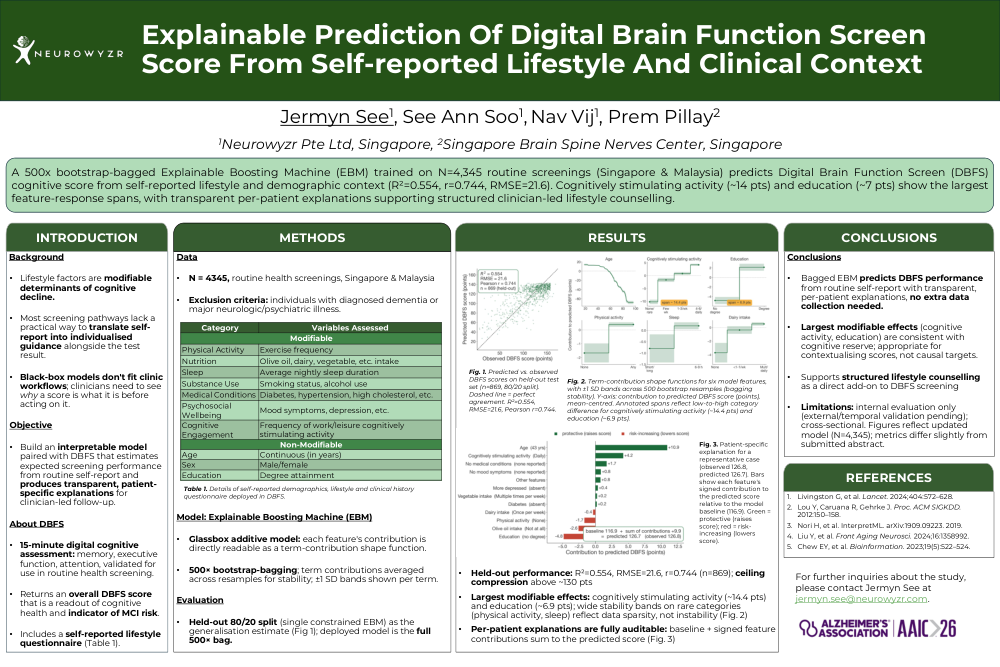
A 500x bootstrap-bagged Explainable Boosting Machine (EBM) trained on N=4,345 routine screenings (Singapore & Malaysia) predicts Digital Brain Function Screen (DBFS) cognitive score from self-reported lifestyle and demographic context (R²=0.554, r=0.744, RMSE=21.6). Cognitively stimulating activity (~14 pts) and education (~7 pts) show the largest feature-response spans, with transparent per-patient explanations supporting structured clinician-led lifestyle counselling.
INTRODUCTION
Background
Lifestyle factors are modifiable determinants of cognitive decline.
Most screening pathways lack a practical way to translate self-report into individualised guidance alongside the test result.
Black-box models don't fit clinic workflows; clinicians need to see why a score is what it is before acting on it.
Objective
Build an interpretable model paired with DBFS that estimates expected screening performance from routine self-report and produces transparent, patient-specific explanations for clinician-led follow-up.
About DBFS
15-minute digital cognitive assessment: memory, executive function, attention, validated for use in routine health screening.
Returns an overall DBFS score that is a readout of cognitive health and indicator of MCI risk.
Includes a self-reported lifestyle questionnaire (Table 1).
METHODS
Data
N = 4345, routine health screenings, Singapore & Malaysia
Exclusion criteria: individuals with diagnosed dementia or major neurologic/psychiatric illness.
Model: Explainable Boosting Machine (EBM)
Glassbox additive model: each feature's contribution is directly readable as a term-contribution shape function.
500× bootstrap-bagging; term contributions averaged across resamples for stability; ±1 SD bands shown per term.
Evaluation
Held-out 80/20 split (single constrained EBM) as the generalisation estimate (Fig 1); deployed model is the full 500× bag.
RESULTS
Held-out performance: R²=0.554, RMSE=21.6, r=0.744 (n=869); ceiling compression above ~130 pts
Largest modifiable effects: cognitively stimulating activity (~14.4 pts) and education (~6.9 pts); wide stability bands on rare categories (physical activity, sleep) reflect data sparsity, not instability (Fig. 2)
Per-patient explanations are fully auditable: baseline + signed feature contributions sum to the predicted score (Fig. 3)
CONCLUSIONS
Bagged EBM predicts DBFS performance from routine self-report with transparent, per-patient explanations, no extra data collection needed.
Largest modifiable effects (cognitive activity, education) are consistent with cognitive reserve; appropriate for contextualising scores, not causal targets.
Supports structured lifestyle counselling as a direct add-on to DBFS screening
Limitations: internal evaluation only (external/temporal validation pending); cross-sectional. Figures reflect updated model (N=4,345); metrics differ slightly from submitted abstract.
REFERENCES
- Livingston G, et al. Lancet. 2024;404:572–628.
- Lou Y, Caruana R, Gehrke J. Proc. ACM SIGKDD. 2012:150–158.
- Nori H, et al. InterpretML. arXiv:1909.09223. 2019.
- Liu Y, et al. Front Aging Neurosci. 2024;16:1358992.
- Chew EY, et al. Bioinformation. 2023;19(5):522–524.
For further inquiries about the study, please contact Jermyn See at jermyn.see@neurowyzr.com.
Comments
Email is required but is not shown publicly.
Loading comments...