4,068 posters, 219 videos, 101 topics, 69 sessions, 14,365 authors, 6,128 institutions
ePostersLive by SciGen Technologies S.A. All rights reserved.
Alzheimer's Association International Conference 2026
July 12-15, 2026 | London, United Kingdom, and Online

3606
Brain Age Gap Interacts With Plasma Ptau217 To Predict Cognitive Decline
Poster Presenter
Authors
Elaine Yi Li Teo, Elenor Morgenroth, Seyed Ehsan Saffari, Yi Jayne Tan, Nicole Isabella Tan, Yu Chin Lim, Sarah Jiayi Foo, Kok Pin Ng, Simon Kang Seng Ting, Hui Jin Chiew, Wahab Syed Shahul Hameed, Jinesh Mukesh Shah, Adeline Su Lyn Ng
Affiliations
Duke-NUS Medical School, Singapore, National Neuroscience Institute, Singapore
Part of Topic
|
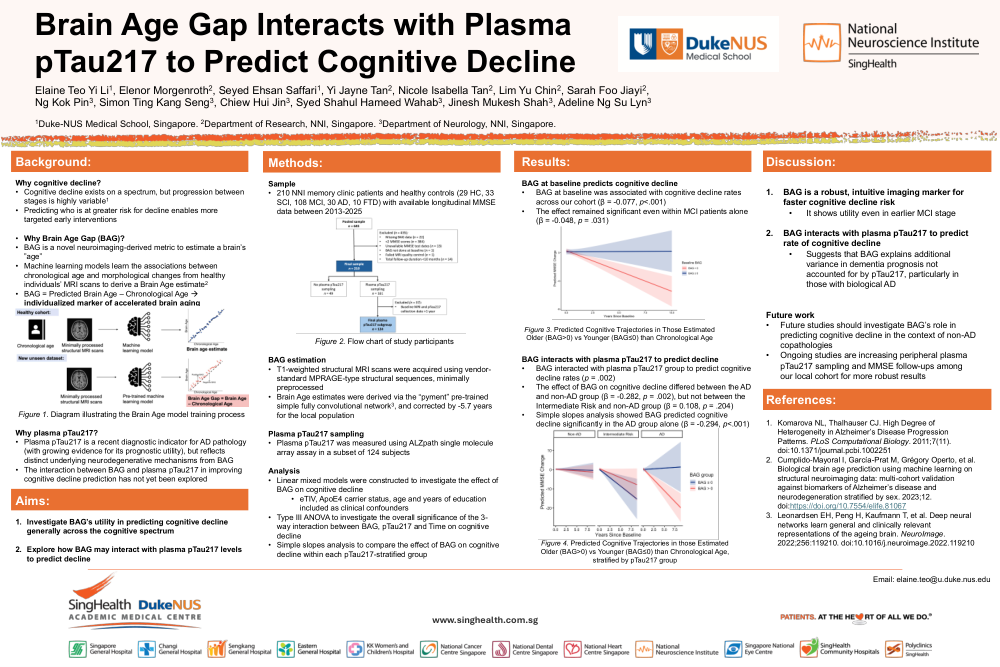
Introduction: Brain Age Gap (BAG), the difference between one’s predicted brain age and chronological age, is an emerging marker of accelerated brain aging. BAG has shown growing potential as a predictive biomarker of cognitive decline in dementia. This study investigates BAG’s utility in predicting cognitive decline generally across the cognitive spectrum, and its interaction with plasma phosphorylated-Tau217 (pTau217) levels (biomarker for Alzheimer’s pathology) to predict decline.
Methods: This retrospective longitudinal study comprised 210 subjects’ pooled data (29 healthy controls (HC), 33 subjective cognitive impairment (SCI), 108 mild cognitive impairment (MCI), 30 Alzheimer's disease (AD), 10 frontotemporal dementia (FTD)). Subjects were recruited from the National Neuroscience Institute’s memory clinics from 2013-2025. Brain Age estimates were derived via the “pyment” pre-trained simple fully convolutional network, with local correction by -5.7 years.
Results: Linear mixed models showed baseline BAG was significantly associated with MMSE decline across all patients (β = -0.077, p<.001), and within MCI patients alone (β = -0.048, p = .031). An ANOVA (Type III) demonstrated that BAG and pTau217 interact to affect cognitive decline rates (p = .002), with simple slopes analysis specifying that BAG significantly predicted decline only in the pTau217-stratified AD group (β = -0.294, p <.001).
Discussion: A larger baseline BAG predicted faster cognitive decline generally across the cognitive spectrum, with the effect remaining robust within MCI, highlighting the utility of MRI-derived BAG as a potential prognostic biomarker. We also provide the first explicit evidence that BAG interacted with pTau217 levels to affect cognitive decline, suggesting that accelerated brain aging helps explain additional variance in dementia prognosis not accounted for by AD-related pathology (pTau217), particularly in those with biologically-proven AD.
|
Comments
Email is required but is not shown publicly.
Loading comments...