4,068 posters, 219 videos, 101 topics, 69 sessions, 14,365 authors, 6,128 institutions
ePostersLive by SciGen Technologies S.A. All rights reserved.
Alzheimer's Association International Conference 2026
July 12-15, 2026 | London, United Kingdom, and Online

4539
An Alzheimer's Disease Diagnosis Interpretable Machine Learning Model Based On Quantitative aί Pet Of Subdivided Brain Regions
Poster Presenter
Authors
Affiliations
Part of Topic
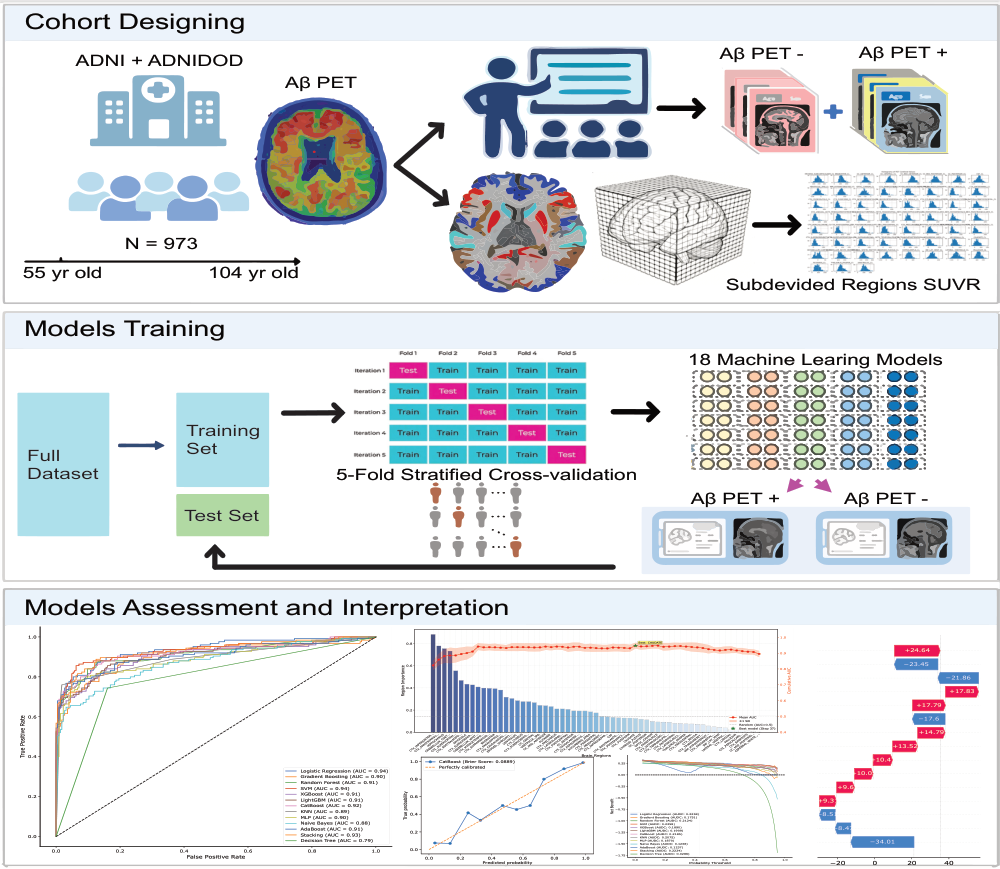
An Alzheimer's disease diagnostic model utilizing Aβ PET quantification and interpretable machine learning within subdivided brain regions
Background: β-amyloid (Aβ) positron emission tomography (PET) serves as the standard method for assessing brain Aβ burden in Alzheimer's disease (AD). However, its visual assessment is subjective. Furthermore, discrepancies between summary Centiloid measurements and visual readings undermine diagnostic consistency.
Objective: To develop an automated, interpretable machine learning model for AD diagnosis using quantitative Aβ PET features derived from anatomically subdivided brain regions.
Methods: Regional Aβ burden was quantified using standardized uptake value ratios (SUVR) from 49 subdivided brain regions. A total of 973 Aβ PET scans, each with consensus visual reads, were obtained from the ADNI and ADNIDOD databases to train and evaluate 18 machine learning classifiers. Model performance was assessed, and SHAP analysis identified the brain regions most influential in diagnostic decisions.
Results: The CatBoost classifier achieved the highest performance, with an AUC of 0.98, sensitivity of 92%, and specificity of 95% on the test set. SHAP analysis revealed that the rostral middle frontal gyrus, nucleus accumbens area, and precuneus were the most influential regions for AD diagnosis, consistent with established patterns of AD pathology and default mode network involvement.
Conclusion: We present an automated, interpretable machine learning framework for AD diagnosis based on quantitative regional Aβ PET SUVRs. This approach offers a biologically grounded alternative to subjective visual reads or standalone Centiloid measures, with the potential to enhance diagnostic objectivity and interpretability.
Comments
Email is required but is not shown publicly.
Loading comments...