4,068 posters, 219 videos, 101 topics, 69 sessions, 14,365 authors, 6,128 institutions
ePostersLive by SciGen Technologies S.A. All rights reserved.
Alzheimer's Association International Conference 2026
July 12-15, 2026 | London, United Kingdom, and Online

8940
Domain-specific Cognitive Profiling From Informant-based Assessments In A Population-based Sample
Poster Presenter
Part of Topic
Introduction:
COGNITIVE ASSESSMENT IN STUDIES
- Clinicopathological studies in population-based cohorts offer the most reliable framework for linking cognitive phenotypes to neuropathology.1
Complexity and cost often limit sample size and
the depth of cognitive characterization.2
- Many studies rely on global cognitive outcomes, which insufficiently capture domain-specific patterns of impairment.1
- Widely used instruments such as the Clinical Dementia Rating (CDR) and the Informant Questionnaire on Cognitive Decline in the Elderly (IQCODE) include items that implicitly assess multiple cognitive domains.3
- Unlocking this embedded information provides an opportunity to derive more granular cognitive information without additional testing or cost.
Objective:
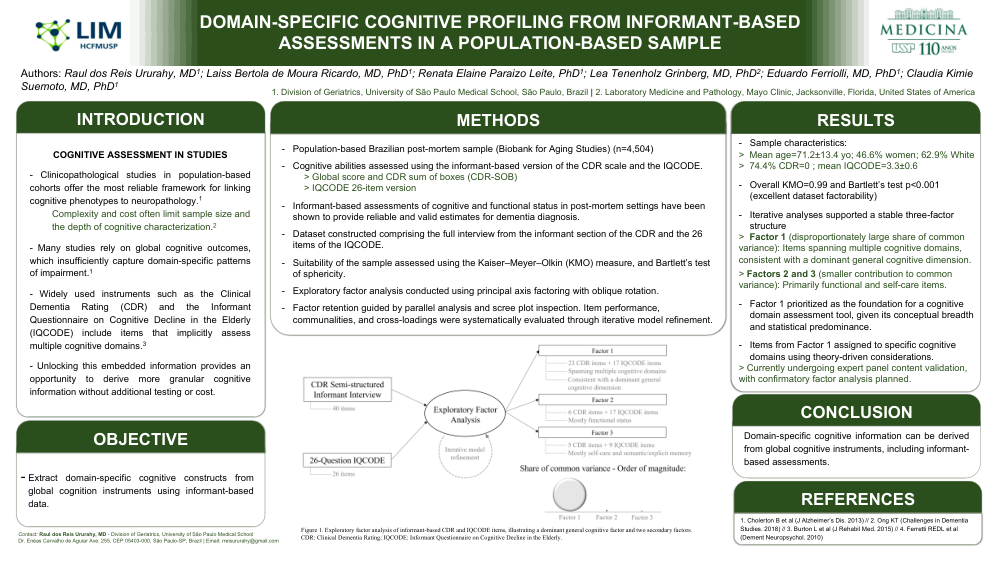
> Global score and CDR sum of boxes (CDR-SOB)
> IQCODE 26-item version
-Informant-based assessments of cognitive and functional status in post-mortem settings have been shown to provide reliable and valid estimates for dementia diagnosis.
-Dataset constructed comprising the full interview from the informant section of the CDR and the 26 items of the IQCODE.
-Suitability of the sample assessed using the Kaiser–Meyer–Olkin (KMO) measure, and Bartlett’s test of sphericity.
-Exploratory factor analysis conducted using principal axis factoring with oblique rotation.
-Factor retention guided by parallel analysis and scree plot inspection. Item performance, communalities, and cross-loadings were systematically evaluated through iterative model refinement.
Results:
> Mean age=71.2±13.4 yo; 46.6% women; 62.9% White
> 74.4% CDR=0 ; mean IQCODE=3.3±0.6
- Factor 1 prioritized as the foundation for a cognitive domain assessment tool, given its conceptual breadth and statistical predominance.
> Currently undergoing expert panel content validation, with confirmatory factor analysis planned.
Conclusion:
- Domain-specific cognitive information can be derived from global cognitive instruments, including informant-based assessments.
References:
1. Cholerton B et al (J Alzheimer’s Dis. 2013)
2. Ong KT (Challenges in Dementia Studies. 2018)
3. Burton L et al (J Rehabil Med. 2015)
4. Ferretti REDL et al (Dement Neuropsychol. 2010)
Comments
Email is required but is not shown publicly.
Loading comments...