4,068 posters, 219 videos, 101 topics, 69 sessions, 14,365 authors, 6,128 institutions
ePostersLive by SciGen Technologies S.A. All rights reserved.
Alzheimer's Association International Conference 2026
July 12-15, 2026 | London, United Kingdom, and Online

3921
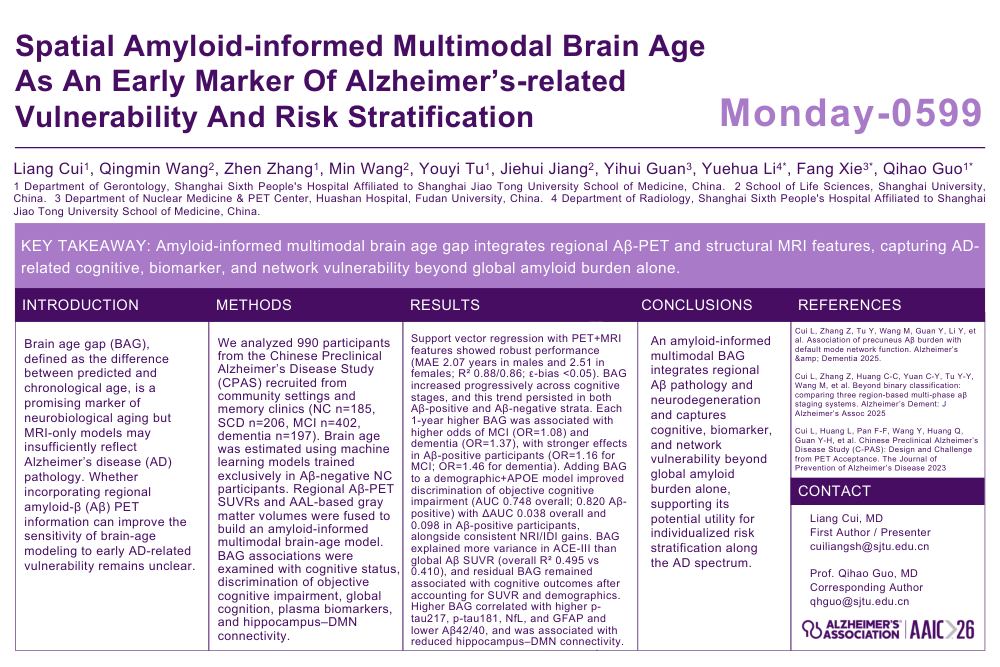
Spatial Amyloid-informed Multimodal Brain Age As An Early Marker Of Alzheimer’s-related Vulnerability And Risk Stratification
Part of Topic
Spatial amyloid-informed multimodal brain age gap (BAG) was developed in the Chinese Preclinical Alzheimer’s Disease Study (CPAS), a deeply phenotyped Chinese cohort recruiting participants from community settings and memory clinics across the Alzheimer’s disease continuum. In 990 participants spanning cognitively normal, subjective cognitive decline, mild cognitive impairment, and dementia stages, regional Aβ-PET SUVRs and structural MRI-derived gray matter volumes were integrated to estimate multimodal BAG. The amyloid-informed BAG increased across cognitive stages and captured Alzheimer’s disease-related vulnerability beyond global amyloid burden. Higher BAG was associated with worse global and domain-specific cognitive performance, higher plasma p-tau217, p-tau181, NfL, and GFAP, lower Aβ42/40, and reduced hippocampus–default mode network connectivity. These findings suggest that multimodal BAG may serve as an integrative imaging-derived marker linking amyloid pathology, neurodegeneration, cognitive decline, blood biomarkers, and network dysfunction, with potential utility for individualized risk stratification across the Alzheimer’s disease continuum.
Keywords: Alzheimer’s disease; Chinese Preclinical Alzheimer’s Disease Study; CPAS; brain age gap; biological brain aging; Aβ-PET; structural MRI; amyloid burden; plasma biomarkers; hippocampus; default mode network; cognitive decline; risk stratification.
Comments
Email is required but is not shown publicly.
Loading comments...