4,068 posters, 219 videos, 101 topics, 69 sessions, 14,365 authors, 6,128 institutions
ePostersLive by SciGen Technologies S.A. All rights reserved.
Alzheimer's Association International Conference 2026
July 12-15, 2026 | London, United Kingdom, and Online

10077
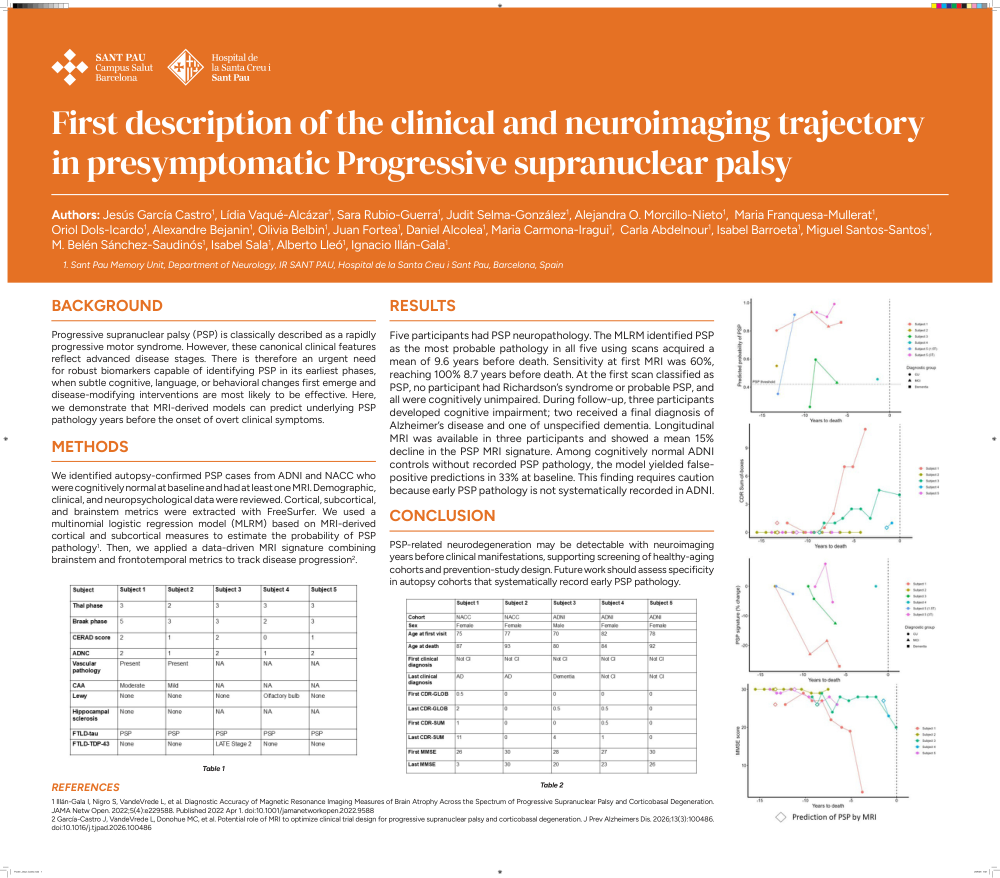
First Description Of The Clinical And Neuroimaging Trajectory In Presymptomatic Progressive Supranuclear Palsy
Poster Presenter
Authors
Affiliations
Part of Topic
BACKGROUND Progressive supranuclear palsy (PSP) is classically described as a rapidly progressive motor syndrome. However, these canonical clinical features reflect advanced disease stages. There is therefore an urgent need for robust biomarkers capable of identifying PSP in its earliest phases, when subtle cognitive, language, or behavioral changes first emerge and disease-modifying interventions are most likely to be effective. Here, we demonstrate that MRI-derived models can predict underlying PSP pathology years before the onset of overt clinical symptoms.
METHODS We identified autopsy-confirmed PSP cases from ADNI and NACC who were cognitively normal at baseline and had at least one MRI. Demographic, clinical, and neuropsychological data were reviewed. Cortical, subcortical, and brainstem metrics were extracted with FreeSurfer. We used a multinomial logistic regression model (MLRM) based on MRI-derived cortical and subcortical measures to estimate the probability of PSP pathology. Then, we applied a data-driven MRI signature combining brainstem and frontotemporal metrics to track disease progression.
RESULTS Five participants had PSP neuropathology. The MLRM identified PSP as the most probable pathology in all five using scans acquired a mean of 9.6 years before death. Sensitivity at first MRI was 60%, reaching 100% 8.7 years before death. At the first scan classified as PSP, no participant had Richardson’s syndrome or probable PSP, and all were cognitively unimpaired. During follow-up, three participants developed cognitive impairment; two received a final diagnosis of Alzheimer’s disease and one of unspecified dementia. Longitudinal MRI was available in three participants and showed a mean 15% decline in the PSP MRI signature. Among cognitively normal ADNI controls without recorded PSP pathology, the model yielded falsepositive predictions in 33% at baseline. This finding requires caution because early PSP pathology is not systematically recorded in ADNI.
CONCLUSION PSP-related neurodegeneration may be detectable with neuroimaging years before clinical manifestations, supporting screening of healthy-aging cohorts and prevention-study design. Future work should assess specificity in autopsy cohorts that systematically record early PSP pathology.
Comments
Email is required but is not shown publicly.
Loading comments...