4,068 posters, 219 videos, 101 topics, 69 sessions, 14,365 authors, 6,128 institutions
ePostersLive by SciGen Technologies S.A. All rights reserved.
Alzheimer's Association International Conference 2026
July 12-15, 2026 | London, United Kingdom, and Online

5333
Hypertension And White Matter Damage Worsen Cognition In Presymptomatic Genetic Frontotemporal Dementia: A GENFI Study
Poster Presenter
Authors
Nol Swaddiwudhipong, P Simon Jones, Arabella Bouzigues, Lucy L Russell, Phoebe H Foster, Eye Ferry-Bolder, John C van Swieten, Lize Jiskoot, Harro Seelaar, Raquel Sánchez-Valle, Robert Laforce, Caroline Graff, Daniela Galimberti, Rik Vandenberghe, Alexandre de Mendonça, Giuseppe di Fede, Isabel Santana, Alexander Gerhard, Johannes Levin, Benedetta Nacmias, Markus Otto, Maxime Bertoux, Thibaud Lebouvier, Simon Ducharme, Chris R. Butler, Isabelle Le Ber, Elizabeth Finger, Maria Carmela Tartaglia, Mario Masellis, Matthis Synofzik, Fermin Moreno, Barbara Borroni, Jonathan D Rohrer, James B Rowe, Kamen Tsvetanov, The Genetic Frontotemporal dementia Initiative (GENFI)
Affiliations
, University of Cambridge, Dementia Research Centre, Department of Neurodegenerative Disease, UCL Queen Square Institute of Neurology, London, United Kingdom, Faculty of Medicine, University of Lisbon, Lisbon, Portugal, Department of Neuroscience, Psychology, Drug Research and Child Health, University of Florence, Florence, Italy, Department of Neurology, University of Ulm, Ulm, Germany, Department of Clinical Neurological Sciences, University of Western Ontario, London, ON, Canada, Department of Clinical Neurosciences, University of Cambridge, Cambridge, United Kingdom; Cambridge University Hospitals NHS Foundation Trust, Cambridge, United Kingdom, Department of Neurodegenerative Disease, UCL Queen Square Institute of Neurology, London, United Kingdom, Department of Neurology, Erasmus Medical Centre, Alzheimer’s disease and Other Cognitive Disorders Unit, Neurology Service, Hospital Clínic, Institut d’Investigacións Biomèdiques August Pi I Sunyer, University of Barcelona,, Barcelona, Spain, Clinique Interdisciplinaire de Mémoire, Département des Sciences Neurologiques, CHU de Québec, Quebec, QC, Canada; Faculté de Médecine, Université Laval, Quebec, QC, Canada, Department of Neurobiology, Karolinska Institutet, Solna, Sweden; Unit for Hereditary Dementias, Theme Inflammation and Aging, Karolinska University Hospital, Solna, Sweden,, Fondazione Ca’ Granda, IRCCS Ospedale Policlinico, Milan, Italy; University of Milan, Centro Dino Ferrari, Milan, Italy, Laboratory for Cognitive Neurology, Department of Neurosciences; Leuven Brain Institute, KU Leuven, Leuven, Belgium; Neurology Service, University Hospitals Leuven, Leuven, Belgium, Fondazione IRCCS Istituto Neurologico Carlo Besta, Milan, Ital, University Hospital of Coimbra (HUC), Neurology Service, Faculty of Medicine, University of Coimbra, Coimbra, Portugal, Division of Neuroscience and Experimental Psychology, Wolfson Molecular Imaging Centre, University of Manchester, Manchester, United Kingdom; Departments of Geriatric Medicine and Nuclear Medicine, University of Duisburg-Essen, Essen, Germany, Department of Neurology, Ludwig-Maximilians Universität München, Munich, Germany; German Center for Neurodegenerative Diseases (DZNE); Munich Cluster of Systems Neurology (SyNergy), Munich, Germany, Inserm 1172; CHU, CNR-MAJ, Labex Distalz, LiCEND, Lille, France, Univ Lille; Inserm 1172; CHU, CNR-MAJ, Labex Distalz, LiCEND, Lille, France, Department of Psychiatry, McGill University Health Centre, McGill University, Quebec, QC, Canada; McConnell Brain Imaging Centre, Montreal Neurological Institute, McGill University, Quebec, QC, Canada, Nuffield Department of Clinical Neurosciences, Medical Sciences Division, University of Oxford, Oxford, United Kingdom; Department of Brain Sciences, Imperial College London, London, United Kingdom, Sorbonne Université, Paris Brain Institute – Institut du Cerveau – ICM, Inserm U1127, CNRS UMR 7225, AP-HP - Hôpital Pitié-Salpêtrière, Paris, France; Centre de référence des démences rares ou précoces, IM2A, Département de Neurologie, AP-HP - Hôpital Pitié-Salpêtrière, Paris, France, Tanz Centre for Research in Neurodegenerative Diseases, University of Toronto, Toronto, ON, Canada, Sunnybrook Health Sciences Centre, Sunnybrook Research Institute, University of Toronto, Toronto, ON, Canada, Department of Neurodegenerative Diseases, Hertie-Institute for Clinical Brain Research and Center of, University of Tübingen, Tübingen, Germany; Center for Neurodegenerative Diseases (DZNE), Tübingen, Germany, Cognitive Disorders Unit, Department of Neurology, Donostia Universitary Hospital, San Sebastian, Spain; Neuroscience Area, Biodonostia Health Research Institute, San Sebastian, Spain, Neurology Unit, Department of Clinical and Experimental Sciences, University of Brescia, Brescia, Italy, Department of Clinical Neurosciences, University of Cambridge, Cambridge, United Kingdom
Part of Topic
Summary
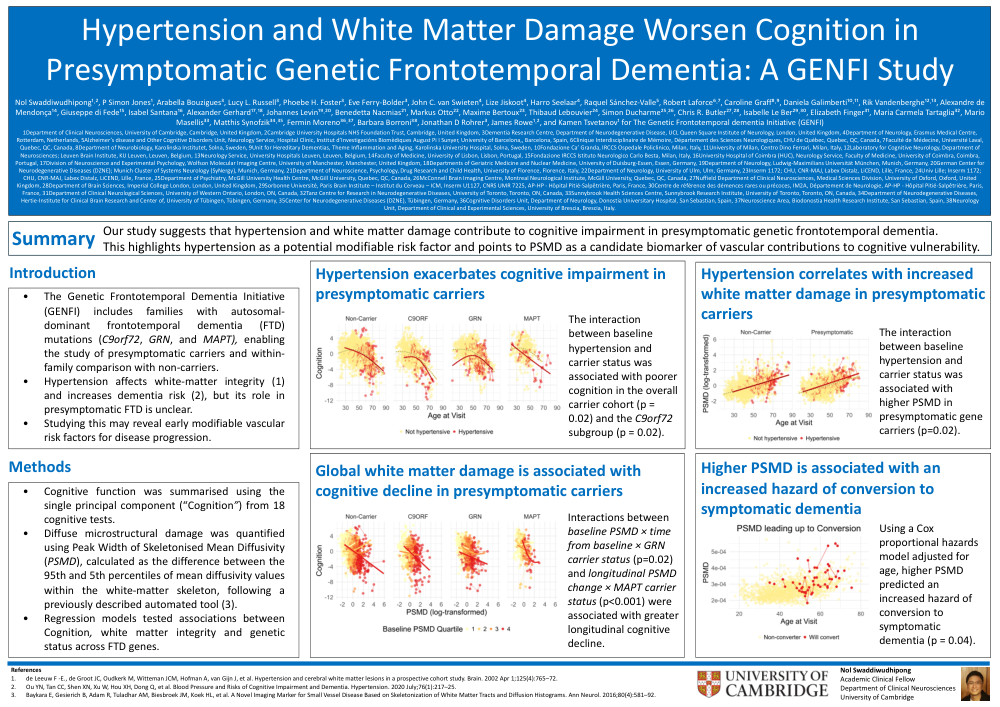
Our study suggests that hypertension and white matter damage contribute to cognitive impairment in presymptomatic genetic frontotemporal dementia.
This highlights hypertension as a potential modifiable risk factor and points to PSMD as a candidate biomarker of vascular contributions to cognitive vulnerability.
Introduction
• The Genetic Frontotemporal Dementia Initiative (GENFI) includes families with autosomal dominant frontotemporal dementia (FTD) mutations (C9orf72, GRN, and MAPT), enabling the study of presymptomatic carriers and within family comparison with non-carriers.
• Hypertension affects white-matter integrity (1) and increases dementia risk (2), but its role in presymptomatic FTD is unclear.
• Studying this may reveal early modifiable vascular risk factors for disease progression.
Methods
• Cognitive function was summarised using the single principal component (“Cognition”) from 18 cognitive tests.
• Diffuse microstructural damage was quantified using Peak Width of Skeletonised Mean Diffusivity (PSMD), calculated as the difference between the 95th and 5th percentiles of mean diffusivity values within the white-matter skeleton, following a previously described automated tool (3).
• Regression models tested associations between Cognition, white matter integrity and genetic status across FTD genes.
Hypertension exacerbates cognitive impairment in presymptomatic carriers
The interaction between baseline hypertension and carrier status was associated with poorer cognition in the overall carrier cohort (p = 0.02) and the C9orf72 subgroup (p = 0.02).
Global white matter damage is associated with cognitive decline in presymptomatic carriers
The interaction between baseline hypertension and carrier status was associated with higher PSMD in presymptomatic gene carriers (p=0.02)
Hypertension correlates with increased white matter damage in presymptomatic carriers
Interactions between baseline PSMD × time from baseline × GRN carrier status (p=0.02) and longitudinal PSMD change × MAPT carrier status (p<0.001) were associated with greater longitudinal cognitive decline.
Higher PSMD is associated with an increased hazard of conversion to symptomatic dementia
Using a Cox proportional hazards model adjusted for age, higher PSMD predicted an increased hazard of conversion to symptomatic dementia (p = 0.04).
Comments
Email is required but is not shown publicly.
Loading comments...