4,068 posters, 219 videos, 101 topics, 69 sessions, 14,365 authors, 6,128 institutions
ePostersLive by SciGen Technologies S.A. All rights reserved.
Alzheimer's Association International Conference 2026
July 12-15, 2026 | London, United Kingdom, and Online

10011
Understanding Functional Trajectories In Dementia And Their Determinants
Poster Presenter
Authors
Affiliations
Part of Topic
Understanding Functional Trajectories in Dementia and Their Determinants
Saira Saeed Mirza,1,2,3 Joel Ramirez,2,3,4 Nathan Herman,2,5, Krista Lanctot,2,5 Mario Masellis,1,2,3 Susan Bronskill,2,6 Sandra E. Black1,2,3,7
- Dr. Sandra Black Centre for Brain Resilience and Recovery, Sunnybrook Research Institute, University of Toronto, Toronto, ON, Canada
- Hurvitz Brain Sciences Research Program, Sunnybrook Research Institute, University of Toronto, Toronto, ON, Canada
- LC Campbell Cognitive Neurology Research Unit, Sunnybrook Research Institute, University of Toronto, Toronto, ON, Canada
- Department of Psychology, University of Toronto, Scarborough. ON, Canada
- Department of Psychiatry, Faculty of Medicine; University of Toronto, Toronto, ON, Canada
- Institute of Health Policy, Management & Evaluation, Dalla Lana School of Public Health, University of Toronto. Toronto, ON, Canada
- Heart and Stroke Foundation Canadian Partnership for Stroke Recovery, Sunnybrook Health Sciences Centre, University of Toronto, Toronto, ON, Canada
BACKGROUND:
Disability as assessed by activities of daily living (ADL) is a common feature of all dementias. White matter hyperintensities (WMH) and neuropsychiatric symptoms are prevalent in all neurodegenerative disorders (NDDs) and contribute to morbidity and dependence. However, it remains unexplored how these factors associate with various trajectories of functionality in persons with NDDs.
METHODS:
This study was embedded within the Sunnybrook Dementia Study (SDS) – a prospective observational cohort study of patients with NDDs being conducted at the Sunnybrook Health Sciences Centre since 1995. Patients are followed every year for comprehensive brain imaging, cognitive, behavioral and functional assessments. 470 patients with variable degrees of cognitive impairment (subjective cognitive complaints, mild cognitive impairment, Alzheimer’s Disease, Lewy body dementia, frontotemporal dementia, vascular dementia, and mixed disease) were included with ADL assessments for up to six visits (min visits: 2). Using Group-based trajectory modelling, trajectories for BADL and IADL were calculated using sex, years of education, APOE-ɛ4 dosage, and age and mini-mental state examination (MMSE) score at baseline as determinants. CV-risk factors (diabetes; hypertension; stroke prevalence), and imaging biomarkers (global normal-appearing grey matter (NAGM) and WMH volume) and neuropsychiatric (Neuropsychiatric inventory (NPI) score at baseline were compared across trajectories using regression.
RESULTS:
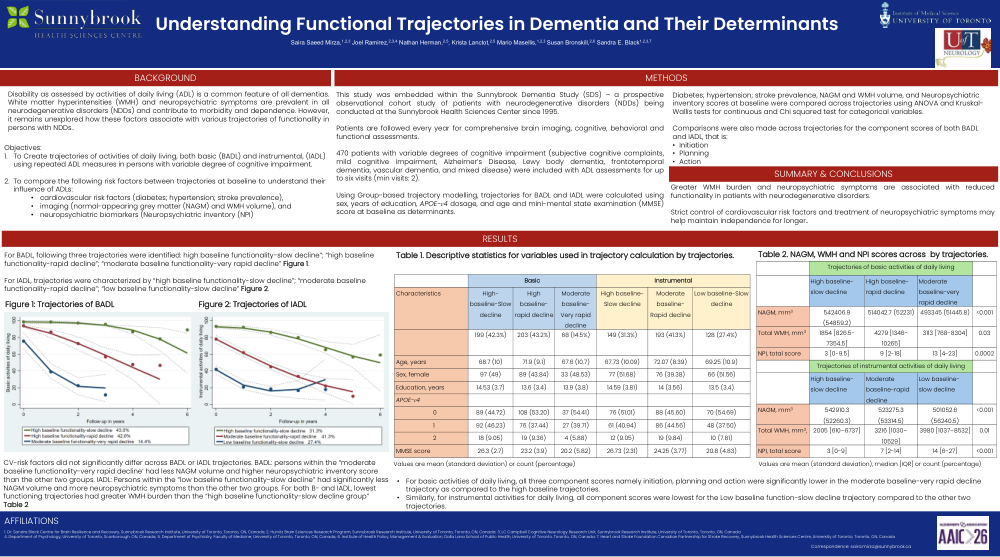
For BADL, following three trajectories were identified: high baseline functionality-slow decline”; “high baseline functionality-rapid decline”; “moderate baseline functionality-very rapid decline”.
For IADL, trajectories were characterized by “high baseline functionality-slow decline”; “moderate baseline functionality-rapid decline”; “low baseline functionality-slow decline”. CV-risk factors did not significantly differ across BADL or IADL trajectories. BADL: persons within the “moderate baseline functionality-very rapid decline’ had less NAGM volume and higher neuropsychiatric inventory score than the other two groups. IADL: Persons within the “low baseline functionality-slow decline” had significantly less NAGM volume and more neuropsychiatric symptoms than the other two groups. For both B- and IADL, lowest functioning trajectories had greater WMH burden than the “high baseline functionality-slow decline group”.
CONCLUSION: Greater WMH burden and neuropsychiatric symptoms are associated with reduced functionality in patients with neurodegenerative disorders. Strict control of cardiovascular risk factors and treatment of neuropsychiatric symptoms may help maintain independence for longer.
Comments
Email is required but is not shown publicly.
Loading comments...