4,068 posters, 219 videos, 101 topics, 69 sessions, 14,365 authors, 6,128 institutions
ePostersLive by SciGen Technologies S.A. All rights reserved.
Alzheimer's Association International Conference 2026
July 12-15, 2026 | London, United Kingdom, and Online

5109
A Frontal Hypermetabolism Pattern In Long Covid Identified By Fdg-pet Across Two Independent Pipelines
Poster Presenter
Authors
Sol Cataldo, Andrea Micciulli, Laura Margulis, Melisa Monteleone, Pablo Aguiar, Marcela Brocco, Martin Belzunce
Affiliations
Centro Universitario de Imágenes Médicas (CEUNIM), Instituto de Ciencias Físicas (ICIFI UNSAM-CONICET), Escuela de Ciencia y Tecnología, Universidad Nacional de San Martín, Unidad de Neuropsicología, Servicio de Neurología, Hospital Interzonal General de Agudos Eva Perón, San Martín, Buenos Aires, Argentina, Instituto de Investigaciones Biotecnológicas, Universidad Nacional de San Martín (UNSAM), Molecular Imaging Biomarkers and Theragnosis Lab, Center for Research in Molecular Medicine and Chronic Diseases, University of Santiago de Compostela
Part of Topic
Background
Long COVID (LC) is a condition characterized by persistent cognitive symptoms lasting at least three months after SARS-CoV-2 infection. FDG-PET studies in LC have reported heterogeneous metabolic findings that remain poorly understood due to the heterogeneity of healthy control (HC) groups, and the choice of intensity normalization strategies in the absence of disease-specific reference patterns. Moreover, most published PET studies evaluated patients shortly after infection. Here, we investigate brain metabolism in a LC cohort with persistent cognitive symptoms for more than two years after SARS-CoV-2 infection, using a robust analysis based on two pipelines with distinct healthy controls and normalization strategies.
Method
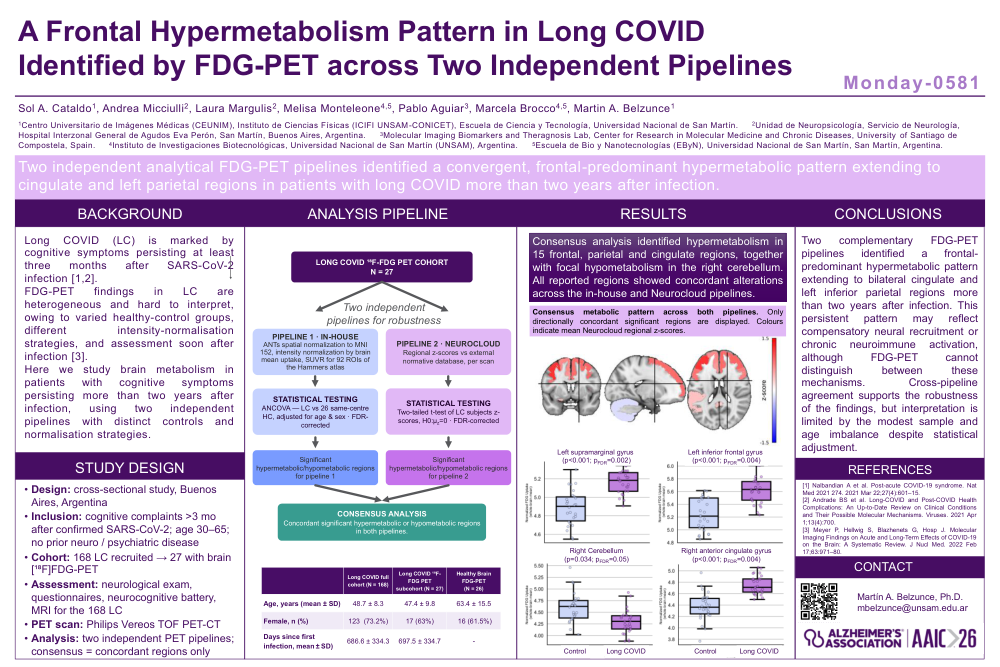
We conducted a cross-sectional study of LC patients with persistent cognitive symptoms from Buenos Aires, Argentina. Inclusion criteria were cognitive complaints lasting more than three months after confirmed SARS-CoV-2 infection, age 30-65 years, and absence of pre-existing neurological/psychiatric conditions. A total of 168 individuals with LC were recruited, of whom 27 underwent brain [¹⁸F]FDG-PET and were included in the present analysis. All participants underwent a neurological evaluation, structured questionnaires, a neurocognitive battery, and MRI. PET data were analyzed using two independent approaches. First, a between-group analysis was performed using an in-house pipeline, with regional glucose uptake extracted using the Hammers atlas and compared with 26 same-centre HC using ANCOVA adjusted for age and sex. Second, an independent analysis was conducted with Neurocloud, a cloud-based platform providing regional z-scores relative to a normative reference database. A consensus criterion was applied to retain only hyper- and hypometabolic regions with significant and concordant changes across both methods.
Results
Table 1 presents demographic characteristics of the full cohort and FDG-PET subset, along with the 26 HC. The consensus across both pipelines identified a robust pattern of regional hypermetabolism involving frontal, parietal, and cingulate cortices, together with hypometabolism in the right cerebellum (Table 2). Figure 1 illustrates the spatial distribution of these regions and their corresponding z-scores.
Conclusion
Using a robust consensus analysis across two independent PET pipelines, this study demonstrates a clear and reproducible pattern of frontal hypermetabolism in patients with persistent cognitive symptoms more than two years after SARS-CoV-2 infection.
Comments
Email is required but is not shown publicly.
Loading comments...