4,068 posters, 219 videos, 101 topics, 69 sessions, 14,365 authors, 6,128 institutions
ePostersLive by SciGen Technologies S.A. All rights reserved.
Alzheimer's Association International Conference 2026
July 12-15, 2026 | London, United Kingdom, and Online

10069
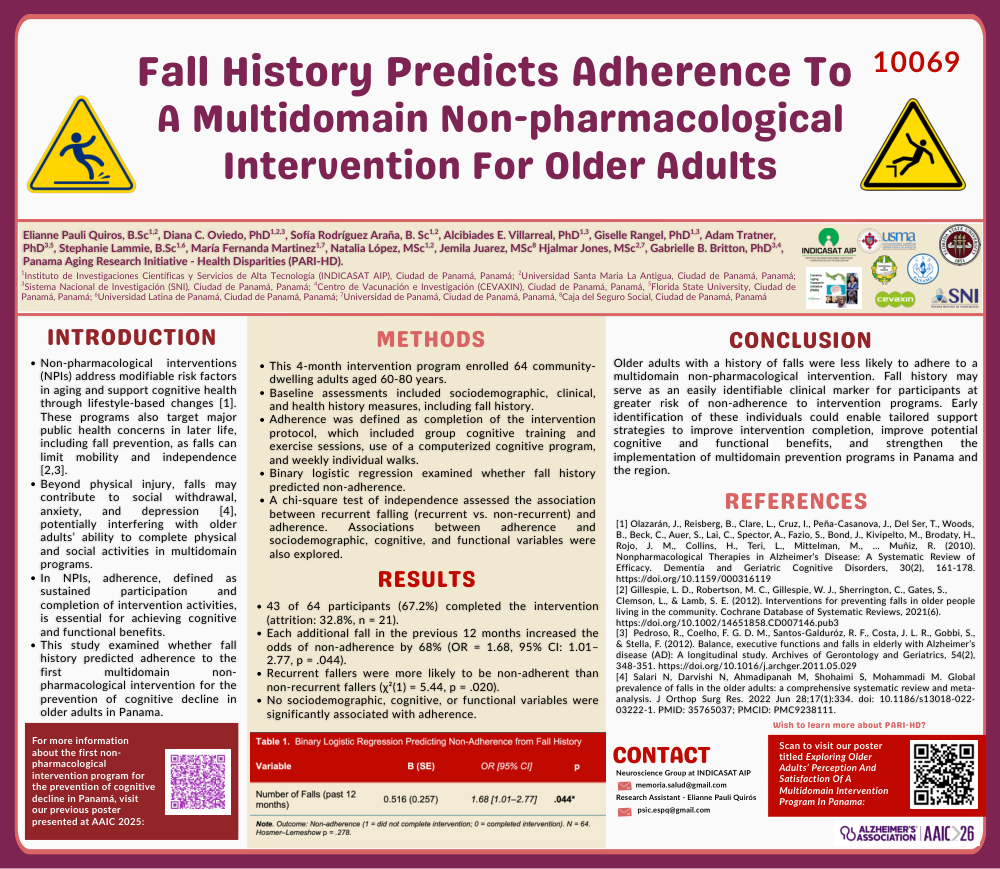
Fall History Predicts Adherence To A Multidomain Non-pharmacological Intervention For Older Adults
Poster Presenter
Authors
Elianne Pauli Quiros, Diana Oviedo, Sofía Rodríguez Araña, Alcibiades Villarreal, Giselle Rangel, Adam Tratner, Stephanie Lammie, María Fernanda Martínez, Natalia López, Jemila Juarez, Hjalmar Jones, Gabrielle Britton
Affiliations
Florida State University, INDICASAT-AIP, Caja del Seguro Social, CIDELAS, Universidad de Panamá, CEVAXIN
Part of Topic
Introduction
- Non-pharmacological interventions (NPIs) address modifiable risk factors in aging and support cognitive health through lifestyle-based changes [1]. These programs also target major public health concerns in later life, including fall prevention, as falls can limit mobility and independence [2,3].
- Beyond physical injury, falls may contribute to social withdrawal, anxiety, and depression [4], potentially interfering with older adults’ ability to complete physical and social activities in multidomain programs.
- In NPIs, adherence, defined as sustained participation and completion of intervention activities, is essential for achieving cognitive and functional benefits.
- This study examined whether fall history predicted adherence to the first multidomain non-pharmacological intervention for the prevention of cognitive decline in older adults in Panama.
Methods
- This 4-month intervention program enrolled 64 community-dwelling adults aged 60-80 years.
- Baseline assessments included sociodemographic, clinical, and health history measures, including fall history.
- Adherence was defined as completion of the intervention protocol, which included group cognitive training and exercise sessions, use of a computerized cognitive program, and weekly individual walks.
- Binary logistic regression examined whether fall history predicted non-adherence.
- A chi-square test of independence assessed the association between recurrent falling (recurrent vs. non-recurrent) and adherence. Associations between adherence and sociodemographic, cognitive, and functional variables were also explored.
Results
- 43 of 64 participants (67.2%) completed the intervention (attrition: 32.8%, n = 21).
- Each additional fall in the previous 12 months increased the odds of non-adherence by 68% (OR = 1.68, 95% CI: 1.01–2.77, p = .044).
- Recurrent fallers were more likely to be non-adherent than non-recurrent fallers (χ²(1) = 5.44, p = .020).
- No sociodemographic, cognitive, or functional variables were significantly associated with adherence.
Conclusion
Older adults with a history of falls were less likely to adhere to a multidomain non-pharmacological intervention. Fall history may serve as an easily identifiable clinical marker for participants at greater risk of non-adherence to intervention programs. Early identification of these individuals could enable tailored support strategies to improve intervention completion, improve potential cognitive and functional benefits, and strengthen the implementation of multidomain prevention programs in Panama and the region.
References
[1] Olazarán, J., Reisberg, B., Clare, L., Cruz, I., Peña-Casanova, J., Del Ser, T., Woods,
B., Beck, C., Auer, S., Lai, C., Spector, A., Fazio, S., Bond, J., Kivipelto, M., Brodaty, H., Rojo, J. M., Collins, H., Teri, L., Mittelman, M., … Muñiz, R. (2010). Nonpharmacological Therapies in Alzheimer’s Disease: A Systematic Review of Efficacy. Dementia and Geriatric Cognitive Disorders, 30(2), 161-178. https://doi.org/10.1159/000316119
[2] Gillespie, L. D., Robertson, M. C., Gillespie, W. J., Sherrington, C., Gates, S.,
Clemson, L., & Lamb, S. E. (2012). Interventions for preventing falls in older people living in the community. Cochrane Database of Systematic Reviews, 2021(6).
https://doi.org/10.1002/14651858.CD007146.pub3
[3] Pedroso, R., Coelho, F. G. D. M., Santos-Galduróz, R. F., Costa, J. L. R., Gobbi, S., & Stella, F. (2012). Balance, executive functions and falls in elderly with Alzheimer’s disease (AD): A longitudinal study. Archives of Gerontology and Geriatrics, 54(2), 348-351. https://doi.org/10.1016/j.archger.2011.05.029
[4] Salari N, Darvishi N, Ahmadipanah M, Shohaimi S, Mohammadi M. Global prevalence of falls in the older adults: a comprehensive systematic review and meta-analysis. J Orthop Surg Res. 2022 Jun 28;17(1):334. doi: 10.1186/s13018-022-03222-1. PMID: 35765037; PMCID: PMC9238111.
Comments
Email is required but is not shown publicly.
Loading comments...