4,068 posters, 219 videos, 101 topics, 69 sessions, 14,365 authors, 6,128 institutions
ePostersLive by SciGen Technologies S.A. All rights reserved.
Alzheimer's Association International Conference 2026
July 12-15, 2026 | London, United Kingdom, and Online

9670
Bpsd Burden Increase Is Associated With Cognitive Worsening In Frail Older Adults With Moderate To Severe Cognitive Decline
Poster Presenter
Authors
Part of Topic
Background: BPSD (Behavioural Psychiatric Symptoms of Dementia) are extremely widespread in dementia, with fluctuating course over time. We aimed to characterize their relashioship with spontaneous cognitive decline.
Method: in this retrospective study we evaluated frail patients with dementia at baseline and after 10-18 months. The patient underwent comprehensive geriatric assessment (CGA), cognitive and neuropsychiatric evaluation. Frailty was assessed with Clinical frailty scale (CFS) and BPSD were grouped in clusters: mood apathy, psychosis and hyperactivity. We split the population according to severity of frailty (CFS 5, 6 and 7 as mild, moderate and severe). Chi-Squared Test was used to explore the association with BPSD clusters. Student’s t-test and Mann-Whitney-U-test were used to explore the association between the variation of MMSE score and BPSD burden between baseline and follow-up. Multiple regression models were used to explore the associations between variables.
Results: 220 patients referred to the geriatric outpatient clinic with MMSE ≤ 24 and CFS ≥ 5 were enrolled. Among them, 61.8% were female; mean age was 83.8±5. The cohort showed partial functional impairment (BADL 3.7±2 and IADL 1.8±1.9) moderate frailty (CFS 6±0.7), and moderate cognitive decline (MMSE 17.7±4.4).
BPSD were present in 88% of patients: 65% of the mood apathy, 42% of the hyperactivity and 44%of the psychosis clusters. While the prevalence of psychotic symptoms was not different among CFS strata, we found significantly higher prevalence of mood apathy symptoms and hyperactivity symptoms in most frail subjects (both p<0.01).
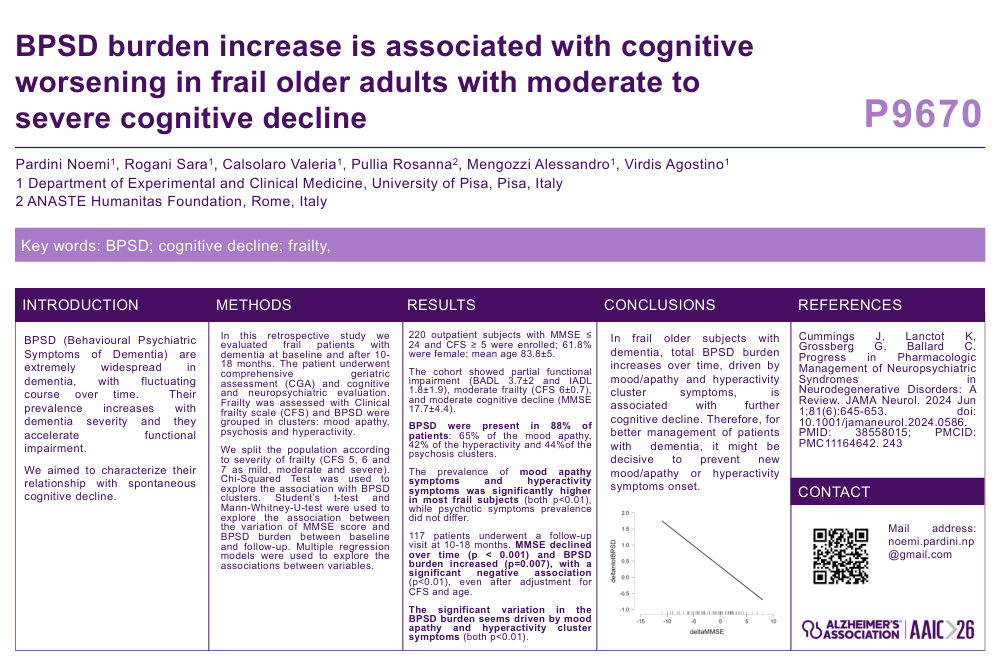
117 patients underwent a second visit at 10-18 months. MMSE declined over time (p < 0.001) and BPSD burden increased (p=0.007), with a significant negative association (p<0.01), even after adjustment for CFS and age. The increase was not significant within each isolated cluster. The significant variation in the BPSD burden seems driven by mood apathy and hyperactivity cluster symptoms (both p<0.01).
Conclusion: in frail older subjects with dementia, total BPSD burden increase over time, driven by mood/apathy and hyperactivity cluster symptoms, is associated with further cognitive decline. Therefore, for better management of patients with dementia, it might be decisive to prevent new mood/apathy or hyperactivity symptoms onset.
Comments
Email is required but is not shown publicly.
Loading comments...